Tuesday, July 30, 2013

Man of Steel


Many of the reviews of the Superman franchise reboot, Man of Steel, have been negative:
For two-thirds of the running time, the film is grandly entertaining.... But then, as we get into the climactic battles, the level of wanton destruction becomes excessive, even tacky. Eric D. Snider, EricDSnider.com
*
Super-duper-overStatement. A cataclysm-caravan of speeches, doomed and desolate landscapes, proclamations of glorious destiny or rebirth, and sprawling, stone-faced seriousness. Can't save itself from self-suffocating grandiosity. Brian Gibson, Vue Weekly
*
Man Of Steel suffers most in its final hour where in degenerates into a seen-it-all-before, CGI-laden action fest. Matthew Toomey, ABC Radio Brisbane
*
There's very little humor or joy in this Superman story. Richard Roeper, RichardRoeper.com
*
Man Of Steel plunges headfirst into a loud, breathless science-fiction slugfest, offering much spectacle but little wonder. Keith Phipps, The Dissolve
*
The worst Superman movie since 1987's Superman IV: The Quest for Peace... David Nusair, Reel Film Reviews
Unfortunately, my opinions aren’t any higher than those of the reviewers.

When Sally and I left the theater after seeing Man of Steel her comment was, “It should have been a half hour shorter.” I agreed. The last half hour is excruciating, with a lot of carnage and damage. Two days after seeing the movie those scenes have blurred in my mind, and I remember very few details. The details I remember are that three times we see Superman crashing through a building and skidding on the floor. Why would they need to show that more than once? Likewise the three times Superman is shown opening his mouth, wide, and bellowing something that in a comic book speech balloon would look like this:


Superman is a comic book character who has been around 75 years. People keep trying to remake Superman by gilding the lily...adding to the mythology which came in such a simple form from his creators, Jerry Siegel and Joe Shuster. Their vision of Superman was an optimistic hero. Superman was not a complicated person. This current dark and gloomy vision of Superman, including a morose Clark Kent, is done to satisfy some fantasy the filmmakers have about the character, making for phony dramatics. The need to “improve” the character reminds me of epic Bible story movies, where stories are puffed up with violence and sex and dialogue not found in any holy writ.

I go back to 1978, and the joy Sally and I had sitting in a Cinerama theater, close to the front so we felt surrounded by the screen, watching Christopher Reeve’s star-making role as Superman/Clark Kent. My personal joy was his relationship with Lois Lane, played by Margot Kidder. The movie had a sense of humor, something completely lacking in Man of Steel. That goes along with how seriously the Man of Steel filmmakers see the subject, taking out much of the humanity I believe they have missed. The best Superman (in my opinion) outside of that first Christopher Reeve movie, is the Superman of the earliest days of the comics, when Superman stories could actually be funny. Those comic books, sitting now in comic book collections and in expensive reprint volumes, aren’t what today’s moviegoing public would be likely to see or experience. A young person seeing this dour version of Superman would not be in on what it was that kept Superman going for decades, even before the smash 1978 hit made him a movie hero.


Nowadays filmmakers don’t make big movies; they put the actors in front of green screens and the CGI artists make what we see. The shame is the filmmakers spent millions of dollars using the talents of many CGI artists in creating such a reality, and yet while it was unrolling before me my brain went somewhere else to keep me from falling asleep. I think the best test of whether a movie is good is whether you leave it in the theater when you go home, or retain memories of it. I remember very little of Man of Steel.

Friday, July 26, 2013

What teachers make

I’ve mentioned before my appreciation and respect for teachers I knew while working in a school district for over 30 years.

To do what a teacher does every day would have me screaming and running out the door, never to return. The clod in the attached comic strip says, "Those that can, DO, those that can't, TEACH," which is mean-spirited, slanderous, and totally untrue. It takes a very special person to try to drum knowledge into some of the hard skulls in a classroom, and I should know. My head was solid concrete. It took a lot of patience of some dedicated folks to get through to me, and I'm forever in their debt.

So this little story I ran across online today has significance to me. There is a poster available, and I'd like to guide people to the website where they can see more information from this talented artist, at www.zenpencils.com

Copyright © 2013 Taylor Mali and zenpencils


Thursday, July 25, 2013

The Mad Artist of the Month Club

Bob Clarke, longtime artist for Mad magazine, died in March of this year at age 87.

Clarke was an artist who joined Mad soon after the original editor, Harvey Kurtzman, left and took artist Will Elder with him. Clarke had been an advertising artist, and had a light touch. A little too light, I thought at the time. I found his uncluttered and ad-like artwork lacking, and it wasn’t until many years later, as I looked back at the history of the magazine, that I began to appreciate what he’d done.

This article from 1958, published in Mad number 40, is a satire on the successful “Of the Month Clubs” that popped up in the fifties in the wake of the popularity of the original, Book of the Month Club, in 1926. When I was growing up in the fifties my mother belonged to the Book of the Month Club, and I belonged to the Science Fiction Book Club. There was always something to read in our house, and that included Mad, which I bought faithfully, every issue.

Copyright ©1958, 2013 E.C. Publications, Inc.


Sunday, July 21, 2013

Girl known, yet unknown

Ever have a memory that is incomplete, that drives you crazy? It happens a lot to us as we age, and it’s happening to me right now. I saw this photo in Friday's morning paper. The photographer took it at a local outdoor concert, and the first thing I saw when I looked at the picture was the girl. I have seen her before.


But where? The picture is in black and white, but in my brain, that incomplete memory that I am trying to pluck out, shows her in living color. It's the face. I don’t remember how tall she is, how she stands or walks, but I know the face.

Grocery store clerk? Restaurant server? School district employee I may have encountered during my last few years before retirement?

I have been two days looking at this picture, trying to conjure up an image, any image that might place her in context of where I might have seen her.

Arrrrgh. Frustration.


The photographer has chosen her face to be the focus of the picture, and rightly so. I wouldn’t be struggling with a memory if I hadn’t been struck at some time by the sight of that face.

UPDATE, August 25, 2013:

Today after leaving Walgreen's with a prescription Sally and I were speaking fondly of our former neighborhood pharmacy, now closed for three or four years, and the really great pharmacists and pharmacy techs that store employed, including pharmacy tech Alma.

I felt like I was struck by lightning. Alma! I exclaimed. Alma is the girl in the picture!

What picture is that? Sally asked. So I explained about the blog post.

Alma and her husband were from Eastern Europe, who had relocated to the US. When we got home I showed the picture to Sally and she said yes, that is Alma.

It is a trick of memory that she looked so familiar, yet I couldn't place her. I attribute it to various factors, including age. But whew. Mystery solved.

Wednesday, July 17, 2013

Be A Nartist

I originally posted this in 2007, and am showing it again with editing.


I found the ad above in a 1957 Mechanix Illustrated magazine. It was aimed at guys who liked to do mechanical things, or at least read about doing mechanical things. Something you didn't often see in the pages of this type of journal was the softer stuff. How to be an artist was among the subjects you wouldn't find. It didn't stop the art school from advertising, though.

I noticed something over the years: When showing an artist, the ad invariably shows the artist drawing or painting a girl. Not just any girl, but a girl in a bathing suit. A pin-up girl, a sexy girl. This is as subtle as a brick upside the head: artists got to draw girls. Sometimes nude girls. That’d be enough to entice some guys to part with money for the course.

When I went to art school I remember thinking that we’d be drawing from a live model, a beautiful woman, but the model they provided for us was a male dancer who was past his prime. He was quite wrinkled in the face, but his physique was still good for his age. I don't think they’d invite him to dance in the ballet again, though. No nude girls for us. It may have been because our life-drawing class was taught by a woman.

The twentieth century was the time of the artistic pin-up, from the earliest years of the century and the Gibson girl to the calendar girls, drawn by commercial illustrators like Gil Elvgren or Peter Driben. Around the time this ad for the art school was published in Mechanix Illustrated the pin-up art was beginning to fade and wind down. The magazines were going like Playboy, with photo covers. Not like these really cute Driben covers from the forties and early fifties.


Paintings of girls in cheesecake poses acting coquettish were replaced by photos of real-live girls. Or as real as an airbrush makeover by photo retouch could be. The painted pin-ups looked way more appealing to me. I knew they were idealized females; the Playboy models were idealized, also; their photos were doctored, but not so the readers would know. As far as the young men who read Playboy were concerned, women had no moles or warts, no scars or varicose veins. Not in those pictures, anyway.


There are modern pin-up artists who work in the old style, but the golden age of calendar girls and pin-up art is still the benchmark by which today’s artists are judged.

Tuesday, July 16, 2013

Lloyd Ostendorf’s Thomas Jefferson

Lloyd Ostendorf was an artist, writer and collector of Lincoln photographs. He published a book on all the known photos of Lincoln, so he was well known to the historical community. He co-authored an article I featured here a few weeks ago, about an “unknown” 1856 painting of Lincoln, which he and fellow Lincoln historian James L. Swanson had written about in a 1990 article in American Heritage. You can read a short article about it here.

Ostendorf was also a commercial artist. When he died at age 79 he was described in a 2000 obituary by his family “as a self-employed commercial artist who created greeting cards, religious drawings and pencil art, but his signature work featured Lincoln.” Unmentioned in the Chicago Times obituary was Ostendorf’s longtime association with Treasure Chest of Fun and Fact, a comic book published for Catholic school students.

Ostendorf wasn’t just a Lincoln artist. For instance, this six-page story, written by Helen Gillum and published in Treasure Chest in 1970, is about Thomas Jefferson. The Jefferson story omits the fact that Jefferson was a slave-holder (except to say in the last panel that he “granted his slaves their freedom at his death,”) or his longtime affair with his slave Sally Hemings, with whom he had children. It was done for young readers, but the vibrancy of Ostendorf’s work stands out, showing him to be a very talented artist, as well as important historian.


Saturday, July 13, 2013

Son of Sam: the demons who destroy


David Berkowitz, aka the .44 Caliber Killer and Son of Sam, struck terror into the city of New York in 1977. In what were random killings of people parked in cars on city streets, he had helped shut down much of the night life of that vibrant city, and sent a population of millions into shuddering fear. Despite those fears some people did venture out. Sometimes they got bullets from Berkowitz’s gun. In reading the 1981 book, Son of Sam by Lawrence D. Klaussner, I am struck by a couple of things. The police, as they usually do, tried looking for patterns. There were no patterns in Berkowitz’s actions because he was operating on orders given him by voices in his head. Demons told him when to go out. The demons told him when, and whom, to kill. As Berkowitz moved about the city, from borough to borough, the frustration of the police and terror of the public began to wear everyone thin. The shootings are described in the book. Here is one:
Valentina Suriani, eighteen, and Alexander Esau, twenty, were youngsters in love.

. . . Valentina had just received her driver’s license, and as she usually did, when the couple began their journey home, she asked if she could drive. . . . Just one block from the high-rise apartment where she lived, the young woman nudged the car to the curb and brought it to a halt. She had chosen a parking place only three blocks from the home of David’s [Berkowitz] first victim, Donna Lauria. Valentina and Alexander turned toward each other in a last embrace.

At 3:00 a.m. Sunday, four shots shattered the passenger-side window. Two shots struck each of the lovers. Valentina died in that first minute, Alexander within two hours, at Jacobi Hospital.

. . . Discussing the double murder with psychiatrists later, Berkowitz is embarrassed by the fact he killed a man for the first time. He admits the demons had demanded he kill a man as well as a woman, but is reluctant to say more.

But why, David? Why would the demons suddently want a man?

“General Jack Cosmo had a wife.”

I don’t understand.

“General Jack Cosmo has a wife named Nancy Cosmo,” (Jack Cassara, Berkowitz’s landlord in New Rochelle, was married to a woman named Nann.)

And?

“Nancy Cosmo wanted some action too.”

Action? What kind of action?

“You know...” Berkowitz says, “Sex.”

The word loosens the flood of madness: “When the soul of a victim leaves the body, demons are right there. They snatch the souls and take them to the attic of 316 Warburton Avenue [Yonkers], or to the houses at 18 and 22 Wicker Street. They chain the souls and have sex with them forever. The demons take the victims’ souls and drag them into houses and rape them and molest them. It’s messy. It’s brutal. There’s no sleep for the victims’ souls, no resting no peace.

“Not now.

“Not for a while.”
What a nightmarish vision.

Police called the killer “the .44” after the Bulldog .44 he used. The name Son of Sam came later. Berkowitz thought he was a conduit to murderous demons. Sam Carr owned a dog that Berkowitz was suspected of shooting. The dog figured into David’s madness, and Berkowitz signed a note to police “Son of Sam.”

More is explained later in the book:
As he drove, he listened to the voices of Sam and the demons. They instructed him to kill. “I purposely drove out to Long Island to kill someone,” he says. “It didn’t matter who I’d kill, whoever I’d come across. When I’d find the right one I’d be told.

“Sam would tell me through his dog, as he usually did when the night would be right. But the dog’s not really a dog. It just looks like a dog. . . . Sam just  gave me an idea where to go. When I got the word, I didn’t know who I would go out to kill, but I would know when I saw the right people.”
The fact that Berkowitz was caught was a fortuitous set of circumstances. Several people, including Sam Carr, suspected something about Berkowitz, as did some uniformed police officers who were sharing their suspicions with detectives. Berkowitz sometimes wrote anonymous notes to people which were incomprehensible to them. But by bringing all the notes together and comparing them, they knew they were after the same person.

There are a lot of mentally ill people out there. Only a very small percentage of them are dangerous.  But I’ve noticed that when we do have an incident of a mass shooting like those in Newton, Massachusetts or the theater shooting in Denver, Colorado, we often try to find reasons why the shooters did what they did. Sometimes, as with Berkowitz, the answers are locked into a spiral of madness and anger and paranoia. It is difficult, if not impossible, to know what such people are really feeling or thinking, or what their grievances are that cause them to commit such antisocial acts.

**********

Elliott Smith was a singer/songwriter who died, presumably of suicide, in 2003. He had his own mental problems to contend with, fueled by paranoia and according to some stories I’ve read, drugs. Smith (real name Stephen Paul Smith) wrote a song called “Son of Sam” which could probably bear some interpretation, both as to what he thought about Son of Sam, but also what was going on in his own head.

"Son Of Sam"

By Elliott Smith
Copyright ©2000 Stephen P. Smith

Something's happening, don't speak too soon
I told the boss off and made my move
Got nowhere to go
Son of Sam, son of the shining path, the clouded mind
The couple killer each and every time
I'm not uncomfortable, feeling weird
Lonely leered, options disappeared
But I know what to do
Son of Sam, son of a doctor's touch, a nurse's love
Acting under orders from above
King for a day
Son of Sam, son of the shining path, the clouded mind
The couple killer running out of time
Shiva opens her arms now to make sure I don't get too far
I may talk in my sleep tonight 'cos I don't know what I am
I'm a little like you
More like Son of Sam

Monday, July 08, 2013

Cher and Cher alike


Cher has had many aspects to her career, which has covered almost five decades. We first saw her as a teenager, paired up with husband Sonny Bono. Their initial popularity was caused by a big hit, “I Got You, Babe.” Cher’s look caught everyone’s attention. She looked hip and cool with her long dark hair and bangs, hip-hugger pants and boots.. At the time I thought Sonny looked kind of clownish. My buddies wondered how he caught her. He got his babe, we said. Bono, by then a music veteran, was 11 years older than his wife.

In 1965 I saw Sonny and Cher at the old Terrace Ballroom in Salt Lake City. After a couple of unremarkable opening bands had left the stage, Sonny and Cher’s bandleader, Harold Battiste, came out with a group of musicians and their instruments.  Here’s the show! we thought, as we all crowded around the stage. But it wasn’t. Battiste rehearsed a pick-up band, all local musicians, in all the songs Sonny and Cher would do that night. The whole crowd watched the rehearsal. Since rock shows  — even the Beatles — in those days were about 35 minutes long, we didn't think we had long to wait. But we did. The band left the stage and after a long wait — my memory tells me it was more than 30 minutes, but it could have just seemed that long — the band came back, this time with Sonny and Cher. And they did the songs in exactly the same order as Harold Battiste had rehearsed.

A group of college boys were in front of us. They were all wearing hats. When Cher would turn her head in their direction the young men would tip their hats. They did this five or six times before they gave up, because Cher didn’t see them. I don’t think she saw any of us. She looked over our heads to the back of the hall. At the time I thought it was crass. After all, Sonny was funny and engaging with the audience, but now I wonder if it wasn’t nervousness or even fear on her part.

Whatever fear she may have had then she had lost by the time of the seventies Sonny and Cher Show, which was on TV for a few seasons. By then Cher had dropped the hippie look, the long bangs and hip-hugger pants, and gone more glamorous. Why not? Cher had a dark, exotic beauty.


A friend of mine was totally knocked out by Cher. He paid a professional artist to do a pencil portrait of her that he framed and hung on the wall of his bedroom. I’m pretty sure the popular “vamp” numbers got his blood to boil. They were very sexy for the time.


For a time after her divorce from Sonny I didn’t see much of her, just heard some songs on the radio. It was when she began her movie career that I developed an appreciation for Cher. Silkwood, Mermaids, and Moonstruck are all movies that impressed me.

I was reminded of all this the other night when watching at clip on MSNBC. It was Cher talking with CNN host Anderson Cooper. Apparently Cher is some sort of news junkie. Cooper asked her if she was still watching CNN, and she said she split her time between CNN and MSNBC. Cooper did a funny flop out of his chair and onto the floor. When the clip was over and MSNBC’s Chris Mathews commented, he said, “It’s a good idea for an interviewer to know what the answer to his question will be in advance of asking it.” I guess Anderson Cooper was surprised by the candor of the woman who, no matter how shy she may have been when I saw her at the very dawn of her long career, is well over her shyness by now.


As a matter of fact, Cher can be too candid, and talk too much. I read recently that she claimed Tom Cruise was in the “top five” of her lovers. (“Before he got into Scientology,” she said.)

Too much information, Cher. We all know you’ve led the life of a star and had the perks. But I, personally, do not wish to hear about anyone’s favorite lover unless it was — ahem! — me.

Friday, July 05, 2013

Ayatollah Big Jim


I’ve been following the news this week of the ouster of Egypt’s president by that country’s army. For many of the people of that country, who are celebrating as I write this, he represented a hated religious rule. In the late ‘70s when the Iranians chased out their shah and installed a religious leader, the Ayatollah Khomeini, it was the opposite situation.

In Utah non-religious types such as me can be made to feel that we’re under religious repression. Despite separation of church and state many laws and public policies can have a strong influence from Temple Square in Salt Lake City to our state legislature, and down to our municipal governments. It can also affect us on the job.

From 1976 to 1988 my direct supervisor at the school district was Big Jim, who was as strict in his religion as the ayatollahs of Iran, and those of us working for him took to calling him the ayatollah behind his back. I called him that to his face, once, and he got a puzzled look on his face.

“Why did you call me that?”

“It’s how you often act. You base your decisions on your religious belief rather than school district policy.”

Ah, me. I had once again opened my big mouth and let my feelings come gushing out, even though I was talking to my boss. “I do not!” he hollered (something he did a lot) and stomped back into his office, probably to tell his secretaries that I was comparing him to the most hated religious figure in the world.

In 1988 Big Jim was promoted to be a director in our department, so he had an office in another building, and we were given another supervisor. Our second supervisor was also religious, but did not bring his religion to work with him. His problem, as he confided in me once, was that now that Big Jim was his boss and they shared a religious faith he found that Big Jim was just as harsh in his judgments as always, and he sometimes felt he was being yelled at by a Mormon bishop rather than a boss on a job.

That sort of thing, a very strong and self-righteous streak, is bound to spill over when the person doing the spilling is never criticized by his own superiors for using religious prejudice rather than company (or in our case, school district) policy on which to base decisions. The reason he wasn’t called down for his bigotry is that his bosses were like him.  It was a big reason Big Jim was promoted to a top management position. The school district was a pyramid, with the tip of the pyramid being made up of very religious men who shared the same beliefs.

A lot of religious folks look at America as being founded on religious principles, of which I’ve written before (see my post, ”How religious were America’s Founding Fathers?”). But every time we let religious principles become the overriding reason for a law we become a state more like Iran than America. Big Jim told a group of us one day if he were made King of America there would be no abortions; homosexuals would be put in prison. No businesses would be allowed to be open on the Sabbath, each business day would open with prayer, and not just any prayer, but a Mormon prayer. A perfect state in Big Jim’s mind would include a religion police like the Taliban used, guys who rode around in Jeeps looking for women who showed a bit of ankle, and beat them with batons for daring to offend God.*

And that’s where I don’t see much difference between Big Jim’s attitude that his religion trumps secular policy, and a government like Iran’s or the former Taliban government in Afghanistan that bases public policy on strict religious rules. I learned my lesson after a time; I never told Big Jim a belief of mine, that had Big Jim been born in an Islamic state he probably would have been just as strong in those beliefs as he is in his Mormon faith. Born in Iran, Big Jim might have been an ayatollah today.

Think of your own beliefs, your own attitudes toward authority or the established order, and then flip them to a country like Iran, and ask yourself could you survive in such an environment? I know I couldn’t, and had I been born in such a place with the same personality and secular beliefs I have now I’d probably be in prison right now having the soles of my feet beaten by religious sadists for not conforming to the established religious order. (Likewise if born into the 15th century I might have been stretched on the rack during the Inquisition.)  Like many Americans I feel lucky for being born where I was, under the political system we have, rather than in a repressive state where one’s worthiness is judged by a religious litmus test. I deeply resented being put through that test on a constant basis by Big Jim (and being found unworthy), rather than being judged on my work, which, in the real world is what is more important.

*A belief by Mormons is that one day they can be raised to an exalted state and become gods of their own worlds. Some of my fellow employees and I used to joke about the “Big Jim planet” and what kind of wrathful god he’d make.


Thursday, July 04, 2013

Bookstore tales

Note: This is a re-posting from 2010. I have done some slight editing, and made new scans of some of the pictures.

From 1976 to 1981 I worked part-time in the rare books department of a large full-service bookstore in Salt Lake City, Utah. Our store was sought out because it was a counter-culture center, and it was celebrated by locals and out-of-town visitors as a liberal oasis in the middle of the conservative Utah desert. I got to know quite a few of my loyal customers because they came in several times a month, but some customers came in once or twice a year, to coincide with the Church of Jesus Christ of Latter-day Saints General Conference in April and October. They were usually people from out of the state, or even out of the country, who made a pilgrimage to the Mormon Mecca for enlightenment by church authorities, and a side-trip to our store for items of which the church would probably not approve.


The fantasy artist Frank Frazetta died in 2010. In the last couple of decades he was famous for his paintings, where for many years before that he had been mainly known to just a hardcore group of fans. Frazetta had illustrated paperback book covers, comic books, and magazine covers, but he became really well known to the general public when this bestselling trade paperback book, The Fantastic Art of Frank Frazetta, came out in 1975. We sold a lot of copies of the book. On a day in 1980 a man came up to me in the store.He said to me, “I’m from Canada. I was here three years ago for Conference, and I remember there was a book of paintings by Frazetta. I didn't get it then, but I want it.” He then pointed to a shelf. “It was right there! I remember, it was right there!” I saw a look in his eye. Sometimes you can tell obsessive-compulsive disorder by the wide-eyed and frenzied look, and this guy had it bad. My immediate reaction was, he thought it was going to be in the same spot on the shelf for three years? but there's no telling what customers think. Especially if they’re people who’ve been thinking about Frank Frazetta for three years. I said, “Hold on there, pal...I think I can help.”

I recalled that I had a couple of used and worn copies we'd taken in trade a few months before. I found them on a back shelf waiting to be priced. The one I sold him was well-used, so I only charged him $2.00 and from his ecstatic reaction I felt like the Angel Moroni handing Joseph Smith the Golden Plates.


At one point we had a lot of copies of Warren magazines for sale on our shelves. Warren was a publisher who began with the cult magazine, Famous Monsters Of Filmland, then went into black-and-white comic books, fantasy and horror, usually with some sex involved. A cowboy from Wyoming had driven about 300 miles to buy Warren magazines from us, but in the months we’d had them on display they hadn’'t sold, so by the time he came in they were in boxes in a storage basement. He had such a fit that other employees gathered around to hear his rant. To satisfy him I went down two flights of stone steps and brought up the boxes one at a time. Out of five or six boxes of several dozen magazines each he bought maybe a dozen issues or so, so after the guy made his purchase my boss told me to set the boxes aside. He sold them to Pete, another local bookseller, and told me, “If that cowpoke comes back in tell 'im to get on his horse and go over to see Pete.” Pete was a character who had guns under his counter in case he got robbed. I figured he could probably outdraw the cowboy if he was causing trouble.


In one case a customer of mine was caught stealing. He was suspected of shoplifting, so one of the employees brought his kids into the store, and when the man came in the kids followed him around and watched as he put a book under his coat. No one ever notices kids, even kids who are spying on them. The guy had been good for a lot of business, but maybe he felt we owed him something so he took freebies. He was banned from the store after that.

Another time my boss bought a big box of various issues of Classics Illustrated comic books. He didn't really know what to do with them, but I had an idea. It was nearly June, the end of school. I put them on the shelf with a sign, “Kids! Remember your last minute book reports! Only $1.00!” I had no idea the trouble that would cause when a local teacher saw the sign and complained loudly to my boss. We even got a letter about our practices from the Better Business Bureau, no less. To me and my coworkers it was funny, but I ended up pulling them off the shelf and putting them back in the box. Maybe my boss sold those to Pete, too.


Before I worked in a bookstore I hung out in bookstores. I still do — at least as long as the book business being what it is — there are any left standing. Bookstore people, both customers and employees, are different. When you get into rare books or comics or anything else that can be collected you run into some oddballs. I had my share of that. I also saw myself in my customers, as if reflected in a funhouse mirror. After that when going into a used or rare bookstore I tried not to act too crazy or obsessive. It hasn't always worked for me.

Wednesday, June 26, 2013

Richard Matheson: He is legend


My one-sided relationship with Richard Matheson (I knew who he was, he never heard of me) goes back to at least 1959, when I read his novel, I Am Legend. Until that point in my life I did not realize a novel could take me and place me a setting, in a series of circumstances, and make me identify to the point it felt like I was the one experiencing it all. That's how real that novel was to me.

This is my copy of the original printing of I Am Legend, published July 1954 as a paperback original.


I Am Legend has been filmed three times. It was made as The Omega Man with Charlton Heston, The Last Man on Earth with Vincent Price, and under its original title in 2007, starring Will Smith. Frankly, none of them ever captured the true feeling and spirit of the novel, and that even includes the last, even though the screenplay was written by Matheson.

The most successful adaptation of the novel wasn't really an adaptation at all; it was that it helped inspire George Romero’s Night of the Living Dead in 1968. (Romero also claims he was inspired by EC Comics of the fifties, but his movie looks more like Matheson’s story than it does Tales From the Crypt.)

You could draw a line from Matheson to the recent movie, World War Z, the megabuck picture starring Brad Pitt. An inspiration like that may not even know the genesis of its inspiration, but everyone making a movie about walking dead people owe a debt to I Am Legend. (Incidentally, the characters in I Am Legend are not walking dead; they are vampires, who became vampires from a virus. But the feelings of human beings at being besieged by people who are no longer human is the same, whether vampire or zombie.)

You could say that Matheson inspired Stephen King. Stephen King and I are the same age. We, and everyone else our age, grew up reading the same literature, watching the same movies (like Matheson-scripted versions of Poe for Roger Corman) and watching the same television shows (Matheson wrote some of the most popular episodes of The Twilight Zone (episodes like “Nightmare at 20,000 Feet” and “Little Girl Lost.”)

We saw Dennis Weaver trying to outrun a pissed-off semi-truck driver in Duel, shown as a TV movie in 1971, and directorial debut of Steven Spielberg. It came from Matheson’s short story in Playboy, which in turn he claims was inspired by his own highway encounter with a truck.

We saw the movies made from Matheson’s books (besides the aforementioned versions of I Am Legend), like The Legend of Hell House, The Incredible Shrinking Man, Somewhere in Time, or What Dreams May Come.

Matheson wrote some Western novels, and at least one novel set in World War II, The Beardless Warriors, which I read when I was in the Army in 1968.

Richard Matheson published dozens of short-stories. Before he hit the big time as a writer, his work mainly appeared in the science fiction magazines of the early 1950s. There were a lot of those magazines, and Matheson’s name on the cover meant people would buy the magazine just to read his latest story. He wasn’t as famous then as Ray Bradbury, but as time went on Richard Matheson built his own success, story by story, novel by novel, screenplay by screenplay, until his name was definitely on the A-List.

Some of my favorite short-story collections by Matheson:


Matheson, born February 20, 1926, died June 23, 2013 at age 87.

Richard Matheson bibliography:

Novels

    Someone is Bleeding (1953)
    Fury on Sunday (1953)
    I Am Legend (1954) filmed as The Last Man on Earth, The Omega Man, I Am Omega and I Am Legend
    The Shrinking Man (1956); filmed as The Incredible Shrinking Man and subsequently reprinted under that title; also the basis of the film The Incredible Shrinking Woman
    A Stir of Echoes (1958); filmed as Stir of Echoes
    Ride the Nightmare (1959); adapted as an episode of The Alfred Hitchcock Hour and later filmed as Cold Sweat (1970 film)
    The Beardless Warriors (1960); filmed as The Young Warriors
    The Comedy of Terrors (1964), with Elsie Lee; filmed as The Comedy of Terrors
    Hell House (1971); filmed as The Legend of Hell House
    Bid Time Return (1975); filmed as Somewhere in Time and subsequently reprinted under that title
    What Dreams May Come (1978); filmed as What Dreams May Come
    Earthbound (Playboy Publications, 1982), as by Logan Swanson[4] — editorially abridged version; restored text published as by Richard Matheson, 1989[citation needed]
    Journal of the Gun Years (1992)
    The Gunfight (1993)
    7 Steps to Midnight (1993)
    Shadow on the Sun (1994)
    Now You See It ... (1995)
    The Memoirs of Wild Bill Hickock (1996)
    The Path: A New Look at Reality (1999)
    Passion Play (2000)
    Hunger and Thirst (2000)
    Camp Pleasant (2001)
    Abu and the 7 Marvels (2002)
    Hunted Past Reason (2002)
    Come Fygures, Come Shadowes (2003)
    Woman (2006)
    Other Kingdoms (2011)
    Generations (2012)

Short stories:

    "Born of Man and Woman" (1950)
    "Third from the Sun" (1950); adapted as a Twilight Zone episode (1960)
    "The Waker Dreams" (a.k.a. "When the Waker Sleeps") (1950)
    "Blood Son" (1951)
    "Through Channels" (1951)
    "Clothes Make the Man" (1951)
    "Return" (1951)
    "The Thing" (1951)
    "Witch War" (1951)
    "Dress of White Silk" (1951)
    "F---" (a.k.a. "The Foodlegger") (1952)
    "Shipshape Home" (1952)
    "SRL Ad" (1952)
    "Advance Notice" (a.k.a. "Letter to the Editor") (1952)
    "Lover, When You're Near Me" (1952)
    "Brother to the Machine" (1952)
    "To Fit the Crime" (1952)
    "The Wedding" (1953)
    "Wet Straw" (1953)
    "Long Distance Call" (a.k.a. "Sorry, Right Number") (1953)
    "Slaughter House" (1953)
    "Mad House" (1953)
    "The Last Day" (1953)
    "Lazarus II" (1953)
    "Legion of Plotters" (1953)
    "Death Ship" (1953); adapted as a Twilight Zone episode (1963)
    "Disappearing Act" (1953); adapted as a Twilight Zone episode (1959)
    "The Disinheritors" (1953)
    "Dying Room Only" (1953)
    "Full Circle" (1953)
    "Mother by Protest" (a.k.a. "Trespass") (1953)
    "Little Girl Lost" (1953); adapted as a Twilight Zone episode (1962)
    "Being" (1954)
    "The Curious Child" (1954)
    "When Day Is Dun" (1954)
    "Dance of the Dead" (1954); adapted as a Masters of Horror episode (2005)
    "The Man Who Made the World" (1954)
    "The Traveller" (1954)
    "The Test" (1954)
    "The Conqueror" (1954)
    "Dear Diary" (1954)
    "The Doll That Does Everything" (1954)
    "Descent" (1954)
    "Miss Stardust" (1955)
    "The Funeral" (1955); adapted as story segment for Rod Serling's Night Gallery
    "Too Proud to Lose" (1955)
    "One for the Books" (1955)
    "Pattern for Survival" (1955)
    "A Flourish of Strumpets" (1956)
    "The Splendid Source" (1956); the basis of the Family Guy episode "The Splendid Source".[22]
    "Steel" (1956); adapted as a Twilight Zone episode (1963); loosely filmed as Real Steel (2011)
    "The Children of Noah" (1957)
    "A Visit to Santa Claus" (a.k.a. "I'll Make It Look Good," as Logan Swanson) (1957)
    "The Holiday Man" (1957)
    "Old Haunts" (1957)
    "The Distributor" (1958)
    "The Edge" (1958)
    "Lemmings" (1958)
    "Mantage" (1959)
    "Deadline" (1959)
    "The Creeping Terror" (a.k.a. "A Touch of Grapefruit") (1959)
    "No Such Thing as a Vampire" (1959)
    "Big Surprise" (a.k.a. "What Was in the Box") (1959)
    "Crickets" (1960)
    "Day of Reckoning" (a.k.a. "The Faces," "Graveyard Shift") (1960)
    "First Anniversary" (1960); adapted as an Outer Limits episode (1996)
    "From Shadowed Places" (1960)
    "Finger Prints" (1962)
    "Mute" (1962); adapted as a Twilight Zone episode (1963)
    "The Likeness of Julie" (as Logan Swanson) (1962); adapted into "Julie" in the 1975 TV film Trilogy of Terror
    "The Jazz Machine" (1963)
    "Crescendo" (a.k.a. "Shock Wave") (1963)
    "Girl of My Dreams" (1963)
    "'Tis the Season to Be Jelly" (1963)
    "Deus Ex Machina" (1963)
    "Interest" (1965)
    "A Drink of Water" (1967)
    "Needle in the Heart" (a.k.a. "Therese") (1969); adapted into "Millicent and Therese" in the 1975 TV film Trilogy of Terror
    "Prey" (1969); adapted into "Ameilia" in the 1975 TV film Trilogy of Terror
    "Button, Button" (1970); filmed as a The Twilight Zone episode in 1986; filmed as The Box (2009)
    "'Til Death Do Us Part" (1970)
    "By Appointment Only" (1970)
    "The Finishing Touches" (1970)
    "Duel" (1971); filmed as Duel (1971)
    "Big Surprise" (1971); adapted as story segment for Rod Serling's Night Gallery
    "Where There's a Will" (with Richard Christian Matheson) (1980)
    "And Now I'm Waiting" (1983)
    "Nightmare at 20,000 Feet" (as The Twilight Zone episode in 1963; as segment four of Twilight Zone: The Movie, 1983; first published in 1984)
    "Getting Together" (1986)
    "Buried Talents" (1987)
    "The Near Departed" (1987)
    "Shoo Fly" (1988)
    "Person to Person" (1989)
    "Two O'Clock Session" (1991)
    "The Doll" (as Amazing Storiesin 1986)
    "Go West, Young Man" (1993)
    "Gunsight" (1993)
    "Little Jack Cornered" (1993)
    "Of Death and Thirty Minutes" (1993)

Short story collections:

    Born of Man and Woman (1954)
    The Shores of Space (1957)
    Shock! (1961)
    Shock 2 (1964)
    Shock 3 (1966)
    Shock Waves (1970) Published as Shock 4 in the UK (1980)
    Button, Button (1970)
    Richard Matheson: Collected Stories (1989)
    By the Gun (1993)
    Nightmare at 20,000 Feet (2000)
    Pride with Richard Christian Matheson (2002)
    Duel (2002)
    Offbeat: Uncollected Stories (2002)
    Darker Places (2004)
    Unrealized Dreams (2004)
    Duel and The Distributor (2005) Previously unpublished screenplays of these two stories
    Button, Button: Uncanny Stories (2008) (Tor Books)
    Uncollected Matheson: Volume 1 (2008)
    Uncollected Matheson: Volume 2 (2010)
    Steel: And Other Stories (2011)
    Bakteria and Other Improbable Tales (2011) (e-book exclusive)

Richard Matheson Filmography:

Films

    The Incredible Shrinking Man (1957)
    Beat Generation (1959)
    House of Usher (1960)
    Master of the World (1961)
    The Pit and the Pendulum (1961)
    Burn Witch Burn (1962); a.k.a. Night of the Eagle (screenplay co-written with Charles Beaumont and George Baxt) based on the novel Conjure Wife by Fritz Leiber
    Tales of Terror (1962)
    The Raven (1963)
    The Comedy of Terrors (1963)
    The Last Man on Earth (as "Logan Swanson", based on Matheson's novel I Am Legend)(1964)
    Fanatic (1965)
    The Young Warriors (1967)
    The Devil Rides Out (1968)
    De Sade (1969)
    The Legend of Hell House (based on his novel) (1973)
    Somewhere in Time (based on his novel) (1980)
    Twilight Zone: The Movie: Fourth segment "Nightmare at 20,000 Feet" (1983)
    Jaws 3-D (1983)
    Loose Cannons (1990)
    What Dreams May Come (film) (1998)
    The Box (2009)
    Real Steel (2011)

Television
    Buckskin: "Act of Faith" (1959)
    Wanted Dead or Alive :"The Healing Woman" (1959)
    Twilight Zone: (16 episodes) (1959–1964)
    Have Gun Will Travel: "The Lady on The Wall" (1960)
    Bourbon Street Beat: "Target of Hate" (1960)
    Cheyenne: "Home Is The Brave" (1960)
    Lawman (Six episodes) (1960–1962)
    Thriller: "The Return of Andrew Bentley" (1961)
    Combat!: "Forgotten Front" (as Logan Swanson) (1962)
    The Alfred Hitchcock Hour: "Ride the Nightmare" (1962)
    The Alfred Hitchcock Hour: "The Thirty-First of February" (1963)
    The Girl from U.N.C.L.E.: "The Atlantis Affair" (1966)
    Bob Hope Presents The Chrysler Theater : "Time of Flight" (1966)
    Star Trek: The Original Series: "The Enemy Within" (1966)
    Duel (1971)
    The Night Stalker (1972)
    Night Gallery (1972): " The Funeral" (1972)
    The Night Strangler (1973)
    Dying Room Only (1973)
    Circle of Fear (originally titled Ghost Story (1973))
    Bram Stoker's Dracula (1974)
    Scream of The Wolf (1974)
    The Morning After (1974)
    Trilogy of Terror (1975)
    Dead of Night (1977)
    The Strange Possession of Mrs. Oliver (1977)
    The Martian Chronicles mini-series (1979, 1980)
    Twilight Zone: "Button, Button" (as Logan Swanson) (1986)
    Amazing Stories: "One for the Books" (1987)
    Dreamer of Oz (1990)
    Rod Serling's Lost Classics (1994)
    Trilogy of Terror II (1996)


Monday, June 24, 2013

Someone is listening, someone is watching: The Anderson Tapes


The recent flap over government surveillance via Internet and cell phone interception by the NSA, should be nothing new to anyone who has lived in this country during the second half of the twentieth century. Someone watching us on camera or even listening to us via various devices has been going on a long time.

I read the novel, The Anderson Tapes by Lawrence Sanders when it was published in 1970, and saw the movie version the next year. To tell the story of a major burglary the novel is constructed as a string of various recorded transcripts made by the government: the IRS, district attorney, and even a private detective,. It would have been difficult to make a movie using that format, so the film is told in a more traditional fashion, with interjections to show that ex-con Duke Anderson (Sean Connery), is caught on audio tape and surreptitious filming as he goes about his business of arranging a heist.


Watching the movie again a couple of days ago I was struck by how modern it seems in its storytelling and location photography, but with scenes of outdated technology. It was 41 years ago, and while technology has gotten more sophisticated, the ideas have remained the same. They record people saying and doing things that will incriminate them in order to prosecute them.

The big leap forward in today's technology is the ability to track cell phones via cell phone towers, and cameras that are so small that they can be hidden virtually anywhere. It doesn’t hurt to have easy access to e-mail, where lots of people say lots of stupid things.

There has never been a technology developed that someone, somehow, can’t figure how to turn to their own advantage; especially governments and law enforcement. We often say that “Big Brother is watching,” after the famous paranoid novel, 1984 by George Orwell (“Orwellian” having entered the language, meaning that sort of constant surveillance), but how much is Big Brother, and how much might be called Little Brother, where private businesses do the work of government? They watch us in places of business, and provide a record of what we were doing (sticking up the place, for instance) to the police.

Being watched is nothing new. Privacy concerns aside, the technology is here, it’s being used, and used against us. And there doesn’t seem to be one damn thing we can do about it.

All of that being said, so Postino, you ask, how did you like the movie?

Well, I loved the movie. It’s directed by Sidney Lumet, one of my favorite directors. It has Sean Connery, stepping away from his James Bond persona.


 Christopher Walken, in his movie debut, is “the kid.”


There’s a tantalizing glimpse of Dyan Cannon’s superhot hardbody.


Martin Balsam, the great character actor, is a very gay interior decorator who helps with the heist.


There are other actors like Alan King (a comedian playing out-of-type as a Mafia boss) Dick Williams and Ralph Meeker. There is even a juicy part as a cop by Garrett Morris, in his pre-Saturday Night Live days.

The movie is tight, fast-moving, intricate, interesting and exciting.

It’s also, with the use of the surveillance devices, paranoid. I don’t remember how much that affected me when I saw it during its theatrical release. I may have thought, “Oh well, they’re all criminals. That couldn’t happen to me.” Four decades later I’m not so sure of that, anymore. We may have gotten more used to the idea that when we walk out of the house to do our daily business we could be watched. Maybe most folks just don’t care.

But I do. There are a lot of things I say in private conversation or on a telephone I wouldn’t want to be made part of a database on me, a file on my private thoughts or even idle chat. What are the chances of a collection like that being made on me? None, I hope.

Thursday, June 20, 2013

Island of Lost Souls

“Are we not men?”

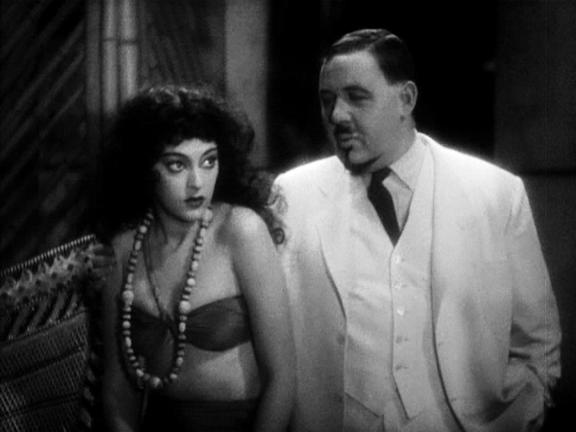
 Although I’m familiar with H.G. Wells’ The Island of Dr. Moreau, and I’ve seen screen versions with both Burt Lancaster and Marlon Brando in the title roles, I’ve never seen the 1932 version starring Charles Laughton,Island of Lost Souls. I watched a restored version issued by the Criterion Collection in 2012, and was much impressed at how an 80-year-old motion picture can affect a modern viewer.


First, the story is classic. John Landis, who gives his opinions in a 2012 feature with the DVD, says Wells’ original story was meant as an anti-vivisectionist tract. Vivisection is part of the story, and was shocking to audiences in 1932. The House of Pain, where vivisection is performed, is shown, and a creature tortured by surgery without anesthesia is shown on the table. Dr. Moreau is a sadist, who enjoys inflicting such pain.

The story is about bypassing evolution, and turning animals into humans. Because the story has been told so many times the phrases, “What is the law?”* and “Are we not men?” have been worn out. But here they are given in their original, and sinister forms, as the beastmen cower before the whip of Moreau. They are forced by intimidation to worship him, and the Sayer of the Law, (Bela Lugosi), gives him the feelings of godlike power. Moreau puffs himself up at the Sayer’s obedient flattery.


There is a strong aura of sex in the story. Lota, The Panther Woman (Kathleen Burke) is pushed at the other male lead, the marooned sailor, Edward Parker (Richard Arlen), with whom Moreau expects her to mate. He tells Parker she is Polynesian.


Too bad “the beast flesh creeps back,” as Moreau puts it, and Lota begins to return to her animal self. Parker probably realizes this after he has kissed her (did he feel her raspy tongue in his mouth?)

What I didn’t expect from this version of the movie was the darkness, not only within the story, but the photography. Cinematographer Karl Struss made a shadowy world of Moreau’s island. The darkness is everywhere, and the film is a superb example of film noir.

John Landis, in additional comments, said that director Erle C. Kenton was something of “a hack” in his later career. Landis was surprised at the excellent job he did with this movie. Landis also said that in the twenties and thirties horror movies were A-movies, but by the forties, with budgets reduced, had been downgraded to B-movies. It’s evident in Island of Lost Souls that much precious Depression-era money was spent on this film. There are many extras in makeup and costumes, and the sets, built especially for the movie, are wonderful.

Something Landis did not mention was the undertone of homosexuality that Dr. Moreau exhibits. Laughton, who was gay in real life (although married to Elsa Lanchester from 1929 until his death in 1962) uses somewhat effeminate mannerisms, and appears to be attracted to Parker.


But the work comes first. He expects Parker to be sexually attracted to Lota, rather than him. There is one scene that seems clumsy, even laughable, when Laughton hops onto a table to talk to Parker. It is  ridiculous because his corpulent body just isn’t comfortable there.


Moreau’s actions are coquettish. I wonder if this scene was filmed as planned, or was an ad-lib by Laughton? It is just so odd in context that it doesn’t look like it was part of the original script.

The script was written by Waldemar Young, from an adaptation of the Wells book by novelist Philip Wylie.

The power of the movie was such that it was banned in twelve countries, including England, from whence the Wells novel came. Individual states in the U.S. were allowed to make their own snips and cuts for censorship purposes.

The booklet accompanying the DVD explains how the technical staff at Criterion was able to take various versions of the movie (both 35mm and 16mm) and restore the original motion picture. The negative is long gone, and what you see in this DVD is probably the best-looking and the most complete version we are likely to ever see.


*Incredible Danny Elfman and his former band, Oingo Boingo, did a very stirring song,  “No Spill Blood,” based on the story.