Saturday, June 27, 2015

The real Mad Men: tales of fear and loathing from Madison Avenue

If you are a fan of Mad Men, then you recognize brand names being bandied about, and people running around in advertising agencies, desperately trying to get new clients or hold on to old ones. It all seems like life and death. In a way, it is. Advertising is a tough racket, and the streets of Madison Avenue in New York City are probably bloodied by those who have been pummeled and beaten down in such a competitive and cut-throat business.

Jerry Della Femina was an advertising man who wrote a best-selling book, From Those Wonderful Folks Who Gave You Pearl Harbor in 1970, telling tales of the high pressure advertising business. He told it in a very personal and funny way, though, and when I began watching Mad Men I wondered if they had used Della Femina’s memoirs as a jumping off point for the series.

Before the book was published, New York magazine did a two-part excerpt, a look at how advertising agencies work. I read the book originally in the early seventies (and it made me glad I was no longer considering that business for a long-term career). In re-reading the excerpts from New York I am surprised at how much I remembered, even after 45 years. It made an impression, just as the television series does.

Della Femina, though, did all right for himself. I saw online he had sold his house for $25 million. Not bad for an ad man.

Copyright © 1970 NYM Corporation


Friday, June 19, 2015

More film noir: Inviting The Uninvited Guest

The Uninvited Guest is a movie I reviewed nearly five years ago. I recently found it listed on one of those internet teaser sites under the heading, “Ten of the best horror movies you’ve never seen.” Seeing it listed got me to dig out my DVD of the movie.

The movie is not a horror movie, although what goes on during the film is strange, often surreal, and has a nightmarish quality. It is more correctly a psychological thriller, and in terms of theme and style I would guess its godfather would be David Lynch, whose movies create their own nightmares. Guest uses some of Lynch’s techniques, although it resists the urge to change characters into other characters in mid-movie. Actually, not quite. There are parallels in Guest, which I also notice in Lynch. The parallels come in protagonist Felix’s total paranoia during the first half of the film, wondering whether there is someone living in his house whom he cannot locate, and the second half, where Felix becomes a person who is living in someone else’s house surreptitiously. Another trick is to use the same actress to portray both Felix’s girlfriend, and the wife of the man Felix believes is the one who was hiding in his house.

I did not mention the most obvious parallel in my first review because, frankly, I wasn’t smart enough to pick it up on first watching. After nearly five years of experience and at times total immersion in films and techniques, I am more aware of those storytelling devices that can be unique to movies.

The Uninvited Guest is also film noir. It is dark and brooding, and presents an existential mystery.

Here is my original review, written October 27, 2010:

Felix is an artist and architect who lives in a huge house he designed. He's alone because his girlfriend, Vera, has left him. One night a man comes to his door and asks to use his telephone. Felix leaves the man in a room, then comes back, but the man has disappeared.

Felix searches for him, but doesn't find him. That night he hears noises as if someone else is in the house.

Is someone, that man, there or is Felix's mind playing tricks? Is he paranoid, or is there a stranger living in his house, a master of evasion, moving one step ahead of Felix while he obsessively searches?

As the audience for the movie, The Uninvited Guest, we're unsure ourselves. Felix draws a portrait for Vera of the man he saw. Later he finds out his portrait looks like the man who lives in Number 5, just up the street.

Felix goes back to his own house with a gun, goes upstairs, where a dark shape emerges from the shadows. Felix fires, hitting the shadowed figure. Rather than call the police, he locks the door so the person cannot get away, leaving him to die. In yet another strange twist, he then enters the house where the man lives, and then Felix becomes the uninvited guest.

The man he believes was in his house is named Martin, and his wife, whose legs are paralyzed from an accident, is Claudia. Both Claudia and Vera, the girlfriend, are played by Mónica López. The resemblance between the two women keeps him from leaving Claudia's house. The bizarre scenes of him staying one step ahead of her are choreographed almost like a dance.

This 2004 movie, in its native Spanish called El Habitante Incierto, is a film written and directed by Guillem Morales. It stars handsome young actor Andoni Gracia as Felix. The film has been called Hitchcockian, but I don't see it as that. It's a horror-suspense movie that plays on some of our primal fears, like unseen presences. The ending leaves some questions, but I like that. I like to think back and figure it out. Some people don't like having to figure out an ending, and some people don't like subtitles. If you don't speak Spanish you need the subtitles, and if you haven't been watching the film you'll find the twist ending enigmatic.

I recommend this movie.

Friday, June 12, 2015

When less is more

I’ve been watching film noir movies lately, specifically the classic films done after World War II, when a new consciousness emerged. It accepted the world as a flawed and dangerous place, and the people in it equally flawed and equally dangerous. It is also because the movies that are described as noir are artfully conceived.

For instance, yesterday I watched a DVD of Crossfire, a 1947 movie with a theme of intolerance and ignorance. It originated with the Richard Brooks novel, The Brick Foxhole, which was about a homosexual murder, but the movie censors in 1947 would have none of that. The producers changed the character to a Jew.

Crossfire was produced as a B-movie, with a small budget. But because it is so well made and broke new ground (confronting anti-Semitism), it was nominated for five Academy Awards and in addition, it did well at the box office.

As director Edward Dmytryk explained it, during the opening scene he wanted to cut the expense of a fight scene, plus keep the murderer’s identity a secret. So he and his cinematographer devised a shadow-play fight. As the movie opens we see the shadows of two figures struggling, we hear the sound of blows being landed. In a 90-second sequence we are given all the information we need that someone is being beaten to death. It is confirmed as the sequence ends when the dead man is flung into camera range.

What was done to save expense actually is a brilliant move on the part of the filmmaker.


**********
When more is too much

Crossfire successfully avoids displays of violence, and presents a suspenseful story through dialogue and human interaction. I wonder if the modern film viewer, addicted to special effects and graphic violence, would accept a story told in such a way.

Special effects are sometimes being used in lieu of making a good movie with a good story. I am not opposed to CGI, but massive action sequences using CGI can actually be boring, rather than exciting.

I found myself yawning during the battle over Metropolis in the Superman movie starring Henry Cavill as the Man of Steel. Was it really any better than the original two Superman movies starring Christopher Reeve, which used comparatively low-tech effects? In one of the infamous hacked Sony memos there was an executive who complained that in Man of Steel (2013) Superman crashed through the windows onto the floor of office buildings more than once (I counted three times). Why? Because money was spent on the effects and the filmmakers could not waste those repetitive shots?

I admit I am not part of the demographic the filmmakers are looking for. They want to bring in young audiences, the guys who play video games, and maybe those guys love that sort of action. The mindless scenes of violence and destruction, accompanied by eardrum-busting sound effects, induce boredom in me, not admiration.

Apparently I am not the only movie viewer who thinks this way.  Sarah Larson, at NewYorker.com, wrote an opinion piece called, “An Open Letter To the White Walker Army,” which, among other points concerning an attack by zombies in a recent episode of Game of Thrones, says:
“To be fair, White Walker Army, it’s not just you. It’s the entire tradition of long, boring fight scenes in movies, on TV, everywhere, made more stultifying by recent years’ onslaught of visual effects, able to conjure anything. I’m sure they enchant some of us, including their creators [Emphasis mine]: you wights, for example, appear in various lovingly rendered stages of decomposition. Some of you are “super-fresh,” dead for a week or two, your flesh only beginning to fall off; some are “mid-decomps,” dead six months to two years, and looking terrible; and some are greenscreen wights, dead as a doornail with decomp to match, rattling around full of negative space. I’m not a zombie connoisseur, but to me, all of you nincompoops, however brilliantly executed, have the emotional pull of an army of ants, minus the ants’ dignified social structures and attractive formic-acid exoskeletons.

Many people love battle scenes and C.G.I.; zillions of them strap on headsets to kill friends and strangers in live-shooter video games all over the world. Plenty of those people must find zombie battles exciting, whole fields of yuckos scrapping and yelling and dying; to me, they’re just a lot of frantic silliness.”
I just love it when thinking people agree with me. It makes me feel I am not alone.


Wednesday, June 10, 2015

Satirizing God

After the murders of cartoonists on the Charlie Hebdo staff in Paris, and the attack on a right-wing conclave in Dallas inviting cartoonists to draw the prophet, Muhammed, the subject of whose prophet or god is okay to satirize came up. Some cultures are pretty touchy about their deity and prophet, to the point of killing those who mock.

In our culture we don’t censor a cartoonist from razzing a creator.

The New Yorker takes on prophets as well as gods.


As far as I know, for their efforts author Andrew J. Schwartzberg and artist Drew Friedman were not killed by hooded men with machine guns for producing this three-page feature in Mad #347, from 1996. But what would have happened had they poked fun at another god, and not the Judeo-Christian god or prophets? And you know what “other god” I am speaking of, don’t you?

So I don’t have to risk waking up to find a group of armed men in my bedroom, insert the name of that god here: ____________. Shhh. No shouting it out, now.

And while we are at it, it is worth mentioning that the god featured in “What If God Were One of Us?” is pictured as none other than William M. Gaines.

Gaines, publisher of Mad from its inception in 1952 until his death in 1992, was certainly a god to some. A god of iconoclasts, that is.


Do you remember the song by Joan Osborne that was the springboard for the above article? As always, if the screen is dark on this YouTube video it is not due to an act of god, or me taking a lightning strike from above, but because YouTube withdrew it.

Thursday, May 28, 2015

The storyteller, Eddie Hunter

I met Eddie Hunter, of Marietta, Georgia, through the old Prodigy message boards in the early '90s. We both shared a love for the old Mad comic books. We also swapped anecdotes about our lives. I found Eddie had an advanced sense of humor and a genuine ability to tell a personal story.

Since Eddie has sometimes used artwork from my blog on his own, Chicken Fat, I thought it only fair to use some of Eddie’s stories on mine.

Eddie is, in the best sense of the word, a reporter. He watches people and listens to what they have to say. This comes through in his word-sketches. Everyone has a story. You just have to be receptive to it, and that is my friend Eddie. He and his wife, Anna, are constant companions, and have a wide circle of acquaintances. Eddie has an interest in family history, and in the history of his community and its fellow citizens.

I went back to some 2005 entries from Eddie’s blog for four short stories, each a few paragraphs. Eddie’s droll observations and comments are in the best tradition of storytelling. My only contributions are occasionally capitalizing a proper noun or providing a comma where I thought it was needed. I hope Eddie will forgive me. Other than those minor touches every word is Eddie’s.
Savannah, a Ghost, and the Unattached Hand

I went with Anna this past February to Savannah. She had four days of business meetings to attend.

The first or second evening we met the others of the working staff along and had dinner at The Olde Pink House in the historic district.

The Olde Pink House was first owned by James Habersham. James Habersham was a Georgia representative and was one of the signers of the Declaration of Independence.

Now, it is said The Olde Pink House is haunted by Habersham’s ghost. The Travel Channel did a bit about Hancock’s ghost there and so did PBS. The waiters claim that he would walk around in his clothing of the period and socialize with the guests and sometimes even play a trick on them, like hiding one’s fork before he or she reached for it, and the list is endless.

We had reservations. Two big tables held ten of us. Our table was round and was in a corner of the a room. Anna's co-staffers' table were within arm’s reach. One of the men sitting across from me I will call Tony. Behind Tony, high up on the wall, was a portrait of James Habersham, the original owner and maybe part-time ghost.

As we made polite conversation Tony, who struck me as a loud mouth braggart, with lack of anything else to say, brought up the subject of somebody that worked in his office, a handicapped person, a person that was challenged in controlling his body movements and his face movements. Tony said if he got excited talking he would lose control of his facial muscles and spit all over all you as he talked. Tony said he learned long ago to keep his distance or step aside when this guy was about to tell something.

Then…

One quiet person, lets call him John, between 55 and 60 years of age said, “Tony I think you deserve a hand for that.”

WHAM!!! A big unattached hand landed onto Tony’s empty plate.

Everything got deathly quiet. John reached over and picked up his rubber artificial hand and reattached it. Everybody at the table broke into laughter and some even were having hysterical laughter. I looked up at the portrait of James Habersham and he seemed to be frowning and not amused at all.

The rest of the evening Tony was mostly quiet. The hand was an inspiration to many to use some one-ones… like, “John can’t keep his hand to himself" — and more. — December 15, 2005

 Eddie Hunter and his sons, Rockwell (Rocky, left) and Adam (right), 2014.

Will Success Spoil Rock Hunter?

Thirty years ago we named our first son Rockwell Tyson Hunter. From time to time some one will ask why did we pick such a name.

Well, my middle name is Tyson, and so it is my father's, and it is also his mother's maiden name.

Now for the name Rockwell. Back in 1957 when I was in high school, one day a new kid came to class. I forgot his first name but his last name was Crane. He was tall and lanky. He sat next to me in class and I asked him was he related to Ichabod Crane. He gave me a hateful look.

Then, that same day, at lunch several of us were up around the baseball field hanging out. Crane walked up near and stood at a distance. Trying to be friendly and to welcome him as one of us, I said, "There is old Whooping Crane!'

He came at me swinging his fists like a lopsided windmill with broken blades. He had no fighting sense about him. He only knew when you are in a rage you attack giving it all you have by swinging your fists.

I am not much of a fighter either. But I do know how to dodge something coming at me, especially when the route of the oncoming fist is so predictable. So, I merely danced around dodging his fists, and from time to time hit him in the face with no problem at all; he knew nothing about blocking oncoming blows either.

I won the fight. I had no damaged look about me at all, no blood, no body scratches or marks, where Crane on the other hand had a bloody nose, and puffed up swelling around the eye, and his clothes were torn and dirty.

There was a movie playing at downtown Marietta's Strand Theater at the time, starring Jayne Mansfield and Tony Randall. The name of the movie was "Will Success Spoil Rock Hunter?" And not many months before the movie "Somebody Up There Likes Me", the story of Rocky Graziano, prize fighter starring Paul Newman. Both movies plus Crane and my actions caused somebody who witnessed the fight to say, "Will Success Spoil Rocky Hunter?"

My new nickname caught on and spread quickly. I was christened "Rock Hunter" by my peers. I went by the name Rock for the next ten to fifteen years, and still when and even now when I happen to run into a long lost friend, chances are he/she knew me as Rock.

So, it was only fitting that I named Rocky Rockwell.

And some place else in this blog world Crane may be at this very moment posting his blog which ends by saying "... and that is why we named our first son Ichabod." — December 18, 2005

Christmas Eve Story or Me the Party Pooper

Last year on December the 24th my sister had us over to her house for a Christmas Eve dinner. The guests included our other sister, my two sons, my son's girlfriend, Tiffany, and my sister's boyfriend, Mark.

We got there a little early to hang some pictures in her newly remodeled bedroom, which I promised I would do. I brought all my tools I thought I would need.

I just got started good and dinner was ready. We sat down, somebody said the blessing and we started passing things. Then, while passing something I suddenly felt dizzy.

I remember I had the same feeling at Kroger's less than two weeks ago in the Deli department. They had free samples of something sweet with a whipped creamy topping and I couldn't resist myself, and within a minute after I did it I went into a dizzy spell. I walked around pushing a cart, thinking if I walked around I could shake the dizziness that was in my head. I walked around and around pushing that cart — I would have fallen over if I didn't have the cart to keep my balance. I was right, I walked right out of the dizzy spell.

It looks like I might be a diabetic I thought, so I guess I better go to the doctor and and check that out — which I promptly forgot in a day or so.

Then, at the dinner table I was having the same feeling. My eyes locked looking at a right angle. I could not look in any other direction, and I was still dizzy, my head was going around and around.

I told them I was going to sit in the living room a few minutes but I would be back soon to join them. When I got up and walked sideways they knew something had happened to me.

I told them not to worry about it, the same feeling came across me at Krogers and it left me soon. But they kept looking at my eyes. Then they rushed me to the hospital.

I had a stroke. Talking about being a party pooper!

I stayed in the hospital for three days with an I.V. that was marinating me with blood thinner.

Now, I think I am OK. (knock on wood — or my head). And ready for a rematch! — December 22, 2005

Eddie’s stories are often an ongoing narrative. In the posting just before this final entry, Eddie and Anna had gone to see Peter Jackson’s King Kong, for which he gave a review. This is the followup post:

Ted's Grill

After we left the King Kong movie we went to Ted's Grill. We had a gift card to use there.

Ted's Grill is partially owned by Ted Turner. The restaurant has a decor of Montana saloon. As you may know, among Ted's vast holdings is a huge ranch in Montana where buffaloes are raised.

And of course the main items on the menu are bison and beef. They also have salmon which I normally order, but hey, when in a Montana make-believe grill, you make believe you are in Montana — I ordered bison. Anna, the traditionalist, ordered beef.

To me, the bison tasted like beef. I remember the last time I ate bison it tasted wild and like the blood had not yet been drained. This time it tasted better — or less wild, which means better to me.

On the other hand, when the manager saw me making my entrance, bumping into chairs and tables, and knocking condiments off tables, he could have informed our waitress to "don't waste the bison on him, give him beef, he won't know the difference."

One time in the nearby town of Roswell, which is near where Ted Turner lives or did live at one time, we stumbled upon a restaurant called "Mouth of the South" which is Ted Turner's unofficial nick name. We thought maybe he took advantage of the nickname and turned it into money, which Ted can do so well. So, we went there to eat, only to learn the Mouth of the South is catfish. — December 27, 2005

I reproduced one other story of Eddie’s, from his days in the U.S. Navy, in this posting from November 3, 2013, “Three examples of telling a personal story successfully”.

Tuesday, May 26, 2015

When Brother Bill warned us: “The topless bathing suit means the end of the world is near!”

Brother Bill was a businessman in his mid-thirties. He may have been all-business at work, but he was mostly fun and jovial on those Wednesday nights he took off his tie and was in charge of us rowdy 16-year-old teenage boys at our local Mormon ward. It was 1964, the year of the Beatles, and less than a year since a U.S. President had been assassinated. It was the year many of us post-war Baby Boomers began our sure rite of passage into adulthood with our first driver’s licenses, and for me, my first steady girlfriend. Heady times, indeed..

One night at church, as usual, we were joking and jostling with each other, boisterous as always. Brother Bill shushed us. He said, “I am going to say an opening prayer!” and we automatically bowed our heads and heard the first words of a typical Mormon prayer: “Our Father in Heaven...” I also remember the words, “Let these young men hear the words I say and heed them, O Lord.”

Amen. The next thing out of his mouth was uncharacteristic of the usually happy Brother Bill: “Boys, I am convinced the end is nigh. The end of the world is coming. And soon.” That got our attention. “I suppose you have all heard of the topless bathing suit.” It was having its fifteen minutes of fame. Yes, we had heard of it, but none of us had seen it. Newspapers could not run pictures because it was, well, topless. But we speculated in school. I heard a girl scoff, then say, “It couldn’t be pretty.” Pretty? I thought. What is prettier than a pair of  boobs?

 The suit is also known as a monokini.

Brother Bill was quite exercised about what the topless bathing suit portended. We got a whole lecture. What I remember was, one, the very existence of the topless bathing suit would lead us teenage boys into acts of sin: depravity and debauchery, and two, it was an indicator to him that the end of times was upon us. “It could be any minute, Jesus will come down from heaven, and the world as we know it will come to an end.” Holy cow.

In some ways the Mormons are a doomsday cult. They would not describe themselves that way, but their official name says it: the Church of Jesus Christ of Latter-day Saints. It’s the “Latter-day” part that is relevant to my story. Their own founder, Joseph Smith, claimed it was the church to belong to when Jesus came back, and that time was soon. (Of course, that was 180 years ago.)

In 1964 I was wobbling in my reception to the message of the Mormon church. If I had a reason for believing, it was because I believed older people were smarter than me. I believed there were people who knew things I did not know, like when the world would end. For various reasons, a year later I had made a decision about the church. Belief had vanished. One Sunday —  in May 1965, 50 years ago this month — I walked out of my local Mormon ward and told myself, “I am never going back.”  Over the past year since Brother Bill had lectured us, I had decided people like Brother Bill were spreading their religious fears and superstitious paranoia. There was some concern from my friends and adults like Brother Bill about me becoming inactive, but no one forced me to reconsider. They gave me the choice and I made it. .

After a while I stopped waking up in a cold sweat because I thought the devil was tempting me with lascivious thoughts into deeds that would cast me into a deep pit of hell. Nowadays I don’t think about it at all. If everybody who had lascivious thoughts were cast into hell, there would be a very sparse group of people in heaven.

I stopped believing there were people who knew when Jesus was coming back. I never worried about what Jesus would think of the topless bathing suit.

 Peggy Moffitt’s iconic 1964 picture, modeling Gernreich’s creation for Women’s Wear Daily.

Anytime something shocking or challenging to long-held beliefs occurs the apocalyptic types among us invoke the end of times. Probably when dress hems rose abve the ankle in the 1920s, religious leaders spoke to some young men, told them the end was near, and the arrival of Jesus was imminent.

Pictures formerly hidden from us of the topless bathing suit, created by designer Rudi Gernreich, can be found on the Internet. Gernreich was born in 1922 and died in 1985, presumably by natural causes and not from a lightning bolt thrown by God. Gernreich liked to challenge traditional ideas; he was a fashion iconoclast. But his designs, while still provocative, don’t rise to the level of world-ending.

An original Gernreich topless bathing suit was sold by auction house Christie’s this year for $2,075.


Sunday, May 17, 2015

Built-in disappointment with the next Star Wars

Star Wars had quite an effect on a generation. My wife and I wanted to see it the first weekend it was shown in theaters in 1977.  At the one theater in Salt Lake City showing the movie, we turned away at the sight of the lines around the block. We were more successful getting seats a week or two later. We were immediately taken by the story and the characters. It was very fresh, and it transformed the movie industry for the decades following its release. The main thing we got out of it was fun. I liked the special effects, but what Sally and I most enjoyed were the characters and their interactions.

“Star Wars Reboots,” in the June, 2015 issue of Vanity Fair, is an article on how the creative team came together for the latest movie in the franchise, Star Wars Episode VII—The Force Awakens. I found the article interesting, and also noticed that for the most part, the team has been involved with Star Wars either as moviegoers, or as movie makers, for a long time. The team decided they wanted to get back to what made the original movie successful, so they have hired some of the original actors, and have done a more retro-styled motion picture.

Another thing that struck me was the reverence with which the project was approached. It reminded me of statements by Roma Downey and her husband, Mark Burnett, when describing their Bible mini-series. Star Wars, in some minds, approaches the level of being a religious experience.

I have seen the sequels and prequels, but I never enjoyed them like the first movie. Using the Law of Diminishing Returns as a guide, I think we got less of the effect as each sequel progressed the storyline. The prequels, for me, are boring, despite a lot of gloss and CGI. Even though I have seen them, I cannot remember anything about any of the movies released since 1999. My feelings about them are not disappointment. Disinterest might be a better word.

Unlike hardcore Star Wars fans, caught up in mythology, I saw them without major expectations. A documentary, The People Vs. George Lucas, goes into great detail describing fan disappointments at these later films, pinning the blame for their disappointment on Lucas. They should blame themselves for not observing another “law”: “Expectation is greater than realization.” What fans had done in 1999 when The Phantom Menace was released was to build it up in their minds; they personalized it, but the film makers were not able to get in the heads of the fans, each of whom had his own vision. Then they actually saw the movie. Instant letdown. One fan described going back to see the movie several times, trying to convince himself it was as good as he wanted it to be. That is a good example of a true believer, akin to someone who believes in the Bible, but suddenly finds the foundation of his faith is showing cracks. He tries to heal those cracks. When I watched the documentary on Netflix I hollered at the screen a couple of times at fan revelations like that. It's only a movie, people!

Despite the fact that Lucas is now gone (he sold his company and the rights to all intellectual property to Disney for four billion dollars), and the onus is off him for the success or failure of the reboot, how can it not disappoint those fans who have built up the mythology of Star Wars into something that can only succeed in their own heads? People who hyperventilate over advance trailers or whose palms grow sweaty just thinking about taking their seat on opening day of a new Star Wars movie have already run the movie, or a movie of their own passions and fantasies,  dozens of times in their heads. Nothing can match up to that experience inside one’s self.

I am sure that what I am describing is already known to psychologists and mental health professionals, because it isn’t just to movies like Star Wars (or Star Trek, or Indiana Jones) that this phenomenon occurs. It also extends to other areas of a human being’s life: relationships, religion, politics, even conspiracy theories.

I doubt I’ll be filling a seat in my local cineplex when Star Wars Episode VII—The Force Awakens opens. I’ll listen to what others have to say about it, and a year from then I may watch it on Starz or HBO. Unlike those with unrealistic expectations I have none at all. In my personal, cynical view, I see it as less of a story than a major marketing tool to gain back the $4B Disney paid to have the rights to make it. And if any of the true believers ever stop their fantasiziing to consider that, then they will be truly disappointed.

Here is where some of my cynicism comes from. The director/co-writer is J. J. Abrams, who took the television series, Lost, and its interesting premise, and by the end of the series had alienated his viewers before driving the series over the cliff with a bad, contrived ending. That is the guy Star Wars fans are pinning their dreams on.

Monday, May 11, 2015

Racist bile, 1868 style

It has been 150 years since the Emancipation Proclamation and the passage of the 13th Amendment. It has been 50 years since the Civil Rights Acts of 1964 and 1965. But racism, sad to say, still rears up, and because of social media and improved technology, more and more it ends up online or on television, filmed by bystanders. Racism today is generally decried as bad, but there was a time in America when even public figures got away with racist remarks. It has been a growing process, or a painful learning curve, to get people past making public pronouncements of their own ignorance.

But even after living around racists and racism for decades, I was still unprepared when I found this book online at the Internet Archive. Page after page is filled with the kind of vicious and vituperative venom that might seem over the top in a Ku Klux Klan brochure, although I am sure that brotherhood of racists would probably co-opt some of the quotes from the book. This is slander to a whole group of human beings.


When reading The Negroes in Negroland on the California Digital Library of the Internet Archive, I had at once a reaffirmation of the basis for deep racial divides in America, and also that as a matter of unwritten public policy, we may not have moved far beyond these stubbornly held beliefs of the “inferiority” of races other than white European.

This book could poison anyone reading it, especially if they were looking to have their prejudices reinforced. The “compiler,” Hinton Rowan Helper, of North Carolina, only picked quotes that conformed to his point of view. There are no comments or quotes as far as I could tell that give a conflicting view of other races. I could not read the whole book...it wore me down with its barrage of hate, but if you look up the book you can look at any page without hope of finding any form of praise for African-Americans.

The year 1868, when this was published, was only three years after the Civil War ended, and the Emancipation Proclamation, and the 13th Amendment ending slavery. Slaves had been freed, but to what? They had no education, and no place to go. It was not like post-Emancipation that they could suddenly apply for a job as a home builder or deputy sheriff and be welcomed with open arms. In many cases slaves had no education at all; they were illiterate, and the white man’s country was a hostile place.

I have my own feelings about why our society has been poorer for its prejudices, but I also understand human nature. It is just in the nature of some to feel superior to others based on how they look or act.

I have “clipped” some especially egregious examples of the hateful sludge between the covers of this book. If it offends anyone, then that’s good. It should offend. It was not written with any other purpose than to dismiss black people as being somewhere between human and animal...and mostly animal.

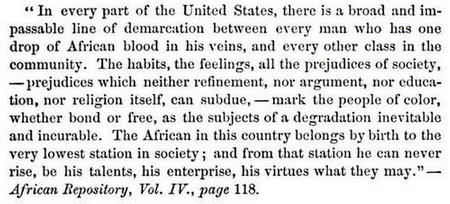
Quotes from the introduction pretty much sum up the author’s attitude:


Invoking God at the end is a specious way of bringing in Diety for the purposes of backing up one’s prejudice. Another is calling on physical racial differences and the supposed difference between blacks and whites. As in, “God must have cursed this race! Look at how different they are from us!”


If that hate-filled list of buzzwords and overkill in expressing disgust of “negroes” is not enough, those of mixed race are not free of disdain and loathing:


Finally, and I could not help but include this, because the description of the black’s singing voice makes me think of a legacy of African-American singers, from the early twentieth century to today, whose voices have changed American music, making it popular all over the world.


In its biography of Hinton Rowan Helper, the Dictionary of North Carolina Biography, speaks of Helper’s books:
“ . . . three of which were extremely racist and unleashed intense hatred towards the Negro race. His writings contained rational, progressive, and farsighted viewpoints and ideas as well as irrationalities and illogical ideas which sometimes sounded like the ravings of a maniac. Historians John Spencer Bassett and J. G. de R. Hamilton have portrayed him as a man of keen intellect with a touch of genius which at times bordered on insanity.”
Helper was born in 1829, and died in 1909.

Tuesday, April 28, 2015

Milking the right-wing politics with Ezra Taft Benson

Ezra Taft Benson was the 13th President of the Church of Jesus Christ of Latter-day Saints (also called Mormons or LDS), from 1985-1994. He was old when he died, 94 years of age. (I just read that the average age of LDS leadership is now 80.)

This incredible picture of Benson was taken in the 1950s when Benson’s job was Secretary of Agriculture for the Eisenhower administration. Born on a farm in Idaho, Benson had the qualifications for the job. He was very influential in government policies that are still being practiced today.

Although gone now for twenty years, Benson represents for me the power of church leadership in determining the faithful’s secular activities. Like politics. He was a Republican, and not just a Republican, but a right-wing Republican, even in a period when Republicans were much more moderate than they are now. Benson was affiliated with the right-wing group, the John Birch Society. He promoted that group’s political agenda, even while serving as a member of the church’s Quorum of the Twelve Apostles.

Sometimes members of the LDS church listen to highly placed church authorities as if they were speaking for God. By the time men like Benson become members of the Quorum of the Twelve they are obviously well-versed in church beliefs and doctrine, but also policies. Officially, they are not allowed to tell church members for whom to vote, and it is made clear to them. No stumping for candidates from the pulpit, in other words. I believe Benson stepped over the line of official church political neutrality when asked for his opinion on Democrats. And because of his status as an apostle, church members’ ears perked up. 
In February 1974 Apostle Ezra Taft Benson was asked during an interview if a good Mormon could also be a liberal Democrat. Benson pessimistically replied: ‘I think it would be very hard if he was living the gospel and understood it.’ — John Heinerman and Anson Shule, The Mormon Corporate Empire, p. 142
Since that quote was widely distributed in the 1970s the normally moderate Utah Republican Party has been taken over by the radical right, and while it would not be politically wise to quote apostle-before-he-became-church-president-Benson during debates on public policy in the legislature, what Benson said over 40 years ago is understood, and is deep in the bosom of the true believers. Its philosophy rules today’s Utah Republican party.

A recent poll conducted by one of the local television news organizations asked Utahns, broken down into categories, Mormon, non-Mormon, Republicans, Democrats, whether they thought the LDS leadership has too much influence on Utah’s legislators. The results were what I would expect. Most Mormons said no, non-Mormons and Democrats said yes, they have too much influence. I am firmly in that latter camp.

A few months ago some over-eager Mormon bishop opined that Harry Reid, Senate Minority Leader from Nevada, a Democrat and also a Mormon, should be hauled up before church authorities and, based on his political actions and beliefs, charged with various offenses against the faith. That bishop was slapped down quickly because he violated church policy, but if he said it, then a lot of people just like him were already thinking it; they just would not speak it out loud. Because of those opinions that Democrats are somehow not living their religion, it must make Mormons who are also Democrats a very lonely group.


Saturday, April 25, 2015

John Keel's self-induced inner cosmology

I am a UFO skeptic. I know the popular versions of the UFO mythology, and I’m not a believer. I still read a lot about flying saucers, but I am more interested in the people who write about flying saucers than I am in reports of sightings. John A. Keel is a case in point. (Keel, who was born Alva John Kiehle in 1930, died in 2009. He is probably most famous for his book, The Mothman Prophecies, made into a film with Richard Gere.)

I am fascinated by Keel’s books because I am fascinated by Keel. When it comes to believing, Keel veers from the standard set of UFO beliefs (“flying saucers from outer space”) and goes into what I would call an “everything that fits” belief system: paranormal, religious, technological, conspiracy theories, all part of his explanations of the UFO phenomenon.

Why UFOs  is a 1976 Manor House paperback reprinting of Keel’s 1970 book, Operation Trojan Horse. In it Keel states:
“. . . ‘illusion-prone spirits’ are responsible for nearly all of the UFO appearances and manipulations. The flying saucers do not come from some Buck Rogers-type civilization on some distant planet. They are our next-door neighbors, part of another space-time continuum where life, matter, and energy are radically different from ours.” [Page 273. Note, all page numbers are from the Manor House edition of the book.]
In the chapter, “Do Flying Saucers Really Exist?” he writes about the wide variety of types and shapes of UFOs reported:
“With very few exceptions, no two UFO photographs are alike. I have received hundreds in the mail and have been shown hundreds more in my travels. I have yet to personally handle two exactly similar photos taken in two different areas . . . I have rarely heard two independent witnesses describe separate seemingly solid ‘hard’ objects in the same terms . . . There seem to be as many different kinds of objects as there are witnesses. Yet I have managed to reassure myself again and again that the witnesses were reliable and were describing the objects to the best of their abilities.” [Emphasis mine. The “abilities” of witnesses has been a subject for study for decades, and witnessing is a highly subjective thing.]
    “. . . we must assume that UFOs come in myriad sizes and shapes. Or no real shapes at all . . . if the phenomenon has built-in discrepancies, then no one will take it seriously.”
[This is the time when I slip in my own UFO “sighting,” from almost 60 years ago. I still don’t know what I saw, but I know what it looked like. See: "Flying Saucer Boy".]

Back to Keel:
“In other words, we have thousands upon thousands of UFO sightings which force two unacceptable answers upon us:

“1. All the witnesses were mistaken or lying.
“2. Some tremendous unknown civilization is exerting an all-out effort to manufacture thousands of different types of UFOs and is sending all of them to our planet.

“I think that some ‘hard’ objects definitely exist as Temporary Transmogrifications. They are disk-shaped and cigar-shaped. They leave indentations in the ground when they land. Witnesses have touched them and have even been inside of them. These hard objects are decoys, just as the dirigibles and ghost planes of yesteryear may have been decoys to cover the activities of the multitudinous soft objects. They hold one of the keys to the mystery.

“There are countless sightings of objects which changed size and shape in front of the viewers or split into different smaller objects, each going off in a different direction . . . Over and over again witnesses have told me in hushed tones, ‘You know, I don’t think that thing I saw was mechanical at all. I got the distinct impression it was alive.’.”
Perhaps whoever wrote this imaginative script for a 1978 issue of the comic book, UFO and Outer Space #14, had read Keel’s book.

The dirigibles and ghost planes Keel mentioned are covered in another section of the book. There was an airship mystery going on in the later part of the 1890s. Some witnesses claimed that man-made airships, looking like what we came to know as dirigibles, were floating over cities and farms in America. Some of the “witnesses” claimed to have spoken to the pilots or crew. The most remarkable thing is that these supposed sightings were made a few years before the Wright Brothers made their first successful flights in heavier-than-air craft. Unlike hot air balloons, the airships were supposedly powered by motors. The ghost planes were described as looking like airplanes, yet when examined on the ground they had configurations not seen in known aircraft.

A very fanciful version of the airship was published as a dime novel. The Wikipedia entry, Mystery Airship, covers a lot of the same ground as Keel. Keel admitted some of the airship stories could have been hoaxes, whereas the Wikipedia article presumes most, if not all, were part of a larger series of hoaxes of the time.

In Keel’s hypothesis, they were controlled by these beings from another dimension, time and space. They made them to look like objects we would be familiar with. Keel describes these entities as “ultraterrestrials,” creating objects that would be familiar to people of the era. In Biblical days they would be seen as flying chariots, for instance.

Yet he ends the chapter from which I have quoted by saying, “It’s a mixed bag. You can take your choice. Every belief can be supported to some degree, but in the final analysis, when you review all of the evidence, none of them can be completely proven beyond a reasonable doubt.” [Pages 130-132.]

While Keel isn’t willing to admit the stories are probably fakes, or at least misinterpretations of evidence, he does say they would be impossible to prove.

Many things that fit into Keel’s own criteria for the entities fooling humans are part and parcel of the larger UFO picture. Even spiritualism is worked in. Although he believes many mediums are fakes, Keel didn’t equivocate when telling of certain spiritualists or mediums he believes are not. He then goes on to tell us stories of “little people” (including some bat people — holy Weekly World News!), and even a famous case studied by none other than Sir Arthur Conan Doyle, the Cottingley Fairies. In a paragraph which begins with a rhetorical question, Keel asks why these entities have not been photographed, he answers himself with, “They have. Sir Arthur Conan Doyle performed a lengthy investigation into one set of photos of fairies taken in England by a couple of children. Apparently they were authentic.” [Page 215.]

Actually, the photos weren’t. They were taken in 1917. To the modern eye they are obvious fakes, and one of the perpetrators finally admitted in the early 1980s to the hoax. Apparently, perhaps swayed by the reputation of the creator of Sherlock Holmes, Keel showed a startling gullibility. Since Keel’s book was published over 10 years before the hoax was finally admitted to, one wonders about Keel’s reaction to the news of the belated confession.

Besides that gullibility, Keel teases us with stories that set up a tantalizing premise, but go nowhere:
“. . . after I had launched my full-time UFO investigating effort in 1966, the phenomenon had zeroed in on me . . . My telephone ran amok first, with mysterious strangers calling day and night to deliver bizarre messages ‘from the space people.’ Then I was catapulted into the dreamlike fantasy world of demonology. I kept rendezvous with black Cadillacs on Long Island, and when I tried to pursue them, they would disappear impossibly on dead-end roads. Throughout 1967 I was called out in the middle of the night to go on silly wild-goose chases and try to affect ‘rescues’ of troubled contactees.”
After setting us up with that laundry list of odd occurrences he slaps us with this:
“More than once I woke up in the middle of the night to find myself unable to move, with a huge, dark apparition standing over me.” (Page 255.)
What!? A “huge, dark apparition”? And what did said apparition do? We aren’t told. Keel just drops it there, with no explanation, not even telling us what he thought it might represent. Since he survived to write of it, obviously it did nothing. Perhaps the fact that he woke up to find the apparition looming over him might indicate it was a nightmare? After all, someone with all of that adventure in his life must have a mind whirling like a centrifuge, even in sleep.

Boo!

Another of those tantalizing tales that go nowhere is this one:
“When a UFO would land on an isolated farm and the ufonaut would visit a contactee, he or she would call me immediately and I would actually converse with the entity by telephone, sometimes for hours. It all sounds ridiculous now, but it happened.” [Page 256.]
I would like to know if Keel recorded any of those reputed conversations (the cassette recorder was in use in those days; I know, because in 1967 I had one), or if not, if he kept notes, and if he did what might have been said. We are given a situation with no further explanation. Do we just accept Keel’s unsubstantiated word? He must have expected we would, having read that far into his book.

Finally, on another personal note, I find Keel’s view of religion and stories that come from religions interesting. He tells of the “visions” of Fatima and Lourdes as if they really happened, and the story of Joseph Smith and his “first vision” as being a real occurrence. In Keel’s versions, though, the visions were not holy beings descended from heaven, but ultraterrestrials out to trick humans. To what end? We don’t know, and at least Keel admits that.

My impressions from reading Keel’s books (not only this, but his others), is that wherever there are out-of-this-world things happening, they happened to, or because of, Keel. These books are all about Keel. What was it about him that made him a magnet for these ultraterrestrials, with their looming dark apparitions or mysterious phone calls from entities in the middle of the night?

My suspicion is that Keel, if not making it up, was at least hallucinating parts of it, and in the ways of all humans from birth, was connecting the dots of otherwise unrelated subjects. His brain came up with a complex cosmology of his own devising.

Does anyone else accept these stories at face value? Did cults spring up around Keel like they did around Joseph Smith and the original Mormon Church, or flying saucer contactees like George Adamski? In reading various versions of Keel’s life I don’t see that. So we might say that Keel was that proverbial prophet crying out in the wilderness. He told us what he thought, and what he “witnessed,” but it wasn’t enough to build a large, self-serving organization of devotees and true believers.

 In The Encyclopedia of Alien Encounters by Alan Baker, published in 2000 when Keel was still living, the entry “John Alva Keel” in part says:
“In spite of his eccentricities, Keel has contributed an enormous amount to the study of anomalous phenomena, and while he still belongs firmly at the outlandish fringes of ufology, his bizarre speculations have at least opened the minds of some to the possibility that UFOs and associated phenomena may represent a more complex reality than is generally supposed. As Jerome Clark states:

“Even his admirers were sometimes willing to acknowledge . . . that his conclusions outdistanced his evidence by some considerable margin, that his historical, psychological, and social analysis was amateurish, that the extreme kinds of experiential claims on which he was fixated were hardly characteristic of the UFO phenomenon as a whole, and that his speculations were laced with paranoia. Yet no one denied that as a teller of scary stories he could be wonderfully entertaining.”
Scary stories, maybe. Outlandish, yes. Entertaining, definitely yes.

John A. Keel, 1992.