Sunday, May 20, 2012

What's in a name? Depends on the year.

When my son was born in 1977 I wanted a name that was solid and unmistakably male, popular, and easy to spell. So I chose David. (Sally's brother's name is David, so that also counted toward my decision.)

When I worked for a large school district at the first of every school year I walked down the halls of  elementary schools and on cork boards outside the kindergarten or first grade classes the teachers would post the kids' names. I could see what the most popular names were five or six years previously. Now I go online and look them up. They give us a pretty good idea of what's hot right now. People haven't a lot of imagination. If not naming the kid after a family member, they pick a name from a movie, pop or television star.

According to a web site with popular names, "David" was number four in 1977, right behind Michael, Jason and Christopher, and just ahead of James, Robert and John.

(I'm speaking strictly of American lists of popular names.)

Of those names, only two are still in the top forty thirty-five years later. James comes in at number 13, and Michael at number 15. Why in the world would great names like David, Jason, Christopher, Robert or even John (arguably the most common name in the English language) have fallen off the list? I have no answer for that, except that names go through fads and phases. This year we have Mason, Liam, Ethan, Noah, and Jacob as the top five, none of which were even on the list in 1977.

Going back to the year I was born, 1947, James, Robert, John, William were the top four, joined by number 5, Richard. Richard had dropped to number 20 in 1977, and is off the top 40 list for 2012.


David may have dropped off the list, but he's still my number one son!

Sally (also not on the top 40 for 2012...or 1977 or even 1947) and I wonder sometimes what happens to names. The girl names we grew up with were Linda, Patricia, Barbara, Sandra, Carol, Nancy...if you look down the list of top 100 names for 1947 the names are virtually all gone from today's lists. When our generation had our children our kids got the popular names of that era, and when they started having their own babies they went to their own popular names list.

There isn't one girl's name on the 2012 top 40 list except for Elizabeth that appears on the top 100 from 1947. Linda was the most popular girl name for the decade of the 1940s, having replaced Mary, which had ruled unchallenged as most popular girl's name for at least the first forty years of the century.

In 1977, when we Baby Boomers were still in our late twenties and early thirties and still having children, names we chose for girls at that time were names like Jennifer, Melissa, Amy, Jessica and Heather. Elizabeth, bless her, is in the top 20 of that list, coming in at number 13. It's the only girl's name to be on all three of my lists.

Flashing forward from the year of my son's birth to the birth years of his girls, 2006 and 2007, he named his older daughter Isabella, which hadn't appeared on a list of the top 1,000 girl's names before it came back in popularity, and has hovered at or near number one ever since. His younger girl, Gabriela, has missed the cut for top 40 in 2012.

David said he got the name from actress Isabella Rossellini, but there's really no telling why a name grows legs and takes off. In the case of Isabella some have speculated it's because of the Twilight series of books, where Isabella is the name of the main character.

I miss those names I grew up with. I miss Steve, Mike, Bill, Rick, Kenny or Scott. Who'd have ever thought that Steve would drop off the list of popular boy names? Or Bill? Incredible. I miss names like Patty, Peggy, Margie, Linda, Kathy...and have pleasant associations with all those names. Yes, I understand it's because of my familiarity with them, having grown up with them.

There is a tendency—wrong-headed, I think—to use variant spellings on names to make a child unique. Spelling a familiar name differently may not work in the way the parent intended, especially if the person having that name goes through life having to spell it for everyone. Naming your child something unusual or difficult to pronounce may cause a hiring manager to put their résumé to the side. It's sad but true that prejudice, even prejudice caused by nothing more than a name, may affect a child's future.

Saturday, May 19, 2012

Happy birthday, Pete Townshend

Pete Townshend is 67 today.

Two classic songs performed live with the original members of The Who, 1974:


Happy birthday, Pete!

Friday, May 18, 2012

Gloria Steinem's 1961 photo-funnies

Famous writer and feminist, Gloria Steinem, wrote this satiric photo-funny (or "fumetti") for Harvey Kurtzman's Help! magazine, issue number 12, in 1961. At the time she was an editorial assistant at the magazine. Like most of Kurtzman's creations, Help! wasn't around long (twenty-six issues over five years), but amongst fans of his is a highly desirable collectible. Steinem wasn't around that long, either, only lasting a short time on staff. She had a talent for satire and wrote for the early '60s television show That Was the Week That Was. In 1972 she co-founded Ms magazine.

"Fumetti," (plural, the singular is "fumetto") as they called their photo-funnies at Help!, is named after Italian comics. The word fumetto means "little puffs of smoke," a reference to the speech balloons. In American usage it refers only to comics made from photographs, but in the Italian it means all comics. In this particular strip, a funny and contemporary look at the beat culture and its relation to police, Roger Price stars as "Peerless Fosdick." Price, a humorist and writer who created the popular Mad-Libs and Droodles series' books, was an admirer of Kurtzman and Kurtzman's work on Mad.

Kurtzman and Price are deceased, but Steinem is still working and writing at age 78.


Thursday, May 17, 2012

...and The Band played on

The Band. Just writing their name conjures up images from years ago, the pictures in my mind when I heard songs for the first time, "The Weight," and "The Night They Drove Old Dixie Down."

In this article, published originally in the August 8, 1970 issue of Look magazine, Rick Danko says he wrote "The Night They Drove Old Dixie Down" for Levon Helm, because Levon felt so strongly about the subject matter. I've heard a lot of versions of this song, but this version he did in the documentary, The Last Waltz, is one of my favorites.

The story of Robbie Robertson being forced to go on stage with a 103º temperature and stomach cramps because their manager wouldn't let them cancel the show, is part of the price an artist pays for stardom.

Rick Danko, Richard Manuel and Levon Helm are now deceased.


Wednesday, May 16, 2012

The Adventures of Tintin


 I approached the movie, The Adventures of Tintin, with a lot of interest. I've read the Tintin books, translated into English. I first encountered Tintin when I found a copy of the Golden Press edition of Explorers On the Moon on a bookstore remainder table in 1969, right after the Apollo 11 moon landing. I find the books fun, with good stories and clear line art that has a lot of appeal to me. Over the years I bought all that became available. The fact that Tintin originated in Belgium and had a history going back to the 1920s I didn't know until later. Apparently Steven Spielberg also became a fan at some point. He's been planning a Tintin movie since the 1980s.

The movie, despite the English accents (and Scottish burr for Captain Haddock) is set in Belgium. According to Cinefex magazine, the decision was made to place The Adventures Of Tintin in 1949. Careful attention was paid to the period and its look, but there is also some artistic license used. Tintin's sports car, a TR3, is an anachronism, but done with full knowledge that it's anachronistic. It just felt like the right car for Tintin.


The character of Tintin is played by Jeremy Bell, and Haddock by Andy Serkis. Serkis is making a career out of being an animated character, also portraying Gollum and King Kong. Snowy, Tintin's dog, is played in part by a wire frame, a stuffed dog and the animator's skill. Snowy is based in part on living terriers, but unlike the humans, remains a cartoon.


Motion capture animation is improving considerably. Look at films made just a few years ago and you can see how much better the technology has become. One of the problems with motion capture was with the eyes, but unlike the flat look of older films, in The Adventures of Tintin the eyes are totally alive.

I was also fascinated in the Cinefex article to read about problems with Tintin's hair. A program called Barbershop was used to create realistic looking hair, but work on Tintin's actual hairstyle was a complicated business. Anyone familiar with the cartoon Tintin knows he's shown with a tuft of hair in front, and except for some ginger color, no real indication of a style. What looks simple in an animated movie usually takes a lot of forethought. The viewer takes it for granted but it is a triumph of the animator's art.


There are small touches that are inside jokes for the knowledgeable. The newspaper Tintin is holding in this frame while talking with clownish detectives Thompson and Thomson is named after the Belgian magazine that first published Tintin cartoon strip serials.

The movie is based in part on three of the books, The Crab With the Golden Claws, The Secret of the Unicorn, and Red Rackham's Treasure. But the Tintin books have a lot of exposition, people talking and explaining the story. The movie, catering to today's short attention spans and expectation of adrenaline-driven visuals, is full of wild action, even slapstick. I got lost in the Cinefex article trying to understand the technology and cameras used to create those visuals, but understand they were first used on James Cameron's Avatar, a benchmark in motion capture. A difference in the two films is that Avatar mixed the animation in with live actors, and The Adventures of Tintin is wholly animated. Before reading the article I had guessed the film was a mixture of both live backgrounds and animation, especially in the scenes set on the water, but once again, it's all animation, so skillfully done it looks real.


Filmmakers face fan expectations when recreating a world familiar to readers of a certain literary character or franchise, such as the Tintin series. I understand what they had to do to make a movie look more realistic, and that's remove the cartoon from the characters while still exaggerating them, with unusual noses, for instance. Fans of Tintin love the look of the artwork. The books are designed for young readers, after all. The movie is designed to appeal to a broad range of viewers, most of whom, I'd guess, had never seen the Tintin books.


The filmmakers had to come to some accommodation between the needs of the movie and the needs of the fans, and for me at least they meet in the middle. My wife and I loved the action sequences, more so for the action than the technical facts of the animation. Once I got used to seeing the cartoon characters in a more human form I let myself go and joined in the story. I'm not dogmatic about it, and I was especially happy that early on the filmmakers decided they weren't going to do what was done with the movie version of Dick Tracy, use live actors with appliances stuck to their faces.

According to reviews I've read, some fans of the original can't accept this movie version, but I think it succeeded in bridging the gap between a cartoon and reality by using modern techniques of motion capture animation at its most amazing. I'll probably watch The Adventures of Tintin again to look for things I missed the first time around.

Copyright © 2012 The New Yorker

Tuesday, May 15, 2012

Mitt's memory


I heard the story of Mitt Romney and his memory lapse at an incident of bullying. The story is he and some fellow high school classmates held down a boy with longish blond hair, and Mitt cut the boy’s hair. Mitt says he doesn’t remember the incident. I'm the same age as Mitt and while I never assaulted a classmate in such a physical fashion, in those unenlightened days I mocked an effeminate boy, which made others laugh at his expense. I carry the guilt to this day. I’ve never forgotten a cruelty done to me, nor any cruelty I did to another. They tend to stick in my mind. I’ve even had to purge myself to a therapist about the ones that cause me the most guilt.

So Mitt “doesn’t remember that specific incident.” Maybe it’s because his life was so full of such “pranks” that the haircut assault was just one in a long string of acts committed against others, and having no conscience he has dismissed it from his memory. As for lying about it, I understand why he wouldn’t come out and say, “I was an asshole, I admit it.”  That would go against the holier-than-thou, purer-than-pure image Mitt tries to project of himself: family man, husband and father, businessman, ruthless when need be, but always aware of the bottom line. “I enjoy firing people,” he once said, to which he can now add, “I enjoy bullying people.”

When I remember back on things that make me feel guilty I tend to remember them as if I’m looking at myself from outside my body. It's a false sense of memory, perhaps a way to deal with the guilt. There are many things I don’t remember at all. My brother is good at telling me things I said years ago that I can't remember in any shape or form. Maybe I don't remember those because they didn’t make me feel guilty.

I’ve groped for a way to explain the ways of memory, but came across a perfect example in Ben Hecht’s 1963 collection of essays, Gaily, Gaily, about his time as a cub reporter just before World War I:
. . . remembering is a shifty process. Since memory is my collaborator in these pages, I pause for a look at it. No more illogical and evasive co-worker exists. It is not to be coaxed or scolded into action. Although memory is as much part of me as the features on my face, it has seemingly divorced itself from me, and retired to some lonely attic, without a stairway leading to it. It is odd that so common an experience as memory should be mysterious. . . . I remember things mistily. There are sometimes brightly lighted little areas, like a well-kept playground. But more often, events stripped  of words signal in a denuded landscape, ‘Here we are, the proofs of your existence. Come have a look at us again.’
Unless Mitt hit his head or took a memory-blocking drug like Versed before his press conference I wouldn't think he’d forget an assault. It may be an embarrassment to him, a memory that he'd rather not admit to, like mine of taunting a gay classmate, or most likely, it’s a lie to prevent having to own up to it. He might not be embarrassed. But I'm sure an advisor or two told him that in 1964 holding a boy down and cutting his hair may have been considered a prank, but in 2012 it’s gay-bashing. At any rate, he gave a sort of half-assed apology for pulling pranks, which means he remembers some memory that had been put in the “lonely attic, without a stairway leading to it.”

Monday, May 14, 2012

Happy birthday, Jack Bruce and David Byrne

Jack Bruce of Cream is 69 today.


David Byrne is 60 today.


Happy birthday to both!

Friday, May 11, 2012

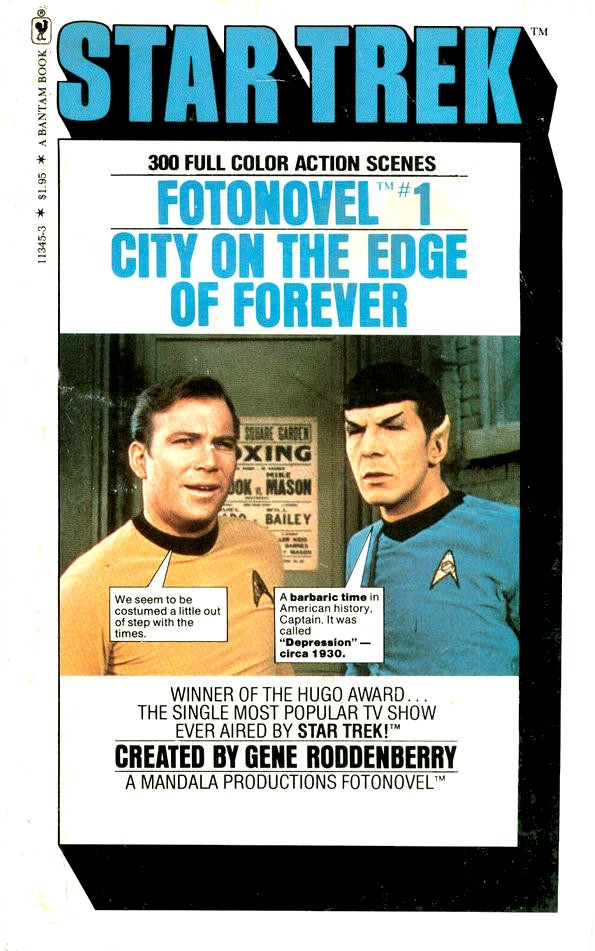
More Fotonovel: City on the Edge of Forever

A couple of weeks ago I showed an excerpt from a Fotonovel, a paperback book set up like a comic book with photographs, overlaid with speech balloons. The excerpt was from a  Mork and Mindy volume I found in a thrift store. Today I went back to the same thrift store and found another, this time a Star Trek Fotonovel, a 1977 version of Harlan Ellison's acclaimed "City on the Edge of Forever," broadcast.

I couldn't scan the whole book, so I selected the sequence where Kirk and Spock appear in 1930, and meet Edith.

Within a few years of the publication of this book the VCR became widely used. Star Trek episodes became available on tape for home use, dooming the Fotonovel forever.


Thursday, May 10, 2012

Tuesday, May 08, 2012

The glam that am

The new issue of Vanity Fair came in the mail today, and I was disappointed. Lawrence Schiller's outtakes of his nude Marilyn photo shoot is the cover feature, but what skin there is is so covered it would get about a PG-rating in a movie. We've all seen Marilyn's famous calendar picture, and the photos in VF don't come close.


The idea behind the photo shoot, according to Schiller, is that Marilyn was trying to get Fox to pay more attention to her, and quit giving all the resources to Elizabeth Taylor. By coincidence, another magazine arrived yesterday with a cover and photos of Taylor. Lifestories is brand new. This is the first issue, sent to my wife as a sample to get her to subscribe. It's kind of thin, but has some good pics.


The cover photo is of Taylor from 1973. A fantastic portrait of the young Taylor is below, from the February 21, 1949 issue of Life, photographed by the one-and-only Philippe Halsman. The thing that amazes me about this picture is that Taylor in the caption is said to be one week shy of her 17th birthday. So when this picture was taken she was 16-years-old! Throw the cuffs on me, sheriff...there's jailbait in the area. Hell, this is practically child porn!
 

Life was on top of the glamour world, with many covers and interior cheesecake and pretty girl photos, starlets, models, movie stars...they liked the pretty ones (they sold magazines, after all.)

These two pictures of Rita Hayworth are some sexy photos that show virtually nothing beyond some leg. But Hayworth is posed provocatively. In both she's on a bed, in both wearing lingerie. They were popular with servicemen during World War II, and Life at one point called Hayworth “the love goddess.”

 1945

 1941 

 Life even considered the 1941 picture the great pin-up picture of all. Maybe it isn't the greatest, but it definitely holds up, even after 71 years.

Yesterday I got an e-mail from the Life website, offering up these previously unpublished photos of Marilyn Monroe from about 1950, where she's wearing more clothing than she is in the Schiller pictures. (They were probably inspired to show them in answer to the Vanity Fair hype surrounding their own unpublished pictures.) Even though Marilyn is in the very early stages of her movie career it's obvious from these photos that whatever that "it" is that movie stars have, she had "it." Despite her star status Marilyn was never really taken all that seriously during her career. Elizabeth Taylor had the meaty dramatic roles, but Marilyn was considered a sex symbol, not a real actress. I don't know about that. I'm sure the two wouldn't have ever switched jobs. Can you see Elizabeth Taylor in Some Like It Hot? Or Marilyn in Who's Afraid of Virginia Woolf? Maybe Marilyn didn't care for her being categorized as a sex symbol, but sex symbols come and go all the time, and yet there's only one Marilyn Monroe. It's too bad she died young, but her legacy is assured; forever young, forever sexy.


Copyright © 1941, 1945 , 2012 Time-Life

Saturday, May 05, 2012

Stolen valor in Utah

My home state, Utah, has had a couple of recent incidents of what is called "stolen valor," where people claim military honors that are undeserved. The latest is with a man named Dave Groves,* 67, who claims to have been a POW in Vietnam. He said he was with an airborne unit, captured and held captive by the North Vietnamese for six months after his unit was ambushed. He said he escaped and hid in the jungle for two weeks before being rescued by a Marine patrol. Groves was part of a dinner on April 13 held for ex-POW's, which got a lot of local media attention.

The Salt Lake Tribune did a search through the Freedom of Information Act and got Groves' service record, which showed he was not in Vietnam during his time of service. He spent his two years in the Army in the United States. Groves denies the newspaper's findings. He says it's a mistake, but if we believe the official record then he's been outed as another liar who is trying to puff himself up as a hero.

Do guys like that think they won't get caught? If so, they haven't heard the story of Douglas Stringfellow, who was a one-term Congressman from Utah,1952-54, who was also busted for stolen valor.


From the Utah Historical Quarterly Fall 1967 by Janet Burton Seegmiller:
. . . Douglas R. Stringfellow . . .had won the First District seat in 1952 largely through his stirring tales of heroism during World War II. Stringfellow had become paralyzed while serving with the U.S. Army Air Corps in France, but he began embellishing his war story as he retold it to Scout groups and young people's gatherings until he had invented his participation in a dangerous Office of Strategic Services (OSS) mission behind enemy lines, an officer's commission, and several faith-promoting incidents in which his life was saved. Not only did Stringfellow share his story at dozens of meetings but the stories were also repeated by Mormon Church leaders and written into church lessons for young people, and he was honored by the U.S. Junior Chamber of Commerce as one of the top ten young men in America. His election to Congress in 1952 showed the strength of his popularity, but during the 1954 campaign his fabrication unraveled, and under pressure from the leadership of the LDS church and the state Republican Party, he confessed and withdrew from the campaign.

. . . In reviewing Stringfellow's career, political scientist Frank Jonas wrote, "If anyone had dared to attack Stringfellow either on his war story or his veteran status, the anger of the electorate would have turned on the accuser and not on the accused..." The congressman had evoked considerable sympathy not only in Utah but also wherever he spoke across the nation.

Recognizing the situation, the Democratic Party had been gathering evidence of Stringfellow's hoax for many months; members of labor unions and veterans' organizations and a few newspapermen were also heavily involved. The party and [Stringfellow's political opponent Walter] Granger did not want to take the initiative to expose the congressman but were willing to assist others. Granger wrote to a Gunnison [Utah] party member on September 13, 1954, ‘We have definite proof that Stringfellow's heroic story is a fabrication of his own mind and he did not do the things he has taken credit for--I am giving you this information in order that you may be able to meet some of the arguments in his favor that you may run into.’”
After being exposed Stringfellow went into broadcasting (using pseudonyms), a job he'd held for a couple of years after the war. He died young in 1966 at age 44.

Jason Chaffetz, who is one of Stringfellow's successors as a Utah Congressman, is hot under the collar over what he sees as himself being made to look a fool by publicly pinning medals on an 86-year-old former U.S. Air Force colonel, Myron "Mike" Brown, who presented him with papers saying he deserved three prestigious medals from his service sixty years ago.** Sometime after the ceremony, held in front of the media, The Salt Lake Tribune found out the documents were fraudulent. Chaffetz called congressional hearings on stolen valor, and is angry because when it comes to medals the military is sloppy in its record-keeping.

The military isn't too concerned, at one point saying that these cases surface rarely, and to put together a database of all its award winners would be a big chore, and costly. Chaffetz, who was one of the first Tea Party candidates to get a congressional seat, normally squeezes a government nickel. He touts his fiscal conservatism, but is apparently not worried about running up costs when it comes to this issue.

Both Groves and Brown deny their stories are false. They claim they are right and the records are wrong, but most everyone (including me) believes both of them have been caught in bullshit lies that are now being exposed.

However, despite our righteous anger, do we really need yet another law? If guys lying to make themselves look important get arrested then you'll put more than half the men in the world in jail. If a man does it to gain medals or acclaim he doesn't deserve it shakes out, mainly because he has a better-than-even chance of being caught. I believe that what happened to Douglas Stringfellow is happening right now to these two men who appear to have lied about their war records. Maybe they have told these stories for so long and so often they believe their own tall tales. They chose their military service to exaggerate and fabricate their personal history because of Jason Chaffetz's complaint: it's hard to check up on this sort of thing. (Not hard enough that they weren't exposed, but maybe they thought they'd never be found out because of the clusterfuck that is military record-keeping.)

I've known people who went beyond simple lies to extravagant lies. Like Groves and Brown those other liars got called out for lying. But both Groves and Brown must be pretty good at it to have gotten away with it for so long with family, friends and coworkers. If I knew them, and had believed their stories, then found out their records proved them liars I'd wonder what other lies they'd told. But it doesn't mean they need to go to jail, especially if they didn't do it for financial gain. Since humans are by nature liars, and we lie all the time for one reason or another, from little fibs to big whoppers, I'm reluctant to make lying for the purposes of self-aggrandizement a crime.

I also believe the humiliation they and their families are going through over these revelations of lying are a very real punishment, just like they were for Douglas Stringfellow almost sixty years ago.

* Article on Groves

**Article on Brown

Wednesday, May 02, 2012

First crush

My son held up the May issue of Vanity Fair. "I think Julianna Margulies and Sofia Vergara are gorgeous," he said. I agreed.

Of course, I also think Claire Danes and Michelle Dockery are gorgeous. But I look at them like I would look at anything unattainable, nice on the eyes, but no emotional involvement. That wasn't true when I was a kid in love with Anne Jeffreys, who played Marion Kirby on the sitcom, Topper, with her husband, Robert Sterling as George Kirby, and character actor Leo G. Carroll as Cosmo Topper. (Oh yeah, mustn't forget Neil, the St. Bernard.)

But enough of the men and the dog. I was totally loopy for Anne. I would lie in bed and scheme ways to be with her. First of all, magic would make me a man, all grown up. I wondered how old Anne was. Maybe she was 21...? She was actually in her early thirties in the mid-1950s (born in 1923), but 21 sounded old and mature to me when I was a nine-year-old boy. If I had some magic, like how Billy Batson, a boy, shouted "Shazam!" and became Captain Marvel, a man, I could move right in. Of course there was the problem of that pesky husband, Robert Sterling, but maybe she'd divorce him for me, or better yet, he could be a car crash and die. Morbid as that was, I felt it was probably the best course of action. I probably got the idea from the show; George and Marion were ghosts of people killed in a car crash.


Since I was a kid with a kid's short attention span I'm sure the crush didn't last long, maybe a few weeks, a month or so, and I moved on to some other obsession. But I remember it as being the first and only time I ever fell in love with a grown woman who starred on TV or in the movies. I remember thinking a lot of women on TV were cute or pretty, but didn't have crushes on any of them. Only her. To this day I still love the name Anne. Anne Jeffreys had started her career in B-movies, and until she got her hit television show, that was pretty much her career. I didn't know anything about a Hollywood pecking order, "A"-list stars and "B"-listers until much later. If they were on TV or in movies they were privileged, and I lumped them all together. Here's Anne all tied up and at the mercy of Bela Lugosi in Zombies On Broadway. I don't know if this was even a B-movie. Maybe lower.

A few years ago I read that Anne Jeffreys had attained great age by living a very healthy lifestyle. So I was surprised that at one point in her career she advertised cigarettes. Did she smoke? Probably not. Even professional athletes advertised cigarettes. They probably didn't smoke, either. But tobacco money was as good as any in those days, when celebrities endorsed products they didn't use.

Anne Jeffreys is 89 this year.


She looks pretty good for being almost 90, don't you think?

My crush on Anne has long been over, but I haven't forgotten how she was my first and only big television heartthrob.