Thursday, December 25, 2014

A Humbug kind of Christmas

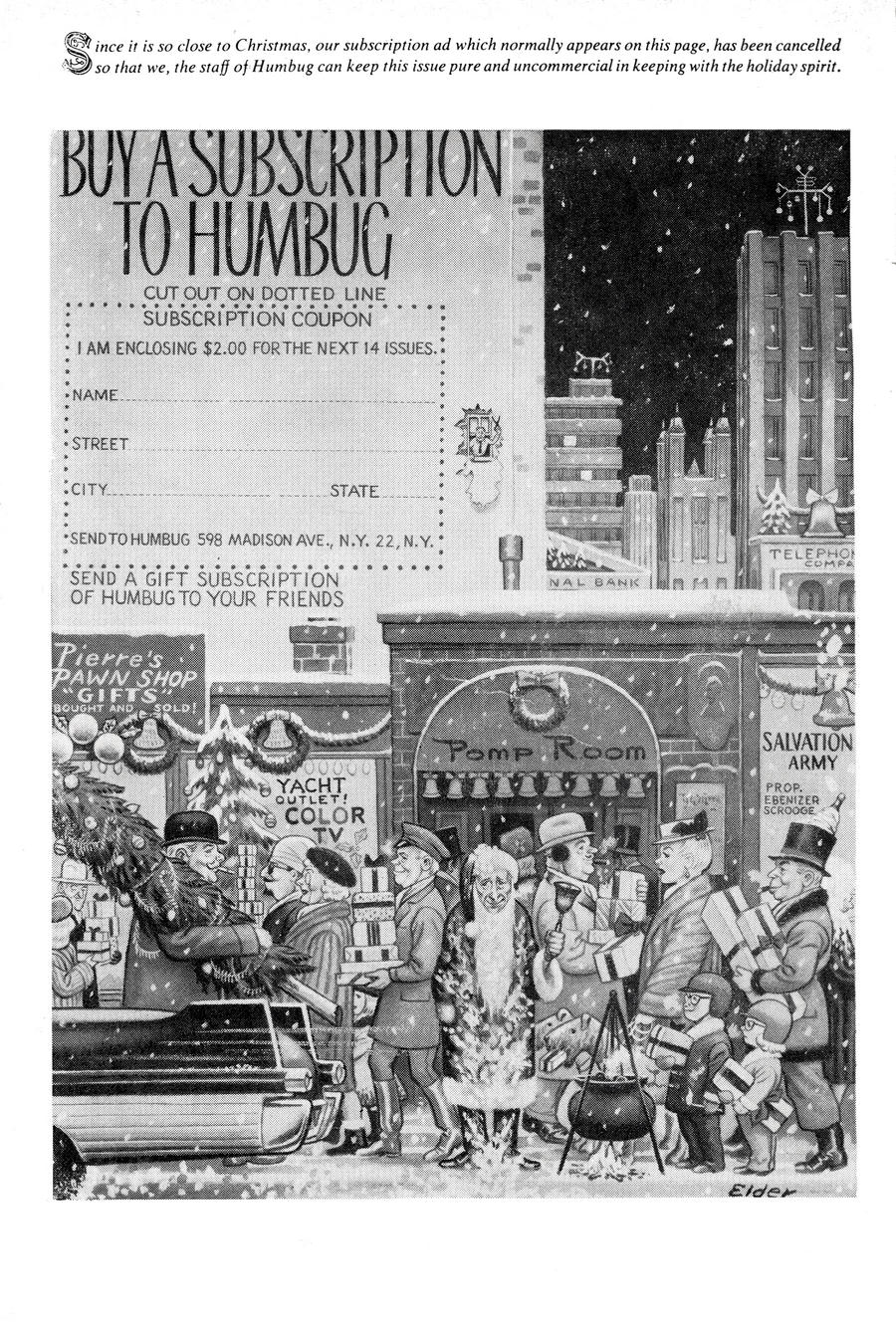
Harvey Kurtzman, who created Mad in 1952, left his publisher, William M. Gaines, in 1956, and edited two issues of Trump, another humor magazine, for Playboy publisher, Hugh Hefner. Trump had high production values, like Playboy. (Kurtzman later went to work for Playboy producing the comic feature, “Little Annie Fanny.”) After Trump Kurtzman and fellow artists formed a company to publish Humbug.

When I saw Humbug in 1957 it was on the comic book spinner racks. Retailers really did not know what to do with it. It was the size of a comic book, printed on cheap paper in two colors. It was printed and distributed by Charlton, along with their regular line of comic books. But unlike the full-color comic books which cost 10¢, Humbug was priced at 15¢.

Mad, which was very popular, was magazine-sized, cost 25¢, and had several imitators. It went on the magazine rack along with issues of Time, and yes, even Playboy. After nine issues in the comic book size, Humbug went to a full-size format with issue number 10, and lasted two issues priced at 25¢. Humbug died. The folks in on the enterprise lost their shirts.

This Christmas issue of Humbug, is a nostalgic favorite of mine. I bought it off the comic book spinner in my local drugstore in Seattle, Washington, in late 1957. I was 10-years-old, did not understand all the humor, but was fascinated by it, anyway. I have scanned my personal copy of the magazine.

In 2008 Humbug was reprinted.  The folks at Fantagraphics Books published all of the issues of Humbug, using original art when possible (see my last post, which features some original art from Humbug, by Jack Davis.) They did a wonderful job and created a two-volume slip-cased, deluxe set. It is published in a format that its creators could not have dreamed of nearly 60 years ago.


Monday, December 22, 2014

Jack Davis, Mad-man, retires!

Jack Davis is a true genius of cartooning. You have seen his work over the past 60 years, and perhaps you haven’t realized it. He did posters for movies like It’s a Mad, Mad, Mad, Mad World.


He did record album covers, magazine covers for Time and TV Guide, art for bubblegum cards, advertising art, and even storyboards for animated commercials. This issue of Time is an example of his cover art:


Davis came up through the ranks of the art world, spending several years drawing comic books. He went into the field in about 1950, and found work at one of the most legendary comic book companies of them all, EC Comics, where he worked on some of the greatest horror comics ever: Tales From the Crypt, The Vault of Horror, and The Haunt of Fear. Here are two pages scanned from The Vault of Horror #34, where Davis got to draw different types of monsters:


The horror comics died with the Comics Code in 1955, but they were never far from Davis’s heart, or pen and brush. In 1960, for instance, he did these covers for the satirical magazine, Sick. The top is the one he originally submitted, which was rejected. The second is the one that was published:


He also did this cover for a short-lived horror digest, Shock, in 1960, which showed he still had the gift of drawing unsettling images.


In 1957 Davis and some fellow cartoonists started up Humbug magazine, a small-sized Mad competitor. Here are some pages, also from Heritage Auctions, scanned from the original art.


In 1964, Davis did the cover that inaugurated the black-and-white, no Comics Code involved, run of Creepy magazines


The work for satire magazines like Cracked, Humbug, Sick, etc., came after Davis’s initial time at Mad for EC, where, with editor/writer Harvey Kurtzman, Davis helped raise satire to high art. Mad was very successful, and as Davis once later explained it, it was his work there that young advertising art directors remembered. His humble beginnings got him his later successes.

These six pages of “The Countynental” are the original artwork for the story from Mad #14, published in 1953. They were sold by Heritage Auctions. The story is a spoof on the types of TV programming from the early days, done, with clever use of shading sheets called Zip-A-Tone, to simulate the black and white images of early '50s televisions. As for the subject matter, “The Continental” was a suave rouĂ© who would invite women into his apartment for drinks and conversation. It was done POV style, the camera becoming the female viewer.


Davis went back to Mad in the 1960s, where he stayed until just a few years ago. He explained when he announced his retirement at age 90 that he could still draw, but his work was not up to his own standards. That is a man who knows when to sit back and just take it easy.

Here are some originals, also sold by Heritage Auctions, from Mad.


The few examples I have shown here cannot begin to show the amount of top notch work Jack Davis did during his fabulous career. All I can add is that I have been looking at and admiring Jack Davis’s artwork since the mid-1950s, and have never lost my sense of wonder at his talent. Happy retirement, Jack!


Postscript, December 24, 2014: Various blogs are saying that the talk of retirement is not true...that Jack is still up to his regular funny business. If so, enjoy the above artwork, anyway, and let us hope Jack goes on for a long time to come.


Wednesday, December 10, 2014

Other peoples' stuff: buying memories

 I wrote this originally in 2006. With some editing and some updating I am presenting it again.

You walk into any thrift store in America, I don't care what it is, Goodwill, Salvation Army, Thrift Town, whatever, about 95% of what you see will be typical thrift store fare.

By that I mean you'll see the same 1970s stoneware dishes, the same coffee mugs that say, “World's Greatest Fisherman,” the same Andy Williams or Herb Alpert LPs. I go in trying to find something different so I've got a practiced eye at mentally sorting the everyday from the exceptional. My granddaughter, Gabby, went into a thrift store with us last summer, and liked what she saw. She said, “We get to buy other peoples’ stuff!”

Like these photos. A few years ago I went looking for a nice photo frame. I found what I wanted and when I got it home took a good look at it. What I thought was the original advertising print in the frame was actually a school photo of a pretty high school girl.

I don't have any idea who she is, or why her picture was in a thrift store. Stuff like that happens occasionally, and it’s probably some sort of mistake. I could give back the picture, but I don't know who she is.

She is a cutey, though. Maybe 16 or 17-years-old, nice broad forehead, connoting smarts — probably an AP or 4.0 student — pretty brown eyes, nice chin, but an especially pretty smile. Young woman, I'm sure that to this day when you turn that smile on you melt hearts.

I don't know how to date this picture. Probably early ’90s; the moussed hair is a clue.

A couple of years later the same scenario: I’m looking for a frame and come across this picture I call Yankee Baby. What the — ! This one I spotted immediately as a family picture. It even came with a name on the back and maybe someday I’ll google that name and see if I can locate the subject.

The photo appears to be from the late ’40s or early ’50s. I love the Yankee outfit! I tried to sell this on eBay once, shamelessly listing it with the name “Yankees” prominent in the headline. I had no bidders. I guess Yankee fans don't want pictures of babies dressed up like Babe Ruth. To me it gives new meaning to the nickname, “The Bambino.”

Family pictures are so intensely personal. They mean something to the family, very little to anyone else. Still, I like the subjects in both these pictures. As a former school district employee, I saw hundreds of high school girls every day and I didn’t take much notice because there were so many of them. But there is something about the frozen moment aspect of a photograph, the attention to the subject that school photos specialize in, as well as that pretty smile that draws me back to her picture.

I've already talked about how many Baby Boomers there are in this country, and the little Yankee Boy looks like he fit in with my generation. Maybe the scenario is something like this: his mom took him to the photo studio and proudly put him on a stool and told him to look at the birdie and smile. Awwwwww, how cute he looks, she thought. Then years later she’s dead, he’s an executive with IBM living in Hong Kong; someone cleans out her stuff, selling it in an estate sale. The new owner looks at this picture along with the van load of other stuff he got at the sale, says, “What the hell do I do with this?” He tosses it in his junk box. From there the picture makes its way into the donation pile at my local thrift store, and ultimately I buy someone else’s memory for 50¢.

Tuesday, December 09, 2014

The coincidence: Me, The New Yorker, Mindy Kaling and J.D. Salinger

Are there such things as coincidences? Yes. They happen to me on occasion. But I have never known what they mean, if anything.

Chilean novelist and poet Roberto Bolaño said, “Coincidence obeys no laws and if it does we don't know what they are.” If you go to the Internet you get a couple of dozen quotes about coincidences, a lot of which contradict each other. Some people see coincidences as part of a grand plan of God’s, others as interesting, yet random happenstance.

What I know about coincidences and me is that they come to me out of the blue. I may go months without noticing anything particularly coincidental, and then get a surprise.

The surprise happened to me yesterday morning. I have been reading a book, About Town, The New Yorker and the World It Made by Ben Yagoda. In a section about author J.D. Salinger I read that Salinger , “. . . wisely chose not to reprint [his story] “Hapworth”* in book form, and as a result many libraries’ bound New Yorker volume containing the June 19, 1965, issue is missing pages 32 to 113, their removal effected by some fanatic devotee of the author’s.”

 The famous issue.

I put the book down and read my newspaper. With the paper is a supplement magazine, American Profile, that comes out on Monday. In an article called “Christmas Memories of the Stars” I read a quote by actress Mindy Kaling (The Mindy Project) of a favorite gift: “I am a huge J.D. Salinger fan. I had a boyfriend who gave me all the uncollected J.D. Salinger stories that were published in magazines but were not compiled into book collections. That was a nice Christmas present.”

Now that I resoundingly claim as a coincidence.  It also explained who had been cutting up the New Yorker!

Did anyone ever ask Salinger how he felt about coincidences? Or cutting up the New Yorker, for that matter?

Because of the aforementioned unknown nature of coincidences it could be months or years before I am surprised by another. As to whether a coincidence means anything, I will leave that for someone else to figure out.


*The story, “Hapworth 16, 1924” is, as I write this, available in both the New Yorker archives (you have to be a subscriber to the magazine to read their archives) and a convenient PDF at GoingWiMax.com. If you click on the link and get an error then the link has been taken down. Sorry, but it wasn’t me who did it.

Saturday, November 29, 2014

War by remote control

Look out below!

“The Unblinking Stare” by Steve Coll in the New Yorker for November 24, 2014, is a chilling reminder that there are places in the world where the United States is an angry god — sending death from the skies to those sinners who have incurred its wrath. As described by Coll in the article:
“Being attacked by a drone is not the same as being bombed by a jet. With drones, there is typically a much longer prelude to violence. Above North Waziristan [Pakistan tribal area], drones circled for hours, or even days, before striking. People below looked up to watch the machines, hovering at about twenty thousand feet, capable of unleashing fire at any moment, like dragon’s breath. “Drones may kill relatively few, but they terrify many more,” Malik Jalal, a tribal leader in North Waziristan, told me. “They turned the people into psychiatric patients. The F-16s might be less accurate, but they come and go.”
All I have to do is use my imagination and think what it would do to me if I saw a drone in the sky over my house. Psychiatric patient, indeed.

The idea of a pilotless aircraft able to attack enemy forces is not new. It was shown in this page from the January 9, 1956 Life magazine. Despite being attached by a wire, even the wingless craft shown here seems fairly sophisticated. I don’t know how far this particular project went, or if there were other projects before it that led to the one in the photo. I can surmise that for decades the American military has been working on just such a project. Right now a pilot can sit at a location in the United States and fly a craft halfway around the world. It then can be then used to bring death and destruction. As with all weapons, sometimes it takes out the innocent as well as the guilty.


Wednesday, November 26, 2014

Bill Cosby and Bob Hope and that old devil Sex

Bill Cosby, one of the most popular American actor-comedians of the latter half of the 20th century, is experiencing a definite fail when it comes to public opinion. Several women have come forward to allege that they have been raped by him. The reason he isn’t in prison right now is because he paid them off. And, in that grand legal tradition, the statute of limitations on the crimes has expired. Whatever he did then he cannot be prosecuted now.

Bill Cosby might be wearing this very expression as you read this.

Reading the stories of the women has been a reminder of the Janus-faced ability of some men to be good guys in public, yet criminals in private. The stories about Cosby began to surface some years ago, just about the time his 37-year-old son, Ennis, was murdered on the side of a freeway. Public sympathy swayed toward Cosby and the rape stories were quickly buried. Of course Cosby, as well as his publicists, have vehementally denied that there is anything to the allegations. Why wouldn’t they? At this stage of Cosby’s career if he admitted he had been drugging and having sex with semi-conscious females, then paying for their silence,that would put a real damper on a magical and trail-blazing career. Cosby was one of the first African-American comedians to break through to the larger white audience in the sixties with his popular mainstream comedy albums. His appearance as a lead in a popular television, show, I Spy, that decade was equally groundbreaking.

Cosby refuses to talk about any of the allegations, preferring to issue general denials and then stand mute on specific charges.

It is probably too late to salvage his reputation.

I did an Internet search, hoping that cast members of his sitcom, The Cosby Show, might have come forward to tell their own stories, or deny that they knew of, or were privy to, any of the stories about Cosby. So far the only one I have been able to find is from Raven-Symoné, who says any stories of her being taken advantage of by Cosby are false.

No quotes from Phylicia Rashad,* Malcolm-Jamal Warner, or Lisa Bonet, as of this date. Are they being approached by reporters and asked their opinions? My guess is that when they were on the show they signed non-disclosure agreements.

Besides Cosby’s fellow sitcom cast members being quiet, I haven’t heard a lot of outrage from the general public. Maybe we have become immune to celebrity scandals. We love them, but maybe we just aren’t so surprised when we find out people we have put on pedestals don’t really deserve such an honor. Yet we also have a problem when we have a public persona that is well established, when we find out there is a darker side we have not experienced. There was some resistance to the stories about Cosby the first time around. The repetition of the charges has now sunk in. The women who have come forward with stories of Bill Cosby’s crimes found out firsthand that just because a person makes you laugh does not make them a good person. Just someone who can tell a joke.

Bob Hope. Ethel Merman...really?

Another famous 20th century celebrity, Bob Hope, is the subject of a new biography by Richard Zoglin, Hope: Entertainer of the Century. I have not read the book, but reviews have picked up the non-traditional view of Hope as a serial adulterer who cheated on his wife, Dolores,** throughout their marriage. A review in The New Yorker describes Hope having sex with Ethel Merman — of all people! — in doorways on 8th Avenue in New York. The difference with Hope’s sexual proclivities is that none of them are described as rape. Hope is linked to other women, including a longtime affair with Marilyn Maxwell.

Maxwell and Hope in 1953 doing a little squeeze for Off Limits.

The difference with Bob and Dolores Hope is that they are dead. Hearing about the secret histories of the long dead is just more historical record. It has little impact on me now to know that Bob Hope, a man I thought was a straight-arrow type, was another horny male...much like the character he played on radio, television and his movies.
*UPDATE, January 21, 2015: Rashad did come forward in early January, with statements that spanned two days:

Ms. Rashad, speaking to Roger Friedman of Showbiz 411, said that she had never seen any of the behavior attributed to Mr. Cosby, a longtime friend.

. . . “Forget these women,” Ms. Rashad said. “What you’re seeing is the destruction of a legacy. And I think it’s orchestrated. I don’t know why or who’s doing it, but it’s the legacy. And it’s a legacy that is so important to the culture.”

The next day, ABC News quoted Rashad:  "We are really missing what is wrong here, which is, this is the United States of America. I know it's changing, but it's still the United States of America and there are tenets that we live by," she told ABC News today. "There is the Constitution of the United States, which ensures innocence until proof of guilt and that has not happened.

“But what has happened is declaration in the media of guilt, without proof. And a legacy is being destroyed because of it. It's being obliterated."

Rashad, 66, worked with Cosby for more than seven years, playing his wife, Claire Huxtable, on The Cosby Show. While she never intended to publicly speak about the allegations made against her former co-star, she said she was dismayed to see that she was falsely quoted as saying, “Forget about these women" in a recent story by Roger Friedman's Showbiz 411.

"I am a woman. I would never say such a thing. I would never think such a thing," she said. "My message is, what happens to a nation in which people knowingly and willfully disavow the tenets that describe the nation? ... This is not about the women. This is about something else. This is about the obliteration of a legacy."
 **An unusual fact is that no marriage certificate has ever been found for Hope and Dolores. His divorce decree from his first wife is found, but his marriage to Dolores is not supported by documents. 

Monday, November 10, 2014

Writing worth reading: William Tenn and Jean Shepherd, and two examples of the humorous essay

There is an old saying: I can read writin’, but I can’t write readin’. That would be true if we did not let precedents be our guides. Reading is a good way to learn how to write, and if you are going to do that why not learn from the best?

William Tenn (1920-2010), whose real name was Philip Klass, was a writer who wrote humorous short science fiction stories. He also wrote this essay about his mother for the magazine, P.S., in 1966. Using the quirks of a late parent is fair game for a writer. Tenn’s story, “My Mother Was a Witch,” about the curses Yiddish women used to lay on others in the New York of the 1920s is very funny. Is it exactly true? I don’t know. But it is a great example of the humorous personal essay.

Copyright © 1966 William Tenn


I don’t think anyone believed Jean Shepherd’s stories of his childhood, his mother, brother, and his “old man,” were true. He wrote at least a couple dozen of them for Playboy in he 1960s. I read them when I was in the Army and passed them around to my friends. We looked forward to a Jean Shepherd story as much as the Playmate of the Month. Shepherd (1921-1999), a radio personality, was great at extemporaneous stories for his program, but he was also a genius at writing carefully crafted funny fiction. They were collected in books like In God We Trust, All Others Pay Cash, Wanda Hickey’s Night of Golden Memories, and The Ferrari In the Bedroom. But what made Shepherd’s indelible and enduring mark on the world was his distinctive voice as narrator telling a tale of his childhood in a movie adapted from several of his Playboy stories, A Christmas Story.

Here he got away from his personal stories and did something any writer can do, collect humor from the daily newspaper. “Triviata Globus” is a collection of various news articles Shepherd took as the basis for his wry observations. It is from the same issue of P.S. as the piece by Tenn.

Copyright © 1966 Jean Shepherd