Friday, September 12, 2014

Invaders of the paranoid

One of the popular themes of science fiction movies is invasion from space. I have been revisiting a few of those movies that on a very basic level affected me.

I bought used VHS copies of a couple of science fiction classics, It Came From Outer Space and Invaders From Mars, both of which I saw originally in the 1950s. Paranoia is a strong theme of the titles I mention. I was too young to understand paranoia when I first saw these movies, but I understood the basic and raw feelings of the characters. They are trying to explain the unexplainable to others and are disbelieved. They watch as loved ones are replaced by alien creatures that look like them. For me this was the recipe for nightmares.

I may not have understood it, but I have plenty of experience with paranoia, in others and in myself. These movies said about my darkest fears what I couldn't have said when I was a child: I'd wake up one morning and no one would be the same; no one would feel love for me, and I would be cast adrift in an emotional, as well as physical, sense. Children have a root fear of being abandoned, and these movies reach into the primal, deep-down stuff we don't like to think about.

In Invaders From Mars the main character is a boy who sees a flying saucer land on a hill behind his house, then burrow into the ground, unseen. The adults who go to investigate return changed. They have been turned into zombies by the invaders. The boy can't make anyone believe him; his fears are from his imagination, from comic books, or television or science fiction movies, according to the very adults who are changing right before him into something alien. Brrrr. What a thing for a kid to have to go through. To a child who depends on adults for everything this is heady stuff. As an adult I can watch this movie and its point-of-view of the young boy, the staginess of the movie filmed on a backlot somewhere in Hollywood, and understand the craft of constructing a nightmare. The sets are fake-looking, crudely constructed, but that adds to the overall surrealistic atmosphere.

[SPOILER ALERT] Anyone who remembers the movie knows that the "invasion" is a dream. But as the boy awakens it has turned out to be a prophetic dream. The events begin to unfold again. His paranoid nightmare has turned real. [SPOILER END]

It Came From Outer Space is a movie I saw in the 1950s in its original 3-D presentation. The sets in many cases are just as phony as Invaders From Mars, showing its low budget origins. The dialogue is written not as people speak, but as actors reading lines which don't sound like human conversation. That also adds to the atmosphere of unreality that the whole theme speaks to.

In the story the aliens are making themselves look like humans, although the human beings they are replacing are still alive. The “real” humans are being used as slaves to rebuild the crashed alien vessel. Although the aliens are out to do no harm to humans--even trying to spare people the horrifying sight of them in their monstrous inhuman form--the idea of someone, a double, walking around imitating you is unnerving. Anyone who ever heard the phrase, “I found out I didn't really know this person,” will recognize that in the movie. Because of its 3-D presentation, It Came From Outer Space depends a lot on gimmicks while telling its story, but on its basic level it tells a paranoid story of being out of control of one’s own destiny, a slave laborer, while the rest of the world remains unaware. The movie was released just nine years after the end of World War II, where millions of people disappeared into slave labor camps. The movie also seems to be at least partially the basis for the very paranoid 1965 novel, Night Slaves by Jerry Sohl, made into a television movie in 1970.

The Arrival is a 1995 update of the theme. A NASA scientist, played by Charlie Sheen, aims radio-telescopes at the stars and receives a short burst of a signal. As he later finds out, alien invaders are already here.

[SPOILER ALERT] They are setting up underground headquarters in countries with no environmental laws. to speed up global warming (from 100 years, which in 1995 was the real-life timetable given for the inevitable, to 10 years for the movie alien purposes).[SPOILER END]

The movie has been underrated as a true paranoid thriller. Charlie Sheen, whose personal life has overshadowed his acting ability, is a driven man who looks and sounds like a paranoid crazy, which plays right into the alien hands. The aliens, who have apparently been here for some time — long enough to build the massive plants to speed up the planet’s heating — also realize something about human psychology. The nuttier a person sounds the less anyone will listen, even if he is telling the truth.

I’m not sure it means we should automatically believe anyone who screams at us that the world is ending, but it is an unsettling thought that maybe, in some instance, that person is correct.

The most paranoid movie of all is probably Invasion Of The Body Snatchers, which is often cited as a reaction to the Cold War.

That could be read into it, but after seeing it a few times over the past 50 years I see it as more of that gut-level fear of not really knowing someone, the fear of being misunderstood, or even ignored. Although the psychiatrist in the movie describes the reaction of the townsfolk who claim a loved one is an imposter as mass hysteria, what the movie shows is a psychiatric disorder called Capgras syndrome. It is named after Dr. Joseph Capgras, who in 1923 described patients for whom a spouse, sibling or child has been replaced by a fake.

Just as in The Arrival, as the heroes rush around trying to warn the populace the general consensus is that those giving the alarm are crazy.

The movies are scary and fun but they are just movies. When the end credits roll we are assured that we have been involved in fantasy. There are no aliens, no sinister plots, no replacing of humans with non-humans to confuse us and terrify us. But that is you and me. We’re rational beings, aren’t we? I hope so. But there are a lot of people who truly believe that there is a mysterious and hidden world out there trying to take control. They might even feel the control over them has already been accomplished. They don't need Hollywood or some low-budget movie to tell them they are surrounded by people or a government manipulating them, their thoughts, their actions. They don't need aliens from outer space who are out to get them, because everyone around them, even their loved ones, are conspiring against them.

And maybe you are one of them who is being persecuted.

People disbelieving you or telling you it's your imagination? Forget it. They're all in on the plot against you.

Wednesday, September 10, 2014

Mountain Man

The Salt Lake Valley is ringed by mountains. If you want to know what direction east is you look at the “big mountains”  — the Wasatch — and if you want to find west you look for the “little mountains,” the Oquirrhs. Big, little…they're all mountains, and they are impressive. Millions of years ago there was a big cataclysm in our area. Big mountains erupted from the ground as the earth shook, rattled and rolled. Even so, our mountains, the Rocky Mountains, are younger than mountains in the Eastern U.S. Their mountains are kind of the middle-aged or geezerish, worn down mountains. We're the upstarts; our mountains are the craggy and pimply teenage mountains.

As a kid growing up in Salt Lake I had one particular mountain which fascinated me then as it does now. Mount Olympus stands higher than the other mountains. It overlooks the valley. I could see it from my back yard.

One day in 2007 I stopped to take a picture because I could see the moon in the daytime, visible over my mountain.

I stopped in a school parking lot and took a picture across the school grounds of the mountain with clouds streaming in to obscure its top. From this vantage point, a few blocks south of the location of the top two pictures, the mountain takes on a configuration called the Twin Peaks.Click on pictures for full-size images.

Mount Olympus is more than just standing there looking down at me. When I was in school if I drew mountains I drew Mount Olympus. It is endlessly fascinating to me. It changes with every season, and it throws shadows in different directions during the day so its features are always changing. Mount Olympus is a moving tableau. When I get close and look up so that it is looming over me, the mountain's perspective changes, and it appears to flatten out. On days when the air is really cold after a storm and the sky is a blue like only an artist could create, it looks almost like a movie backdrop.

On one of those days where it looks like a movie backdrop and I was still working my school district job I was walking into a school down the hill from the mountain. I got there at the same time as the U.S. postal carrier. I noticed as we walked into the school both of us were looking backwards at the mountain. I gave her the short course of what I've just told you; I've spent over 50 years looking at that mountain. She said, succinctly, “It's why I moved back here from a life in the Midwest.” I haven’t seen her again, but that sounded about right. When I was in the Army in Germany at the time my father died, I came back for his funeral. From his gravesite where we gathered I had only to look over my right shoulder and there was Mount Olympus.

Until I sat down to write this I had never thought about the origin of the name Mount Olympus. Any of you classicists know that in Greek mythology Mount Olympus was the home of the gods. I wondered if the Mormon pioneers named the mountain, or if it had been named by fur trappers before the pioneers arrived. I'm sure the local native Americans who lived here at the time (specifically, the Utes), didn't call it Mount Olympus.

It would seem uncharacteristic for early Mormons to name a mountain after the home of mythological gods, but maybe not. Maybe when they looked at that mountain they saw something I see, something that transcends religion, but is in itself something monumentally spiritual. A mountain which, by looming over and watching us, seems as alive as any living thing I know.

Sunday, September 07, 2014

A well respected man


Above is a family picture I never saw until the 1980s when a lady loaned it to me for re-photographing. It's a picture of my grandfather and his family, including my father as an infant.

My grandfather is the distinguished looking gent with the high collar in the middle of the picture standing between the two ladies in white. My grandmother is to his right. My dad is the little boy in a cap being dandled on his grandmother's knee.

Based on the clothes and my dad’s apparent age I’d date the picture about 1921.

Before I got the picture I wasn't aware it existed. While on my route I used to visit a small market once a week for a cup of coffee. An old woman was usually standing behind the cash register, smoking a cigarette, glaring at everyone. The indoor clean air act was in effect by that time but she had always smoked behind that cash register and no law was going to stop her from continuing to smoke! Even the cops who stopped in for a doughnut wouldn't have dared tell her to put out her cigarette.

One day I picked up a few odds and ends and rather than pay cash I wrote out a check. She looked at it and said, “That's my uncle's name.” She was looking at my name. I'm named after my paternal grandfather and have the exact same name. As she explained it, she was my late father's first cousin, Lorna.

Lorna told me she had family pictures and for me to stop back the next day to pick them up so I could have copies made. I did. At that time she told me of the family secret: She said my grandfather had been the hidden family scandal. She claimed he had killed himself and it had been covered up.

To back up, my grandfather was a well respected man. In 1918 he quit a job teaching school and went to George Washington University in St. Louis where in 1920 he got his M.D. He came back to his small hometown in Utah to his wife, two daughters, and they soon had a son, who became my father. Grandpa practiced medicine for several years. Dad told me stories of him riding around with his father in his big sedan, making house calls on patients. (Ah, those were the days!)

Dad had told me the story of his father’s death in 1932. He said, “Dad went to a party. He felt sick. His way of dealing with stomach trouble was to drink a lot of water and vomit. He went home to do that and when my mother got home she found him in his chair, dead of a heart attack.”

Lorna’s revisionist version was that my grandfather was quite a ladies’ man, and had women all over the county. It put him in trouble with some of the local men. To avoid scandal he took some pills and killed himself. His friend, Doc Madsen, signed the death certificate. I was stunned, as was my brother when I told him the story. He sent to the Bureau of Vital Statistics for our grandfather's death certificate. It reads almost word for word what my father had told us…“came home from a party, drank water, vomited, died in his chair from apparent heart attack.” It was signed by Dr. Madsen.

There's a mystery there we’ve never solved. Which story is true? We don’t know. The year my grandfather died was 1932, the height of the Great Depression. Apparently he left my grandmother and his family pretty well off, because my grandmother never worked a day in her life and lived to be 93. My father went to a fancy prep school and then a private college where he graduated just as World War II broke out.

Over 80 years since Grandpa died is a long time, and all of the people who would know the truth are dead. I don't think my dad would have known his father was a suicide if it were true. His mother would have kept it from him, and taught him to say what he told us.

There’s just a bit more to the story, so hang on. When I was going to college I had an English teacher named Nell Madsen, who was pretty old. In those days she would have been called a spinster, never married. She saw my name on the first day of class and said, “I knew your grandfather.” She called me over after class. She said, “My brother was a doctor who worked with your grandfather. He had left his practice and was driving to Las Vegas to work in a hospital. He got to Southern Utah and felt something very strong, like he had to turn around and go home. He did, and that was the night your grandfather died. My brother took over his practice and lived many years afterward.”

I heard that story in 1965, and I heard the story about the suicide from Lorna in 1988 or thereabouts. I have a way of putting things together in my mind and when I thought of what Lorna had told me I remembered Nell Madsen’s story about her brother. If my grandfather had committed suicide then his friend could have easily suppressed the fact for the sake of my grandmother and her children. Suicides didn’t get insurance payouts. It would have been easy to do; in those days I’m sure that laws on autopsies weren't routinely enforced, if they even existed. We are talking about a rural Utah community in the depths of the Depression.

The story of my grandfather’s death has always been like a jigsaw puzzle to me. Many pieces have been put in place over the years, but the biggest pieces, the ones that complete the picture, are missing and may never be found.

 **********


This is a yearbook picture of my dad, Leon, taken when he was in prep school, circa 1936. He was about 15 or 16. He looks very mature for his age, but some of that is because in those days teenagers weren't a separate breed of human like they are today. The clothes they wore were cut down adult wear, not a completely different wardrobe with matching hairstyles, piercings and accoutrements.

My dad’s cousin, Lorna, gave me a print of this picture which I re-photographed. The details are a little murky but you can see right off that dad was a handsome guy.

When I first joined the school district where I worked for 32 years I met a lady named Enid. She said she was from my dad’s home town. She told me, “Your dad's family was well off compared to the rest of us. We barely made it through the Depression but your dad and his sisters seemed to have everything they wanted. Your dad even went to a private school.”

She added, “That Leon, he was the most handsome guy. I used to think he was the handsomest guy in town.”

I waited for her to say, “…and you take after your dad.” But she didn't. And I don't.


Friday, September 05, 2014

Is it me or is it he? Tales of my elusive doppelgänger

The mirror knows! Is there someone out there who looks like me? Photo by David Miller

My wife’s brother was talking to her recently. He said, “You know how [Postino] says people tell him they saw someone they thought was him? I met a guy who looked like him, had the beard, the voice...I told him, ‘You look just like my brother-in-law.’”

So my mysterious double, who has stayed tantalizingly out of my sight since he was first reported to me, has reappeared. During those days of the mid-sixties I was asked, more than once, “Are you Steve Jensen?” At the time I wondered what it was that made Steve (whom I had not met nor seen) look like me. In the eighties I met a UPS driver with that name. He was in my age group so I asked him if he had ever been called by my name. He couldn’t remember, but I did not think we looked much alike and his is a fairly common name. Perhaps another Steve Jensen is out there at this moment being mistaken for me.

Over thirty years ago, during my time driving a route for a large school district, I was approached by a school librarian who said, "Is that you in an ad in a tennis magazine? You are modeling underwear...?” I thought that was funny, but she said, “No, really, the guy looks just like you.” Not only did she tell me that but the school secretary chimed in with, “I saw it. The guy looks just like you.” I snorted. I thought I was being ribbed. Nobody who looks like me is going to get chosen for an underwear ad. Or mistaken for a tennis player, for that matter.

I asked to see the magazine. “I want to know what you think I look like in my underwear,” I said. No such luck. The librarian claimed she could not find the magazine, so I was left without seeing what my lookalike underwear model had that made a resemblance.

A few years later the bookkeeper in one of the junior high schools said she was at dinner with her husband and saw “me.” She was so convinced it was me she crossed the restaurant to talk to me, only I turned out not to be me. “Maybe you’re his brother?” she asked my dining doppelgänger. Nope.

Some time later a teacher at another junior high approached me and asked, “Aren’t you the guy in the Auto Zone poster?” I asked where he had seen a poster with someone who looked like me. He said it was on the side of a bus. He said, “I was in the car with my wife and kids and told them, “I know that guy! He comes to our school!’” Only I didn’t. Well, I mean I did, but my double who posed for auto parts store posters (and presumably underwear ads) did not. I never spotted the poster although I looked at every bus that passed me.

Since I retired I have dropped out of circulation, so I don’t have a lot of interaction with the same people on a day-to-day basis. I had not heard any additional stories of my double until a year or so ago. When my wife and I were taking an exercise walk in the neighborhood a man approached me. "Do you know Mel?" he asked, indicating a mutual neighbor. I did. Not only was Mel a neighbor, but I had known him from the school district. He was also retired, but he had worked in their paint department, and I often saw him in schools doing his job. Mel had died, the neighbor told me. Had a heart attack. I expressed my sympathy because the guy was closer than me to Mel, and broken up about the loss.  Then he asked me, “You worked with Mel at Sears, didn’t you?” I dimly remembered Mel had worked at Sears part-time. I told the neighbor about the school district connection, but I had not worked at Sears. He looked skeptical. “There was a guy at Sears. Looked just like you.” Aha. My double had re-surfaced.

A couple of months later at a family function I told them of my double, and of the Mel/Sears story. My nephew entered the conversation. “I've seen that guy. My friend and I were in Sears one time and he asked me, ‘Isn’t that your uncle?’”

So we return in a circular fashion to what caused my wife’s brother — father to the just mentioned nephew — to have the conversation he had with my wife in the first paragraph above.

Questions are launched in my mind every time I hear one of my double stories. Is there someone out there who looks that much like me? Or maybe a whole bunch of guys who are doubles? (I am thinking of the movie Multiplicity with Michael Keaton.) Clones?

Or despite my skepticism of anything supernatural perhaps during those times when I tend to zone out mentally is it because my astral body has departed and is off doing other activities? Like posing for underwear ads or Auto Zone posters, or working the night shift at Sears?

Applying Occam’s Razor to the phenomenon and finding a simpler solution, it could just be that someone generally resembles me, a bearded man in my age group, and because of tricks of the brain is mistaken for me. That would be my answer to so many sightings of a double over the years.

A couple of months ago I was in a restaurant with my wife and my other brother-in-law and his wife when I heard my name. One of the secretaries I worked with for years was sitting at the next table with her husband. I am happy to report that it was me who answered her and had a brief conversation, and not my mysterious dopplegänger.

Sunday, August 31, 2014

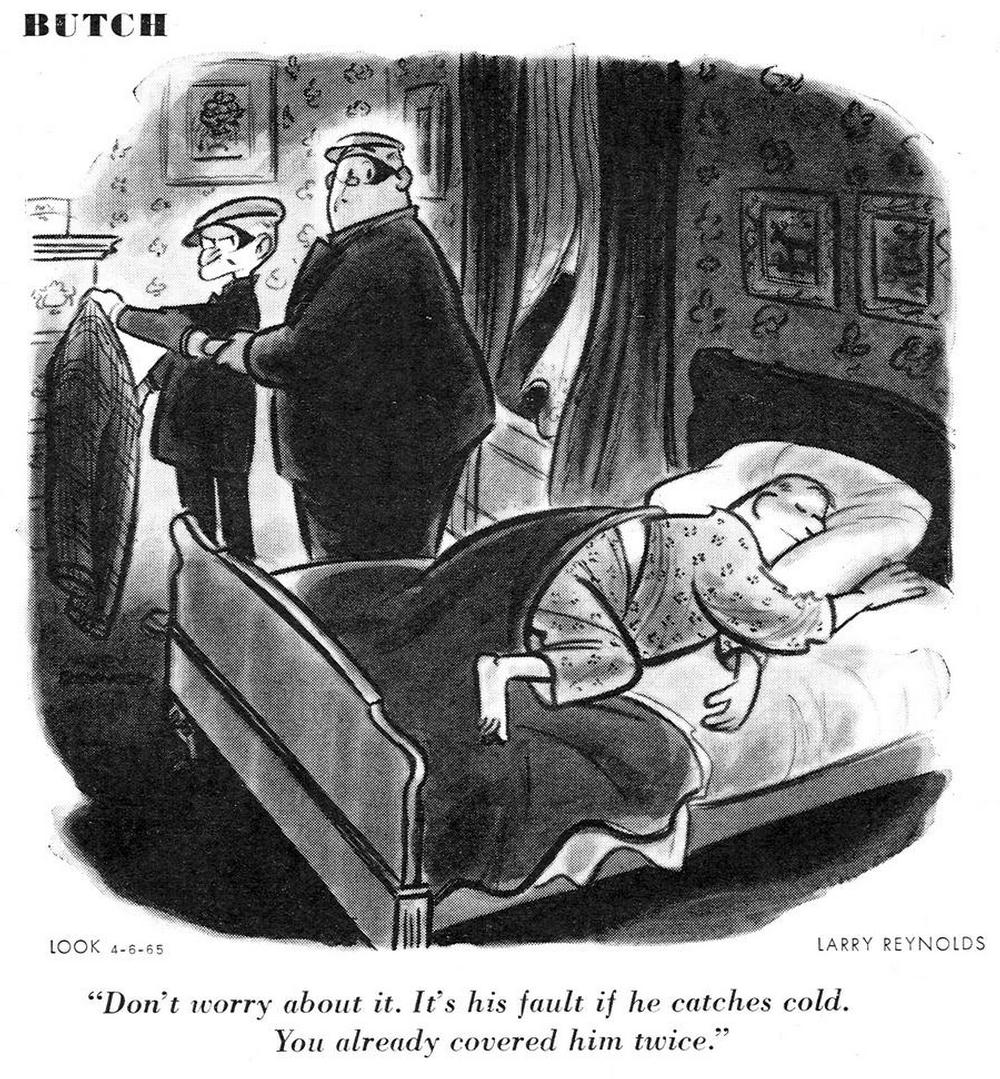
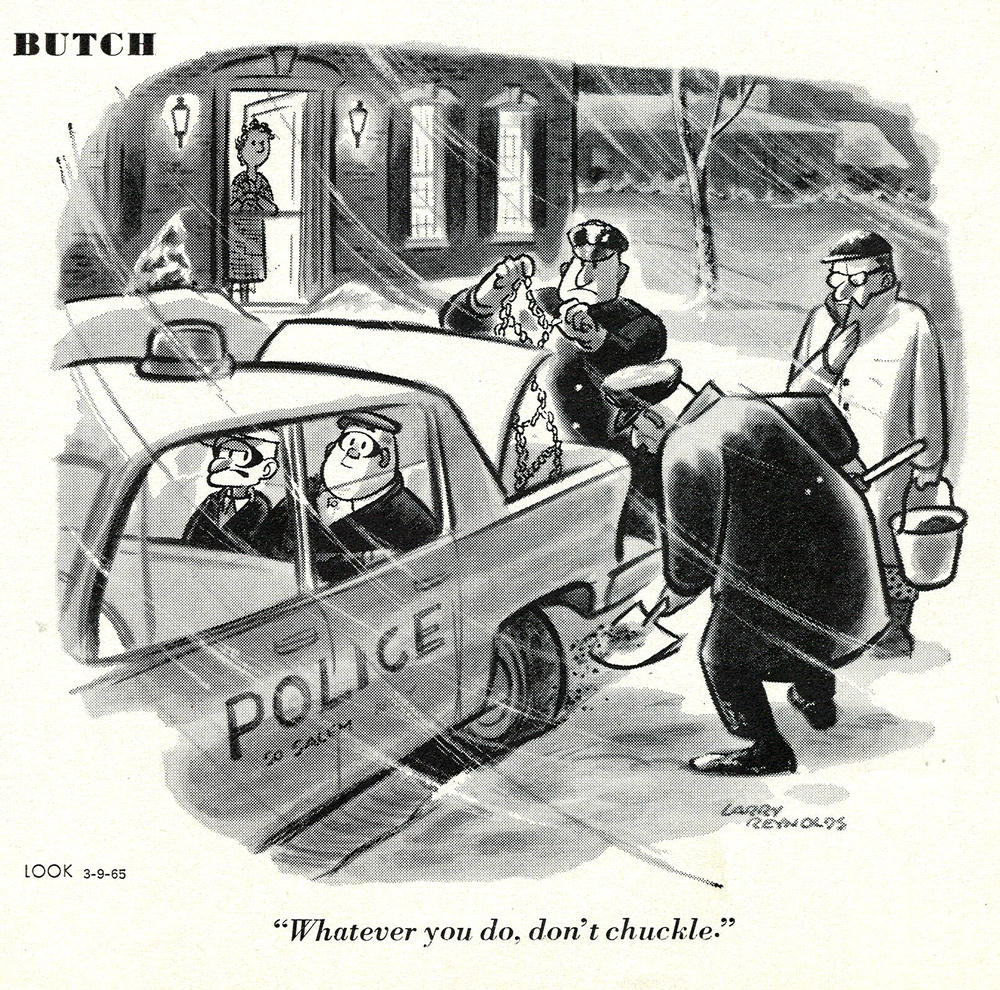
Cartoons from Look magazine...1965 and 1968

I found some 1960’s issues of Look, and just like I did as a kid when my parents’ subscription copies arrived in the mail, I turned first to the cartoons.

I recognized the familiar styles of the cartoonists. Look’s cartoon and humor editor was Gurney Williams. Williams, who had formerly been the cartoon editor for Collier’s, showed the same sharp eye for cartoons which were topical yet timeless, with an edge but without any meanness. If you are a cartoonist you can study the styles of these artists to see how a successful gag cartoon was done.


Larry Reynolds’ “Butch” panels are favorites of mine. You can find more “Butch” by going to this Hairy Green Eyeball post from 2008, with examples from Colliers in the forties.


Friday, August 29, 2014

Factoid or fictoid?

I wrote this and posted it in 2007. With some minor editing I am presenting it again.

Some time ago I got one of those e-mails that friends send. It was titled “Did You Know” and included “facts” like “Stewardesses is the longest word typed with only the left hand and lollipop with your right.”  Who figured that out, and should I believe it? I'm not going to go through the unabridged dictionary typing out words to see if I can make one with my left hand that's longer than stewardesses, so it’s basically impossible to know if it’s true or not.

Suspicious type that I am, I call little factoids like that “fictoids,” because I suspect they may be fiction.

I am willing to accept some things the e-mail says like, “A dime has 118 ridges around the edge,” or “Peanuts are one of the ingredients of dynamite,” because I believe those facts could be readily checked. I'm not going to go check them by counting the ridges on dimes or blowing myself up with dynamite to see if the taste in my mouth as I die is peanutty, but they sound reasonable. I’m less willing to accept at face value that “the average person's left hand does 56% of the typing,” or “women blink twice as much as men.” How could I check either of those? Into the suspected fictoid file they go.

One of the factoids had a familiar ring to it. “If the population of China walked past you, eight abreast, the line would never end because of the rate of reproduction.” I heard something similar over 50 years ago when I was in junior high. The teacher who said it to us had a slightly different, more ghoulish, take: “If you lined up all of the Chinese and machine-gunned them as they walked by you you'd never kill them all because they'd reproduce too fast.” Those were the years of more open and casual racism. There was the Cold War: China was Red China, Chairman Mao had his Little Red Book, and fresh in our memories was the Korean War and thousands of Chinese soldiers coming over the hills in North Korea to engage our guys in battle. My smartass classmate, Richard, piped up: “It'd be hard for them to ‘do it’ if they were walking.” The teacher looked at him for several seconds until the laughter died down. “All right, it would,” he conceded, and went on to another subject. I got a mental image of people having sex and babies while lined up, walking, waiting to be machine-gunned to death.

In 2014 I ask, was this fictoid determined before or after the Chinese adopted the one-child to a family rule? They do have a lot of people. According to no less an authority than the CIA China has a population of about 1,300,000,000 people in a land mass a little smaller than the U.S. The U.S. has a population of 300,000,000, or roughly one billion less residents. So would you be able to machine gun all of the residents of America if they’d be so dumb as to march by you and be shot, or would we be reproducing too fast, too?

Whew! That is a lot to think about from one little e-mail.

Here is another factoid I consider suspicious: “If you are an average American, in your whole life you will spend an average of six months waiting at red lights.” Awww, c’mon! If you live in Utah like I do you just blow through red lights. That could skew the averages. Over a lifetime Utahns probably only wait three months at red lights. People in Utah do not think of a red light as stop, but more like a challenge to get through an intersection without being t-boned by another car. Into that alleged fictoid file it goes.

I have no way of knowing if this is true or not (it’s the first time I've ever read it, and I’ve read a lot about Prohibition-era gangsters): “Al Capone's business card said he was a used furniture dealer.” But I like it. You could sound real smart at a party if you dropped this one into a conversation. “Well, you know,” you say grinning, slowly swirling the ice in your whiskey glass, “Al Capone’s business card said that he was a used furniture dealer.” Gasps of astonishment come from the crowd. You are suddenly the smartest guy in the room, with the most unusual and arcane trivia. Is it factoid or fictoid? You don't care. They don’t either.


Tuesday, August 26, 2014

“To kill, Drill Sergeant!” Virgil Partch military cartoons

I wrote this post in 2006, and with a couple of edits I am presenting it again.

Vip (Virgil Partch) was a cartoonist who was popular from the 1940s right up until his death in 1984. He did the “Big George” comic panel for national syndication for years, and filled up magazines with his bizarre cartoons. He was a master of grotesque line, as well as some pretty funny captions.

Last night I went through a couple of his old cartoon compilations, Water On The Brain (1945) and Armed Farces (1968). Some of Vip’s best subjects were military. I’m showing you some of my favorites.

The above cartoon reminds me of my basic training days and learning to use the bayonet. I planned on never getting that close to anyone who was trying to kill me, and especially with a bayonet. So I went through the drills half-assed. The drill sergeant had his routine down pretty well. After one ragtag attack by our platoon on the bayonet practice dummies, he screamed out, “YOU MEN DON'T LOOK LIKE YOU WANT TO KILL SOMEBODY! YOU LOOK LIKE YOU WANT TO MAKE LOVE!”

For some reason that hit me real funny and I started to snicker, then broke out into a big laugh. His response to that wasn’t to thank me for appreciating his good humor, but to put me down for 50 push-ups.

He also did a call-and-respond riff by yelling, “WHAT IS THE SPIRIT OF THE BAYONET?” and our answer back (we were coached, of course) in unison, was, “TO KILL, DRILL SERGEANT! TO KILL!” I was pissed off over the 50 push-ups. I stuck in an extra word, so what came out of my mouth was, “TO KILL THE DRILL SERGEANT! TO KILL!”

Despite Vip’s creativity, he wasn't above swiping from himself. The top cartoon is from 1945, the bottom from 1968.


The final cartoon is pure, vintage Vip. That's one tough sarge!


Monday, August 25, 2014

Orange is the new comedy?

My wife, Sally, and I are finishing up watching Orange Is the New Black on NetFlix. We think it is a great series, but the last thing we would describe it as is a comedy.

But comedy is the niche into which it fits for the benefit of the Emmy Awards.

It’s not that humor isn’t a part of the show, because there are absurdities about life in a women’s prison that make us laugh. But to call it a comedy is a misclassification. Or is it? I look at the publicity picture I took off the Internet for illustration purposes and it certainly looks like it could be a comedy. Those wacky prison gals! A barrel of laughs! That is when they’re not engaged in sex acts or violence, both of which make up other parts of the storyline.

Maybe I’m wrong, but in my mind a comedy is a half hour show where people shout lines at each other, all of them zingers (or they are supposed to be, anyway; some are better than others.) In a comedy there are quips every few seconds, and there are often laugh tracks which describe an audience reaction to hilarity I’m not seeing on my TV screen. In other words, the less funny, the louder the laugh track.

In recent episodes of Orange we have seen inmates trying to seduce other inmates into having sex as part of a game, we have inmates in a plot to smuggle contraband, we have had the main character, Piper Chapman (Taylor Schilling) transferred to a federal prison in a vain attempt to get her to testify against a drug lord. Before that Piper and another girl got into a bloody brawl that got Piper sent to the SHU (maximum security).  You know, real funny stuff!

Now that I know it is supposed to be a comedy I may actually cut loose with a laugh. If I see anything funny, that is.

On the other hand I didn’t notice any Emmy nominations for another series I watch, Sons of Anarchy, which is played so deadpan and serious that it makes me laugh. What is played as unfunny becomes just as phony as those comedies I describe.

It is in its final season, and god help me, I have watched all of them. I keep watching, hoping to see all of these serious, frowny-faced and murderous bikers meet their ends in the kinds of violent ways they dole out to others. It probably won’t happen, but I can dream.

This is a cast picture. Ron Perlman, whom you may recognize as the gray-haired actor* who played Clay, the leader of the pack, was shot and killed by his stepson, Jax, who is next to him on Clay’s left. Jax is now the president of SAMCRO (Sons of Anarchy Motorcycle Club Redwood Originals). He had the job anyway, even before assassinating Clay, because Clay was in prison. The gang is responsible for all kinds of mayhem. They ran guns too, until they got out of that business.

The fact that they do it under the noses of law enforcement and no one can seem to catch them in the act means the police in this series are Keystone Kops.

In the 1970s I worked with bikers on two separate jobs. They were not that smart. They were interested in getting loaded and riding motorcycles, and not necessarily in that order. They wore a uniform which shouted out to every cop they drove by on the streets that they were outlaws waiting to be shaken down for weapons or drugs. And they often were, as I sometimes reminded my biker colleagues. “Take off the colors (jacket) with your club name on it, and cut your hair so you look like a human being.” No chance of that...they were too proud of their outlaw associations and they paid the price.

Something that makes Sons of Anarchy seem fake to me is Jax himself. Played by actor Charlie Hunnam, his face is in a perpetual frown. Nothing good happens to him: his mom (she was once married to Clay)  is overbearing, his wife is conspiring to take his kids and make for parts unknown,he has enemies all over the place. Oh, and I watched him committing some murders last season, any one of which would get him life w/o parole or even the death penalty. No wonder he is glum. But the other thing can be seen in the picture. He wears white athletic shoes. In all my time spent around bikers I never saw one of them wearing anything but boots; motorcycle boots, heavy, with steel-toes for inflicting maximum damage during a fight. The bikers I knew would have looked at Jax and hoorawed him out of the club.

For me Sons of Anarchy is more like Sons of Absurdity.


*Also Vincent in Beauty and the Beast and Hellboy in two movies.

Monday, August 18, 2014

Gas!

Recent events in Ferguson, Missouri — protesters taking to the streets over the police shooting of an African-American man — and crowd control with tear gas, brought to mind something I wrote in 2008. My own experience with tear gas seems relevant to the situation. With some minor editing I am presenting it again.

The years 1967 and 1968 in America were years of civil rights and anti-war demonstrations. Watching old film on TV of protesters being gassed by police reminds me of an old line I used to use: I went through more tear gas than most demonstrators.

Despite the Vietnam war being current, when I took U.S. Army basic training in January, 1967 it had a definite World War I flavor. We went through an infiltration course where we came out of trenches, then crossed a simulated battlefield while live machine gun bullets were shot over our heads. I guess the Army brass figured if World War I ever came around again we’d be trained for it. We also had gas canisters thrown at us. That wasn’t the first time we'd experienced gas. Our introduction to that took most of a day. We were taken to a place on the Fort Lewis, Washington Army base with several run-down looking shacks. I also noticed a sand pit with wire stretched over the top. “That just doesn't look very good,” I thought. I was right.

I’ve pushed a lot of this unpleasant experience out of my mind over the years, but here’s what I remember. We were marched, 10 or so at a time, wearing our gas masks, into a small shack. In the air was a thick mist of CS gas, also known as tear gas. We were told, “when it's your turn, take off your mask, say your name, rank and service number, then right face, put your hand on the shoulder of the soldier next to you. When everyone has said their piece, we will march around in a circle and out the door. At any time if anyone breaks rank and runs we will all be brought back to do it again.” After taking off the mask and gasping out name, rank, and service number, then marching around the shack praying for the ordeal to end, had any one of the group run the rest of us would have killed him. We stood outside with our faces to what breeze there was, our eyes watering and stinging.

A while later we went into a chamber filled with chlorine gas. We went in without masks, and told we had nine seconds to don our masks or die. Seemed drastic to me, and I’m still not convinced that stuff was really lethal. The capper was the aforementioned sandpit. We were lined up four men abreast. We had our masks in our carriers at our sides. We low-crawled through the sand, and then a canister of vomit gas was thrown amongst us. We had a few seconds to get our masks on. Some guys tried to jump up, and that’s what the wire stretched over the pit was for. A jumper would bounce right back into the sand. Several guys — but not me — crawled to the end of the sandpit, threw off their masks and ran for the nearby woods where they heaved. Some guys vomited in their masks. Not me. I had my mask on in no time, because I was watching the sergeant’s movements as he got the canister ready to throw. I had my mask on before the first fumes hit me.

After the training we were lined up in formation to march to our barracks. I looked back and at the edge of the wood line I saw a soldier skulking through the trees. I grabbed the snaps of my mask carrier. I told the guy next to me, Porter, “Get ready, we're gonna get gassed again!” Porter looked at me stupidly, and then the canister landed right by his foot. We had been told if we saw anyone throwing gas we were to yell at the top of our lungs, “GAS!” The hell with that, I was too busy getting my mask out. Porter made no move for his mask, but I had mine on before the gas got to me. He just stood there looking dumb, and when the gas hit him he headed for the woods. It took fifteen minutes of the sergeant hollering, “Porter! Come out! Private Porter, report for formation, NOW!” before they could convince him to come out of the woods, and even then he was suspicious he’d be gassed again.

In my service time, two years in the regular Army and two weeks serving with an Enlisted Reserve unit in California 18 months after leaving Germany, I went through tear gas five times. None of the experiences were even remotely pleasant, but by the fifth time into the chamber I felt I had it down. The instructions were, “Take a deep breath, crack your mask, remove your mask, say your name, rank and service number and then walk in an orderly fashion for the door. No running.” I thought, I know this drill. But when it got to be my turn I turned things around. I cracked my mask, then took a deep breath, pulling a big load of tear gas into my lungs. What came out of my mouth was a strangled peep. The sergeant grabbed me by the arm and threw me out of the chamber.

What I learned about tear gas is that you really want to avoid it.

Sunday, August 17, 2014

The daydream believer

There are believers who appear to have no real rational reason for their beliefs. It’s some sort of internal thing with them with no apparent physical foundation on which to build a belief. They believe it, therefore it is true. I have a problem understanding that.

For instance, I don’t understand why author Philip Imbrogno, a UFO researcher, has the belief system he has. I'm left baffled after reading his 2010 book, Ultraterrestrial Contact, and his acceptance of alien contactee stories and experiences by people who, to me, are either mentally ill, on drugs, or just imaginative and skilled liars.

Imbrogno goes beyond the folklore of little bug-eyed gray men levitating unwilling subjects into flying saucers for the purpose of medical exams. He gets into stories of mystical "channeling" of alien entities (not unlike those claims some make of channeling spirits of the dead), or stories of little people and genies from mythology. He somehow connects it all with those contactee stories that have become modern folk tales.

The author goes into several stories of contactees, but I’ll only tell you about one, the story of Dean Fagerstrom. The author tells us how delightful Fagerstrom was in person, and how forthcoming he was with his stories of channeling an alien named Donestra from planet Solarian. I would think it fantasy if someone told me of a planet called “Solarian,” creating a proper noun by adding a three-letter suffix to the word “solar,” but Imbrogno doesn’t. He begins Fagerstrom’s story by saying, “Although Dean’s contacts seem to date back to his childhood . . . his adult experiences began in 1966, while he was in the army, stationed in Bad Kreuznach, Germany.”

Fagerstrom described to Imbrogno what sounds to me like a hallucination: Dean was at his desk (figuring out a system for lottery numbers (!)) when he felt a presence. He got up, didn’t find anything, sat back down at his desk. He looked at a whiteboard in front of him.

Quoting directly from the book:
“Suddenly a human-like face appeared before his eyes! The face filled up just about the entire three-foot-square board. As the image got clearer, he saw that it was not one face, but two. There was a bluish shimmer around the edges of the image, and he could now make out the face of a man, and the other of a woman. The man had shoulder-length blonde (sic) hair while the woman had slightly darker and shorter hair. Both had what Dean described as ‘piercing blue eyes.’ . . . The male gave his name as ‘Donestra’ and the female gave her name as ‘Kilestra,’ Donestra’s wife.”
Apparently Donestra and Kilestra are beings who have ascended to a higher plane of existence. Donestra has been receiving Dean’s thoughts “for years.” The story goes on to tell how Donestra gave Dean a sign a few days later, when Dean saw a UFO performing maneuvers in the sky. Dean was discharged from the army and went to live in Brewster, New York. There he had yet another encounter:
“[Fagerstrom] woke up that morning and saw a bluish shimmer in the upper corner of the room. He also heard a high-frequency buzzing sound that vibrated his head and made him feel uneasy. Gradually, an object about three inches in diameter materialized in the location of the blue light. The object was round and metallic-looking, and resembled an old-fashioned microphone.”
The object moved toward him, and hovered about ten inches from Fagerstrom’s forehead. It emitted a sound that “oscillated at a very high frequency,” and then “the probe came to within three inches of his forehead and emitted a very intense vibration that shook his head and neck . . . The object then went quiet and vanished right before his eyes.”

The next day Dean went to an art store and bought some supplies, went home and drew these “designs” for unknown devices, apparently inspired by his channeled source.


 A couple of the drawings by Fagerstrom. They have a certain phallic look to them, but that would be coincidental, wouldn’t it?

So far, the people who’ve seen them haven’t been able to figure out what they are, although they praise the drawings.
“As the years passed, Dean continued his contact with Donestra, resulting in him writing three unpublished five-hundred-page manuscripts: The Book of Solarian, The Celestial Citizen, and an untitled one.”
Those manuscripts, including Imbrogno’s copies, mysteriously disappeared. Robbing us of Donestra/Fagerstrom’s cosmic wisdom, no doubt.

Fagerstrom even met another ascended entity, “Aphax,” who was “once a priest who taught philosophy and math in ancient Thebes in 2334 B.C.E.”

There is a lot more claimed by the author, including Fagerstrom’s ability to play piano and compose melodies like Franz Liszt. Dean is extremely lucky with lotteries (remember that lottery system he was working on in Germany, when he was contacted by Donestra?), but to bring this chapter to an end, Imbrogno says:
“I stayed in touch with Dean until 2007, when he fell ill and had to be hospitalized. He’s now in a specialized facility that provides the care he needs. Dean’s legacy is still with us, and if I had to pick one case that convinced me about the possibility of extraterrestrial contacts, it would be the incredible experiences of Mr. J. Dean Fagerstrom.”
The word “incredible” I translate as “beyond credibility.” I don’t know either Fagerstrom or Imbrogno, but Fagerstrom seems either delusional or a liar, and Imbrogno…well, I see him as being conned, perhaps due to a need to believe such fabulist tales. After years of working toward solving the “mystery” of alien contact and abduction, I think Mr. Imbrogno seems at a point where even the most fantastic tale from someone’s head is reasonable to him.

LSD was available in 1966 when Fagerstrom was in the army in Germany. I was familiar with it and a lot of other drugs being used by GIs in 1966-68 during my own time in the U.S. Army. (I spent 18 months serving in Germany during that period. In the interest of disclosure, I’ve never taken any of those drugs. I figured I had enough problems without altering my consciousness.) There’s no indication by Imbrogno that Dean took drugs, but his experience with the faces on the whiteboard sounds a lot like it.

Fagerstrom’s vision of Donestra having long blond hair echoes the stories of 1950’s flying saucer hoaxer George Adamski,* of an alien named Orthon. Adamski described him as “medium height . . . with long blond hair and tanned skin,” a 1950’s look at a surfer dude of a few years hence. I have a feeling that rather than there being a race of Nordic-like alien blonds, that Fagerstrom was more likely channeling fellow conman Adamski, who had published a couple of best selling books before his death in 1965.

I believe people in the mental health profession would have some questions to ask Dean Fagerstrom. What were those “contacts [that] date back to his childhood”? Did Dean “see” invisible people, did they come out of his closet at night, or from under his bed, or have the ability to float through walls and take him to the mothership?

What is the “specialized facility” where Dean is (presumably still) living? My mother had dementia, and saw people who weren’t there. I got several excited calls from her, including a couple where she told me of children she didn’t know playing in her living room. She left the room and came back, and the children had vanished. If my mother had read flying saucer/contactee/alien abduction literature would the children she saw have been little gray men? My mother also spent her last years in a “specialized facility” (an Alzheimer’s nursing home). There are a lot of things that can go on in the brain that cause people to see and experience incredible things. To me it explains the story of Dean Fagerstrom. Philip J. Imbrogno has more of these tales of contactees and he tells them straight-faced, without delving into any other possible mental conditions the contactee may have, or even a motive for telling such tall tales.

Imbrogno’s book, Ultraterrestrial Contact, is available from Amazon.com and other booksellers. I don’t believe a word of it, but in its own oddball way it’s an entertaining read.

*There’s more about Adamski here.

Thursday, August 07, 2014

Time travel that goes nowhere

I’m a skeptic by nature and don’t believe anything but what I can see or can be demonstrated. Even so I sometimes enjoy those programs that proliferate on cable TV promoting searches for Bigfoot, or the “truth” about UFOs. I think of them as fantasy. But with the earnestness and drama of the presentation, in their own way they can be entertaining.

Take Unsealed Conspiracy Files, ten episodes of which are currently on Netflix. The shows, which are only 18 minutes long, cover a lot of ground in a short period of time. They have elements typical to all of these programs of the paranormal, a deep-voiced narrator, and talking heads from various areas of “expertise” in the subject matter. And, of course, some outrageous claims.

The program on time travel caught my attention. I love a good time machine story, which has been a staple of science fiction since H.G. Wells published The Time Machine in 1895. The Unsealed Conspiracy Files episode begins with a photograph of the South Fork Bridge opening in Gold Bridge, B.C. in 1941. The Canadian government released the photo as part of an archival web site and according to the Unsealed narration it went viral. Apparently people thought one fellow looked too modern to be from 1941.(1)

The comments are about his hair, his clothes, sunglasses, and what looks like a digital camera in his hand.

 My apologies. I took photos with my own digital camera from the TV screen.


I’ve heard outrageous claims about other “time travelers” who show up in old photos, and in order to accept them you would have to accept that time travel exists. I think it is easier to accept that the above photo is what it purports to be: a group of people from 1941, not from 2014 or 3000 A.D. or some other year along the time continuum. Applying what I learned from Occam’s Razor, if I have a choice of believing that time travel exists and this guy was visiting the past, or that this guy, modern as he may look, was just a bystander in 1941 at a bridge opening and not a time traveler, then I choose the latter.(2)

John Greenewald Jr, whose bona fides are apparently that he has a web site,(3) talks about things like the butterfly effect, (a small change somewhere back in time that could have big consequences for the present and future), and also warns that someone going back before humans appeared on earth could make changes that would mean human beings might never exist. Horrors!

Frankly, if someone erased our DNA by killing our non-human ancestors,  humans never existed and we were never here. All our works and technology would never happen, and our planet would be in a completely natural state. But the kicker  is we wouldn’t know because there were never any human beings. So John needs to stop worrying. If someone does just what he prophesies then he won’t feel a thing when we all blink out, because we were never here. (Time paradoxes can drive you crazy when you think of them.)

But, back to the program. A real howler is this picture of a youngster, taken at Gettysburg, supposedly during Lincoln’s address. Seattle attorney Andrew Basiago claims this is a picture of him. He says he has been a time traveler since he was a child. As unlikely as that sounds — why would a black operation like a time travel program send a child? — the credibility really goes out the window when we see that the photo has no face. In those days, with long exposure times for photographs, a turning face blurred, and that is what happened here. Sorry, Andrew. I don’t buy your claim.

So who made time travel possible? Why, the Nazis of course. We can give the Nazis and Hitler credit because they were developing secret weapons to win the war. (P.S., they lost.) Amongst those weapons was one called The Bell (Die Glocke), which could travel in time. This is one of those stories that when started caught the attention of UFO and black ops-conspiracy true believers and has taken on a life of its own. Wikipedia has a concise article on Die Glocke which explains more.

This is a fanciful image of The Bell done with special effects for the program. Some people might believe the show’s producers got film of the actual machine.

 The show did not miss an opportunity to show a photo of Hitler to remind their viewers who might be weak on history that it was Hitler who ordered all of this special weaponry to be developed.

I wasn’t surprised to see William J. Birnes show up to give an opinion on the whole matter. Birnes, who has a Ph.D in medieval literature, would seem a natural to speak of time travel to the past. But it has more to do with his visibility as some sort of expert on UFOs. Birnes is not camera shy. He has a way of finding his way onto television programs that even touch on the subject.

Birnes ties in the story of the Nazi Bell with an event that happened in Kecksburg, Pennsylvania, in 1965. A fireball crash landed near that town. Some witnesses reported it was bell shaped. Birnes merges the two stories. Die Glocke left Nazi Germany in 1945 and showed up 20 years later in Pennsylvania! Wow. The U.S. military showed up, put it on the back of a truck, threw a tarp over it, and hauled it away, never to be seen by the eyes of citizens again.(4)

On its own the Kecksburg incident is a good story, and has an essential element, witnesses who are still alive to talk about it. But is the bell the U.S. forces retrieved the Nazi Bell? Adding that bit of conjecture makes it an even better story, much more exciting.

Conspiracy theories can be interesting, and at times even make some sense. But they can also pile delusion upon delusion. It is an illusory correlation when people falsely perceive an association between two events or situations. If you begin with a shaky premise you believe, an unproven theory  based on wild rumors that time travel exists and that knowledge is kept from us by a super-secretive government, and you extrapolate from that, you have a hell of a story. It doesn’t make it true, it just embellishes the fable on which it is based.

(1) Website with pros and cons on the photo.

(2) From the Wikipedia article on Occam's (aka Ockham’s) Razor: “If we have multiple hypotheses that can explain a thing, we ought to reject the hypothesis that involves agents or processes for which we have no evidence.”

(3) TheBlackVault

(4) Article on the Kecksburg Incident.