Saturday, March 30, 2013

“Behold his mighty hand!” The Ten Commandments on TV again

The annual television showing of The Ten Commandments is tonight on ABC-TV.

Director-showman Cecil B. DeMille made the Charlton Heston-as-Moses version of The Ten Commandments in the early fifties. Heston was only thirty when he started work on the film, and the makeup people did a good job turning him from a strapping young prince into an old, bearded prophet. I’ll bet when a lot of people for whom The Ten Commandments is an annual must-see television event think of Moses and the story of Passover and the Exodus, they picture Heston. The word “iconic” is seriously overused, but here seems fitting.

An early publicity photo of Heston in makeup.

I call The Ten Commandments a silent movie with sound. DeMille directed the actors to emote to the back rows, just as silent movie actors would have done. But in this case he had the luxury of sound (not to mention widescreen and Technicolor®). In their cases, Yul Brynner as Rameses II and Heston seem hammy, but in their other movie roles they were often portrayed as larger-than-life. For the era I can’t think of two other actors who could have played the parts.

Publicity photo of Brynner and Anne Baxter.

The movie enjoyed a publicity heyday in its time. It was considered a major event. Life had an article in its November 12, 1956 issue.

Copyright © 1956, 2013 Time-Life


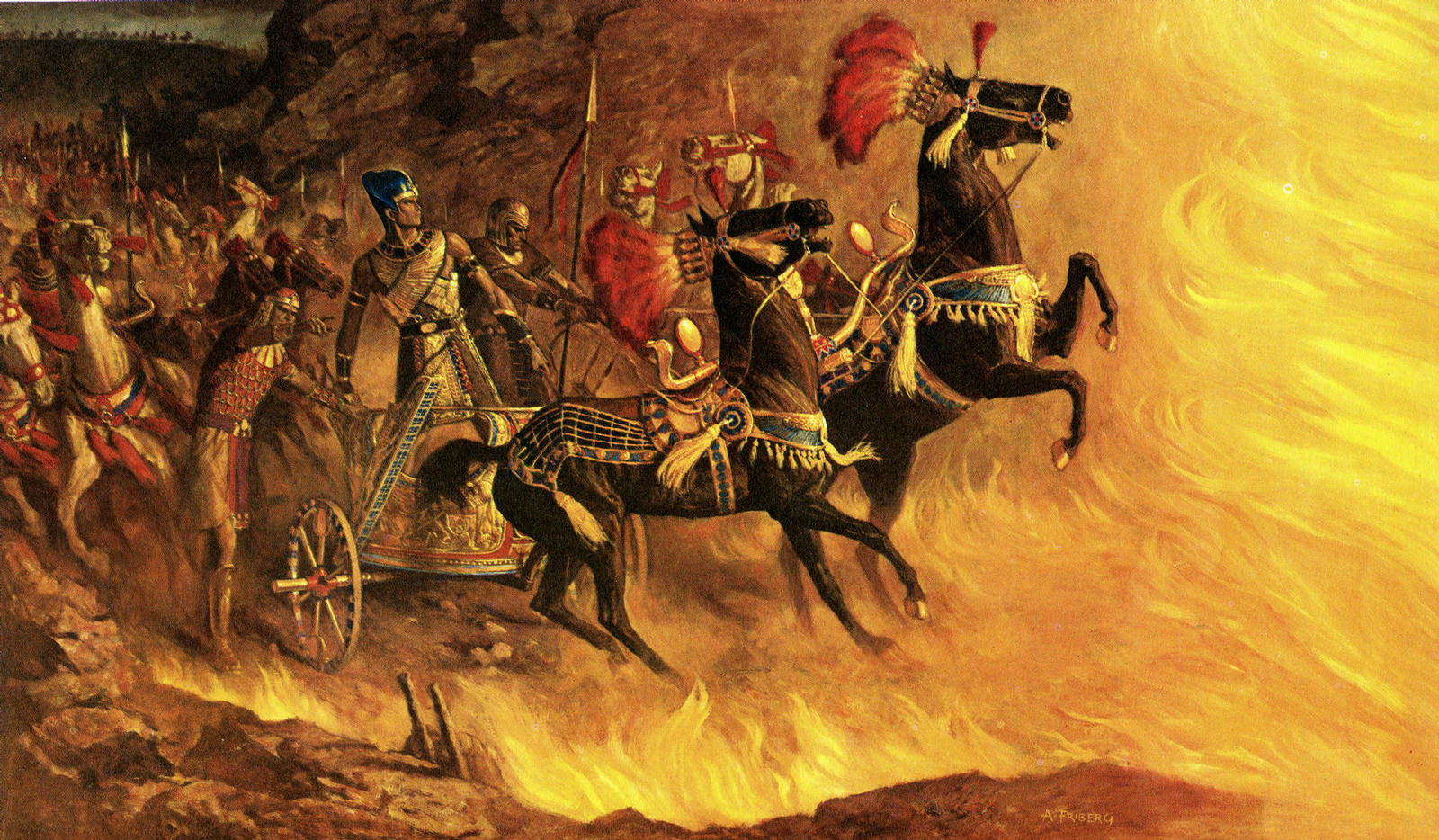
Dad took the whole family to see The Ten Commandments in 1956. He got us tickets to an event before the movie featuring artist Arnold Friberg, who did the magnificent paintings that DeMille commissioned to accompany the film. I shook hands with Friberg in a reception where the original paintings were on display, and I remember my nine-year-old eyes as big as pie plates when I gawped at the absolute splendor of Friberg’s art.

Friberg (1913-2010), a Mormon convert, was into that sort of Biblical art. Like DeMille, who used film as his art form, Friberg used heroic characters, painted in heroic proportions, to give his artwork life.

These paintings are from the program book which Dad bought right from Friberg for a dollar. I remember him as being star struck by Friberg, and as goggle-eyed as me at the paintings. The art is slightly too big for my scanner so the illustrations are trimmed about ½” on each side, but the important stuff is shown.




The History Channel has been running a series called The Bible, which has been a huge ratings hit. It’s so successful that I heard more Bible movies are being planned. To me, if people who really get into these movies are like my father, they are using them as a way of substituting for church. Hollywood is the preacher  telling them what to think when they think of Noah, or Jesus, or Moses. Dad never went to church a Sunday in his life, but we never missed a big blockbuster movie based on a Bible story.

Wednesday, March 27, 2013

Futurecast from the futurepast

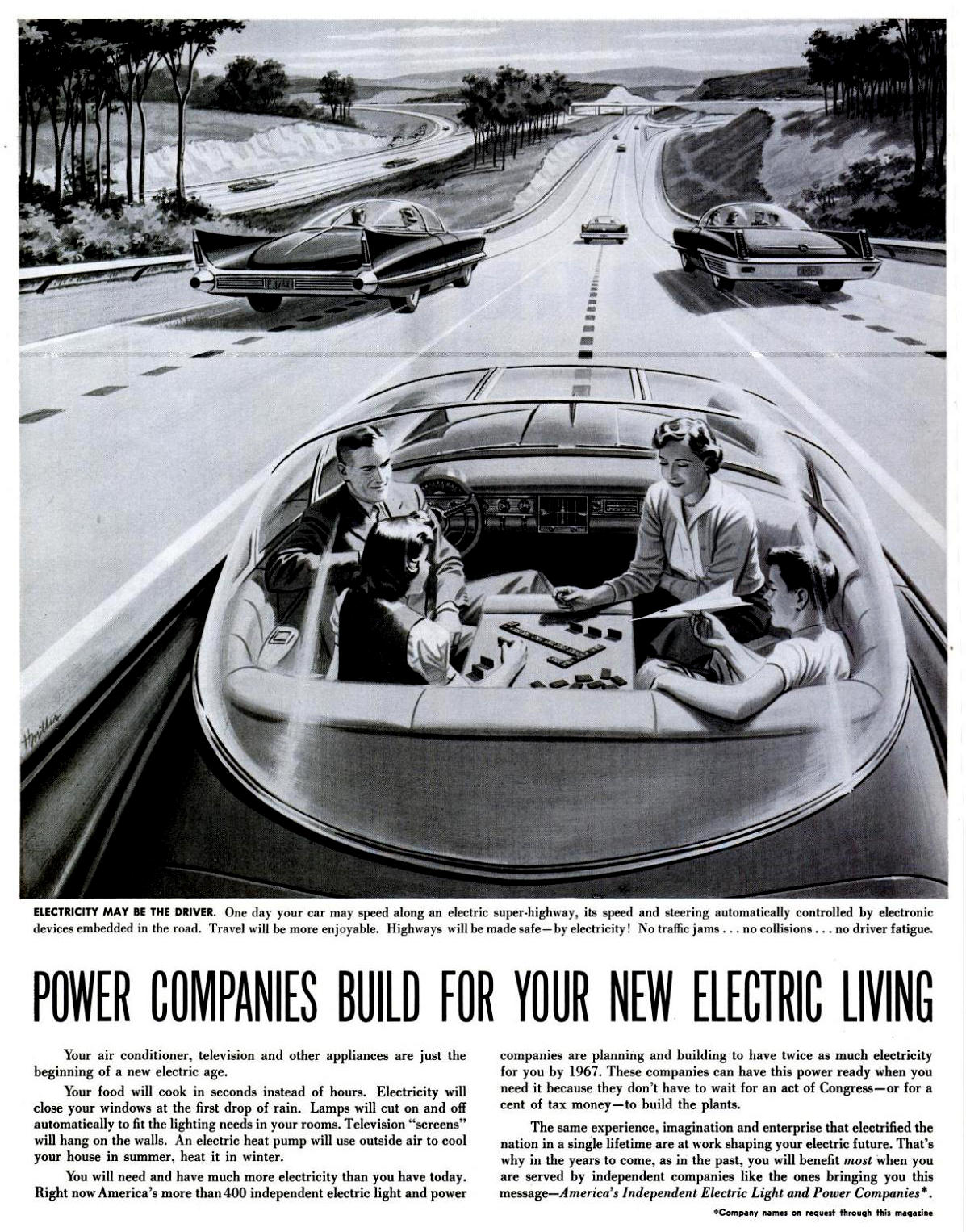
“Your food will cook in seconds instead of hours. Lamps will cut on and off automatically to fit the lighting needs in your rooms. Television ‘screens’ will hang on the walls.” These are predictions made in 1957 for America’s Independent Electric Light and Power Companies. Not bad. The main prediction, the one promised in the illustration  of cars driving themselves on freeways thanks to electricity  has not happened. Yet.

I enjoy looking at the future through the imaginations of people during a long-ago past. Just because it hasn’t turned out exactly as it did in the ad doesn’t mean some form of it won’t happen at some point. My favorite example of a prediction that came true in a form totally un-imagined at the time, is the picture-phone. For years we were promised we’d be able to see the person we were talking to on the telephone. The “examples” of this technology (2001: A Space Odyssey is a good one) showed a standard telephone with a video screen. That never really took off with consumers. But the Internet and cell phones did, and they make that sort of communication possible. When the Bell Telephone people imagined it many years ago they built on what technology already existed.

So it is with these finned behemoths motoring, driverless, on down some nearly empty freeway of the future. The artist built on what was known at the time. At the time the Interstate Highway System was still in the planning stages, with construction nearly a decade in the future.

A dirty fact not mentioned in this ad, which also predicts “twice as much electricity . . . in 1967,” is that most electric plants are fueled by coal. Yes, the prediction of more electricity has come true, but we have paid a very high price for it.

Tuesday, March 26, 2013

GOP: Putting lipstick on a shark

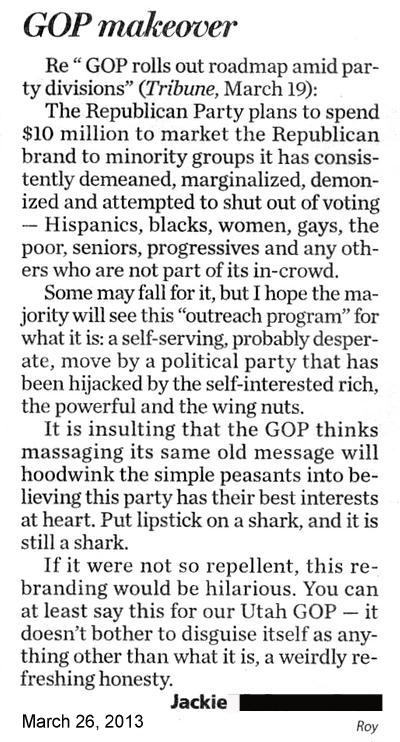
A couple of letters to the editor in my local newspaper today caught my eye. Interestingly, the second letter seems to answer the first.

Kathy, who wrote the first letter, seems to think that winning elections is secondary to keeping one’s core values. I agree with her. I figure the more Republicans like Kathy who hew to the party line and don’t try to change their party the better it will be for us Democrats.


On the other hand, Jackie, author of the second letter, believes that those GOP plans to change their party will fail because the people they are trying to reach have been “consistently demeaned, marginalized, demonized and attempted to shut out of voting.” Right on, Jackie! Your thinking is straight. Your letter makes it unnecessary for me to answer Kathy’s letter with one of my own.


Monday, March 25, 2013

Li’l Abner gets musi-gal

This Life article from January 14, 1957, is about the Broadway musical created from the comic strip, Li’l Abner. Al Capp’s creation was a gen-yoo-wine cultural phenom in its time. It had millions of readers and the running gags, like “Sadie Hawkins Day,” became part of the American consciousness.

The strip shut down in 1977 because of Capp's illness. He died in 1979.

The musical, made into a movie in 1959, is rated 6.6 out of 10 on the Internet Movie Database (imdb.com), and I recall seeing it at the time but don’t remember much about it. In checking on the IMDb listing I see in the article that the part of Daisy Mae, as played on Broadway by Edie Adams, was taken over for the movie by Leslie Parrish. Nothing against Leslie, but I would have loved to have seen Edie on the big screen. Likewise, Tina Louise (Ginger!) who had played Appassianota Von Climax (!!) on stage was replaced by Stella Stevens.

Luckily for us, Julie Newmar, just a few years away from her stint as Catwoman on the Batman TV series, was Stupefyin’ Jones on Broadway and in the movie. As you can see by the YouTube video after the article, she was probably the only actress in the world for whom the part could be said to have been perfectly made. Stupefy she is supposed to do, and stupefy she does.

Copyright © 1957, 2013 Time-Life


My standard disclaimer for the video. If the screen is black it has been removed by YouTube, not by me.


Thursday, March 21, 2013

Goodbye Harry Reems

Harry Reems was a broken down alcoholic when he landed in Park City, Utah. He had been living in a dumpster behind an Albertsons store. In Park City he went to AA meetings, then joined a Methodist Church congregation, and got a job as a real estate broker. He got sober, got religion and cleaned up, but no matter how he changed his personal life he never shook off his image as the (in)famous male porn star of the most groundbreaking porno film of all time, Deep Throat, which also gave notoriety to its female lead, Linda Lovelace.

At one point in the seventies Harry was arrested and charged in Memphis, Tennessee with obscenity for conspiring to take Deep Throat over state lines. All he did, really, was act in porno movies, so eventually all charges were dropped. A lot of people may not like it, but in this country it isn’t illegal to have sex in a movie with a consenting person of legal age, and Reems’ case was the first and last time, to my knowledge, a man was charged with a crime for doing so.


For the record, I’ve never seen Harry Reems do his “acting.” In order to see a triple-X movie in the seventies one had to go to a theater, and there weren’t any in Utah. When video tapes came out, when DVDs began to be produced, and let’s not forget the motherlode of pornography, the Internet, made porn part of everyday life, Harry Reems and his type of stardom seemed out of place. How many male porn stars can you name, really? Offhand I can think of Ron Jeremy and Peter North…and Harry Reems. Harry Reems (and actually any male who has a name in porno) is an anomaly. We know people watch porn to see women. The guys are easily replaceable, even by vibrators.

Reems claimed he had a “PG body.” You can see in the above photo of him he was slim and hairy. Nowadays male porn performers (I hesitate to call them actors) shave their body hair, and work out in the gym about five hours a day.

I like Reems’ mustache, and in some circles that is now known as a pornstar mustache, in memory of those guys of Reems’ era who sported disco hairdos and handlebar mustaches. I wish I could grow one of those. Not to be a pornstar, mind you, but because I like the way it looks.

Harry died yesterday at age 65. He had been diagnosed with pancreatic cancer last summer. He died at the VA Hospital in Salt Lake City, because at one time in his life he had been a U.S. Marine.

Harry was born Herbert Streicher in the Bronx, New York, in 1947. Since I am a Utah resident, after reading a  newspaper article in 1992 about Harry Reems residing in Utah I wondered what it was about our state that drew him. Then I realized that Park City, where he lived, isn’t really Utah. It’s an island in the middle of Mormon country where movie stars come to visit, and sometimes live, where CEOs and captains of industry own summer and winter ski-vacation homes. It’s the home of the Sundance Film Festival, created by Robert Redford. It’s a resort, and a nice one at that. Now along with its other distinctions it can be known as the place where Harry Reems, in pornstar retirement, lived and died.


Wednesday, March 20, 2013

Twinkies resurrection

According to an article credited to Combined News Services, a bankruptcy judge has awarded two investment companies the right to make Hostess Twinkies.

The article says, “Hostess Brands Inc. is selling Twinkies, Ding Dongs, Ho Hos and other brands to Apollo Global Management and Metropoulos & Co. for $410 million. Evan Metropolous . . . said he wants to have the snack cakes back on shelves this year . . . Hostess closed its factories in late November after a strike by the union. The company had been struggling financially for years.”

I haven’t had a Hostess Twinkie in years, but I still remember the texture and taste, even the taste of the cream filling. There may be hundreds of thousands of Twinkie junkies right now who have gone through serious withdrawals since their favorite snack food was taken off the market. They may be rejoicing right now at the news that Twinkies will return.


Ah, but I have a suspicion that when Twinkies do return, no matter how they are touted to be exactly like the original Twinkie snack cakes, that many jonesing Twinkies lovers will cry foul, that the new Twinkies don’t taste like the old Twinkies!

I believe that even if the original recipe is followed to the letter, and produced by the same production people rehired by the companies taking over former Hostess bakeries, that some customers will say the “new” Twinkies do not taste like the “old” Twinkies. I think it has something to do with a trick of memory, or even the cliché, expectation is greater than realization.

We all remember Coca-Cola replacing their original Coke with New Coke to much fanfare in 1985, and then the complaints came rolling in that customers wanted their old Coke back. Coke did something they hadn’t planned to do. They came out with “Classic Coke” and even then Coke fiends screamed. The Classic Coke did not taste like their original Coke, they claimed, even though the company said it was the same formula.*


New Coke went away after a while. The whole thing is now considered one of the most ill-advised corporate blunders in merchandising history, right up there with the Ford Edsel. Maybe those same people who felt cheated of their “real” Coke will be the same ones screaming for their “real” Twinkies.

*A mistake made when re-introducing the original formula was that bottlers used high fructose corn syrup, which is cheaper than cane sugar, an ingredient of the original Coke formula.

Tuesday, March 19, 2013

Fred Allen, vaudeville and vanished fame

In his day Fred Allen was probably one of the most famous people in America. He had a popular radio program, Allen’s Alley, and millions of people listened to him. His nasally voice was as familiar as any movie star or U.S. president. Nowadays I’d be safe in betting that if asked, very few people would know who Fred Allen was, or what he did to make him famous.

It’s the way of fame: Each generation builds on the talents of the last, developing its own stars and celebrities. Short attention spans cause us to forget the past. So it is with Fred Allen, apparently. He died in 1956. His autobiography, Much Ado About Me, was published posthumously. This chapter, excerpted from the book for the November 12, 1956 issue of Life magazine, is about vaudeville, by 1956 nearly as vanished in public consciousness as Allen is now. It was during those years, touring with vaudeville troupes from city to city that Allen honed his act, and from whose ranks many of the most popular entertainers of the 20th Century came. 

Some of Fred Allen’s radio shows can be heard on the Internet Archive.

Copyright © 1956, 2013 Time-Life


In 1956 comedian Phil Silvers was popular as Sgt. Ernie Bilko on the TV sitcom, You’ll Never Get Rich, aka The Phil Silvers Show. These ads for Camel cigarettes, which came out the same year, use Silvers and the cast to sell smokes. Silvers, and actor Maurice Gosfield, who played fat, dumb Private Duane Doberman, were as famous as anyone in America at the time.


Friday, March 15, 2013

What is there to read around here...?

I’ve had a tough couple of weeks. My knee, which I damaged somehow before going to Los Angeles, got swollen and painful from doing a lot of walking during my time in Southern California. I’ve had an off-and-on complaint since I got back; some days are worse than others. For the past couple of days it has been painful to even sit upright and work at my keyboard.

To pass the time I usually just go to my reading material. I always have a bunch of books and magazines I haven’t had the time to crack. Enforced idleness is a good excuse to read, even if it includes positioning an icebag around my knee before opening a book.


Author Andre Norton was born Alice Mary North in 1912. She died at age 93 in 2005. She chose a gender-neutral pseudonym because when she began writing science fiction and fantasy it was a male genre. She began her writing career in Cleveland, Ohio, and before 1950 worked for the library system in that city.

Stand To Horse, a 1956 novel of a U.S. cavalry unit in New Mexico just before the Civil War, is the type of novel not usually associated with Norton, but like her fantasy and science fiction is full of action. A group of soldiers pursuing renegade Apaches become the hunted. It was written for young readers but is of interest to anyone who likes Westerns, or cavalry, or stories of America’s wild frontier. Norton researched it by going to old journals and contemporary accounts of the time.

I checked and the book is available for Kindle right now at $3.99. One seller has listed the paperback edition I bought for 50¢ in a thrift store at $192 (!) on Amazon (good luck on getting your price, seller). Another seller has a hardback edition for sale at a much more reasonable price.

A library book sale got me this book about the self-promoting showman, P.T. Barnum, which includes the information that Barnum was his own top attraction.


Bennett Cerf, who wrote a series of books over several years with funny anecdotes about the celebrities and politicians of the era, published The Life of the Party in 1956. I found this first edition at another thrift store.


Besides Cerf’s witty writing, it is illustrated by one of the top cartoonists of the era, Carl Rose.


I haven’t yet read this edition of She by H. Rider Haggard. I like Haggard, but I keep putting novels by him at the bottom of the stack. I assume I’ll get to it someday.


Perry Mason books by Erle Stanley Gardner are like popcorn for me. They are so entertaining I can read two or three of them in a row, as I did with these two.


There are magazines stacking up, waiting to be read. These two issues of  the art magazine, Juxtapoz, are library copies. I was happy when my library subscribed. A good use of taxpayer money, and I’m not being sarcastic. Someone at my county library system is really sharp, and their purchases belie the fact we are in one of the most conservative states in America.


And then there is The New Yorker. Not only am I unable to keep up with the new issues, I buy old issues at thrift stores, and get behind on them, too.

The Barry Blitt cover of the retired Pope Benedict is funny.


I grabbed this 2003 issue with its Gary Larson cover as soon as I saw it. It is a cartoon issue, something that used to be an annual event, but along with the yearly fiction issues, something I haven’t seen in a while.


The issue features this funny story by cartoonist Roz Chast. My wife spent last weekend in Vegas with her niece, who was celebrating her 25th birthday. She didn’t report any experiences like these, although the two of them saw the sights, and more important, did no gambling.


Monday, March 11, 2013

Two days, two obituaries

Over the weekend I saw obituaries of two men I briefly worked with in the 1970s.

I met them both at the school district warehouse where I worked at the time. Mike I met first, in 1976. I worked with him for a couple of months. He was just out of the Army after having a career that had lasted since the Korean War. He had told us he was just waiting until the Postal Service took him on. Sure enough, he got the call and went to work for the USPS, never to be seen again by me until his obituary appeared. I notice it says he spent 18½ years as a letter carrier.

The other, Bernie, I met when he was hired to be our supervisor. I believe Bernie had a problem with supervising guys in their twenties, which is what we all were in those days. Being young we were profane. Bernie was a religious person, as it says in his obituary. I thought he was a churchgoing person at the time, based on his reaction to said profanity. Bernie was memorable to me because he got the supervisor job I had applied for and I was somewhat indignant at being assigned to train him. He only worked for three days before quitting. He walked off the job, probably because our lack of civility offended him.

There may not have been another person like me who saw both of these obituaries, whose path both of those men crossed. Of the hundreds of people I worked with in my 45 years on various jobs, these two, whom I worked with very briefly decades ago, stuck out in my mind. Then I saw their obituaries at the same time. I take note of coincidences when they happen.