Friday, October 19, 2012
“…it’s all about those sonsabitches with all the riches…”
The campaign for president of the United States is fast coming to a close. Not fast enough for me. The steady and relentless coverage of this campaign has apparently deadened the senses of the electorate. The polls have shifted in Mitt Romney’s favor for reasons unclear to me. It’s as if those remarks he made to a bunch of filthy rich contributors about the “47% who depend on government” didn’t register with the public, or if they did, have been forgiven. American voters have short attention spans, not to mention selective memories. They are also suckers for slick con men.
My fellow Americans, to me the 2012 presidential election boils down to one thing: the Republicans wish to keep a status quo that ensures that the richest Americans will keep all their wealth and pay less in taxes than the rest of us. We will continue to support their privileged lifestyles by taking cuts in our social safety nets, including Social Security and Medicare. But do voters, even voters in my Social Security and Medicare-receiving age group, care? Judging by a surge in the polls for Romney, I guess not.
I can’t be the lone voice crying out in the wilderness of this election. Surely many others my age — and those who will one day be my age — do not think it is okay for the gilded group to sit inside their mansions bought with money gained through unfair tax rates, while we hoi polloi, our entitlements taken from us, stand outside with hats in hand and faces pressed against the iron bars of the fences that separate us.
If there are those who feel the same as me, then why is there not a roar, a deafening, ear-splitting scream of outrage coming from the 99% of the citizens of our nation to hold the bastards upside down and shake them until their fair share falls out of their pockets? I’m afraid that if any million-billion-or-zillionaires are at this moment shaking in their shoes in fear of their favored tax status being extinguished if their pal Mitt doesn’t take the oath of office, then with his election they will suddenly relax and settle back into their leather armchairs, snapping their fingers at their servants to bring them a mai tai. Perhaps, in some extreme and condescending way, they will drink to the damned dumb lumpen masses who have given them a fresh chance to enjoy a life of luxury, free from care for at least another election cycle.
What we should be doing is attending Mitt Romney rallies with a fury, like villagers waving torches at the castle of Frankenstein. We should not be placidly standing by, then voting for a man whose whole life has been one of extreme privilege, and who has nothing to give the American people but another four years of Reaganomics. They didn’t work thirty years ago, and sure as hell won’t work now. It will just further divide the 1% from the 99%.
Wednesday, October 17, 2012
Happy birthday, Michael McKean
Michael McKean is 65 today. Here are some clips* with him singing lead from the brilliant mockumentary, This Is Spinal Tap.
“Gimme Some Money” by the Thamesmen:
“Listen to the Flower People” by Spinal Tap
“Big Bottoms” by Spinal Tap
Happy birthday, Michael!
*My standard disclaimer: If you find a black screen and no video it’s because YouTube pulled it. It’s their fault, not mine.
“Gimme Some Money” by the Thamesmen:
“Listen to the Flower People” by Spinal Tap
“Big Bottoms” by Spinal Tap
Happy birthday, Michael!
*My standard disclaimer: If you find a black screen and no video it’s because YouTube pulled it. It’s their fault, not mine.
Tuesday, October 16, 2012
JFK and Jackie: a bright spotlight and a long shadow
On a September day in 1953, John F. Kennedy, former two-term congressman, and at the time of his wedding a first term U.S. Senator, married Jacqueline Bouvier. It was the society event of the season, if not the year.
As the story states, “600 diplomats, senators and social figures,” and “2,000 society fans,” who had rolled up in chartered buses to see what they could, added to “900 guests at the reception,” made for a huge event. The grand affair garnered a story in the September 28, 1953 issue of Life.
Just nine years later President Kennedy stood on the precipice of nuclear war with what is now called the Cuban Missile Crisis. The threat was real, and the stakes were high. A year after that he was killed in Dallas, and from that moment on everything his wife and family did was news, fed in near daily doses to a never satiated public.
John F. Kennedy was a special person and will be remembered by future generations of Americans. Sometimes a story like this, which was probably something Life editors thought of as human interest, or maybe just a frou-frou type of thing: millionaire former playboy, now senator, marries high society gal, has a short life span, forgotten by the next issue.
But now, when we know what is to come, the story has additional meaning. It has that air of drama not then foreseen, and a long, long shadow that falls over the events of a decade hence.
As the story states, “600 diplomats, senators and social figures,” and “2,000 society fans,” who had rolled up in chartered buses to see what they could, added to “900 guests at the reception,” made for a huge event. The grand affair garnered a story in the September 28, 1953 issue of Life.
Just nine years later President Kennedy stood on the precipice of nuclear war with what is now called the Cuban Missile Crisis. The threat was real, and the stakes were high. A year after that he was killed in Dallas, and from that moment on everything his wife and family did was news, fed in near daily doses to a never satiated public.
John F. Kennedy was a special person and will be remembered by future generations of Americans. Sometimes a story like this, which was probably something Life editors thought of as human interest, or maybe just a frou-frou type of thing: millionaire former playboy, now senator, marries high society gal, has a short life span, forgotten by the next issue.
But now, when we know what is to come, the story has additional meaning. It has that air of drama not then foreseen, and a long, long shadow that falls over the events of a decade hence.
Monday, October 15, 2012
Life goes to a screening: “The Tell-Tale Heart”
An article in the September 9, 1953 issue of Life magazine gives some publicity to this vivid and animated version of the Poe classic, “The Tell-Tale Heart" by studio UPA.
After the article, the film itself from YouTube.
Copyright © 1953, 2012 Time-Life
After the article, the film itself from YouTube.
Copyright © 1953, 2012 Time-Life
Thursday, October 11, 2012
The wealthy have a heart, after all
My problem during the 2012 Presidential election cycle has been with the Republicans and their support of the richest one percent, to the exclusion of us ninety-nine percenters.
In this short tale, a very rich couple is retiring, closing their four-story mansion, and moving to smaller quarters. It leaves them with a problem, the servants. They have a couple who have been with them for many years, and don't want to just dismiss them and send them off to be old and homeless, so they do the right thing.
The right thing for the rich, of course.
In this short tale, a very rich couple is retiring, closing their four-story mansion, and moving to smaller quarters. It leaves them with a problem, the servants. They have a couple who have been with them for many years, and don't want to just dismiss them and send them off to be old and homeless, so they do the right thing.
The right thing for the rich, of course.
Wednesday, October 10, 2012
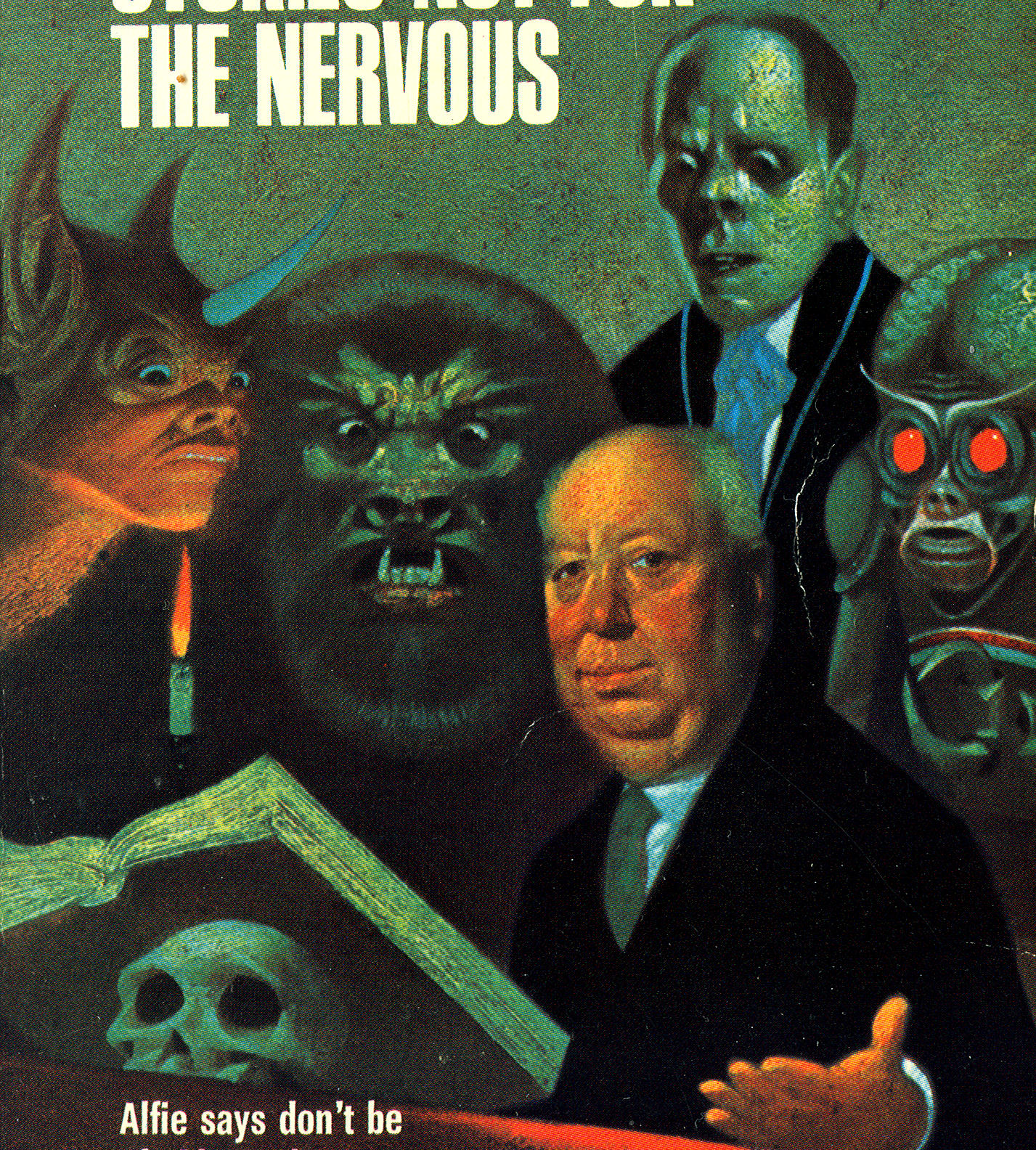
What's it all about, Alfie? Some Alfred Hitchcock paperback books
From 1959 until the mid-'60s I bought Alfred Hitchcock's Mystery Magazine, and had a stack of dozens of them. In the early '70s I traded them to a used paperback store for store credit. Big mistake! The magazines are hard to find and when I find them they cost $$$$.
In retrospect AHMM was one of the finest magazines of its type anywhere, and stories from its issues have been reprinted and used in movies. The authors’ names hold magic and nostalgia for me: Arthur Porges, Talmage Powell, Edward D. Hoch...the list goes on, including names like Lawrence Block, Ed McBain, Donald Westlake. It was where I learned to recognize the names of writers that I still look for.
Alfred Hitchcock's name was also used on books for young readers.* The two pictured below are reprints of deluxe hardbound books, sold in the 1960s and '70s. I have all of them and there will come a time to show them, also. The cover artists are listed for these 1982 editions: Hector Garrido did Monster Museum, and Joe Burleson painted Daring Detectives.
*Alfred Hitchcock and the Three Investigators was a very successful young detective series.
In retrospect AHMM was one of the finest magazines of its type anywhere, and stories from its issues have been reprinted and used in movies. The authors’ names hold magic and nostalgia for me: Arthur Porges, Talmage Powell, Edward D. Hoch...the list goes on, including names like Lawrence Block, Ed McBain, Donald Westlake. It was where I learned to recognize the names of writers that I still look for.
After trading away my original magazines, and suffering the remorse of a compulsive collector, at some point I turned to collecting the paperback collections. They skimmed the cream of the magazines. Every few years I take out a few of the books and re-read stories.
Sometime within the last few months I saw a man on television who had some of the original paintings for the covers. He said he worked for the publisher and they were going to throw them out, so he took them. I was immediately envious. But I'd ask why a publisher would throw out any paintings or illustrations in these days of auction houses looking for such cool stuff to sell? I guess the folks who had the paintings saw them as junk piling up in a back room or something. Their loss.
These are some of the books from my stacks:
Sometime within the last few months I saw a man on television who had some of the original paintings for the covers. He said he worked for the publisher and they were going to throw them out, so he took them. I was immediately envious. But I'd ask why a publisher would throw out any paintings or illustrations in these days of auction houses looking for such cool stuff to sell? I guess the folks who had the paintings saw them as junk piling up in a back room or something. Their loss.
These are some of the books from my stacks:
One of the best covers I have is from a German paperback edition:
Enlarged to show details:
Hard to see the subjects of the paintings until the cover is enlarged:
Alfred Hitchcock's name was also used on books for young readers.* The two pictured below are reprints of deluxe hardbound books, sold in the 1960s and '70s. I have all of them and there will come a time to show them, also. The cover artists are listed for these 1982 editions: Hector Garrido did Monster Museum, and Joe Burleson painted Daring Detectives.
*Alfred Hitchcock and the Three Investigators was a very successful young detective series.
Monday, October 08, 2012
“Where are my eyes?”
Kids like scares, and they don’t need Halloween as an excuse. They like creepy stories, books and movies. That was true of me when I was a kid, too. I paid for it in nights where I couldn’t go to sleep, worried that some moaning specter or the Headless Horseman would suddenly appear. It didn’t stop me from reading scary stories, though. And even now I sometimes pick books for young readers just to read what kinds of chills authors of this media-saturated age can deliver.
I just read The House on Hackman’s Hill by Joan Lowery Nixon, published by Scholastic Books in 1985, At 126 pages, it’s a perfect length for an elementary school reader level. For an senior reader, like me, tired of plowing through bloated 600-page novels for adults, it was a good, fast read. It's out of print, but still available from Amazon.com.
I thought the story told by Ms Nixon was perfect in setting up a situation a kid could identify with. During a raging snowstorm two youngsters, Jeff and Debbie, are trapped in a large haunted house, deserted for years. Over the years, as they have heard from a Mr. Karsten, anyone who has tried to stay in the house has run out screaming that there was something there.
The owner, who had disappeared years before, had illegally obtained a mummy with jeweled eyes, and stashed it in the basement. The kids see a man-sized statue of the Egyptian god, Anubis, in the foyer, then go into the basement and find the mummy. Then their troubles really begin, as this creepy sequence shows.
There’s a name written in childish handwriting on the inside front cover of the book, “Rachael.”
I wonder if Rachael felt a chill go down her spine when she read that. Did she lie awake in bed that night waiting for a scratching on her door and a whispered voice? If so, then the author succeeded.
I just read The House on Hackman’s Hill by Joan Lowery Nixon, published by Scholastic Books in 1985, At 126 pages, it’s a perfect length for an elementary school reader level. For an senior reader, like me, tired of plowing through bloated 600-page novels for adults, it was a good, fast read. It's out of print, but still available from Amazon.com.
I thought the story told by Ms Nixon was perfect in setting up a situation a kid could identify with. During a raging snowstorm two youngsters, Jeff and Debbie, are trapped in a large haunted house, deserted for years. Over the years, as they have heard from a Mr. Karsten, anyone who has tried to stay in the house has run out screaming that there was something there.
The owner, who had disappeared years before, had illegally obtained a mummy with jeweled eyes, and stashed it in the basement. The kids see a man-sized statue of the Egyptian god, Anubis, in the foyer, then go into the basement and find the mummy. Then their troubles really begin, as this creepy sequence shows.
“’We’d better get them right now,’ Jeff said, as he snapped off his flashlight. He had one hand on the doorknob and one hand on the key, ready to turn it, when they heard measured footsteps coming toward them, up the stairs!I believe Ms. Nixon would have her young readers panting with fear, identifying with her characters on the other side of the door from a walking Egyptian god. She helped them visualize it with her vivid writing.
‘Who’s here?’ Jeff croaked, and it frightened him even more to know he was following so closely the story Mr. Karsten had told them.
The footsteps stopped.
Jeff remembered the little desk chair. Trying to tiptoe, but stumbling and tripping, Jeff grabbed the chair and quickly shoved it under the doorknob of the door, making sure it was wedged tightly.
Again there was silence, until a board on the stairs creaked, and the slow footsteps began again.
Neither Jeff nor Debbie moved as the footsteps came closer and closer, then stopped outside the door.
There was a pause, as though someone was listening. Then a light scratching began on the other side of the door.
Debbie gasped. Jeff’s knees wobbled. He backed up and plopped down on the bed, sending up a cloud of dust.
He knew Debbie was going to say it, and he shuddered, knowing what the answer would be.
‘What do you want?’ Debbie whispered.
And a voice whispered back, ‘Where are my eyes?’”
There’s a name written in childish handwriting on the inside front cover of the book, “Rachael.”
I wonder if Rachael felt a chill go down her spine when she read that. Did she lie awake in bed that night waiting for a scratching on her door and a whispered voice? If so, then the author succeeded.
Saturday, October 06, 2012
Picture this...
Dr. David will give you a whole new look!
Sally handed me this ad from one of those mailers full of coupons and local advertisements that fill up our mailbox. She was giggling over the pictures of the snaggle-toothed people, turned into pretty people with flashing white teeth. We thought that not only did they get new teeth, they got new faces! The man went from having limp blond hair to a full head of dark hair, the girl became a beauty queen.
Then I noticed the asterisks, and read at the bottom, “Not actual orthodontic patients.” Well, there went my fantasy. I was about to call Dr. David to see if he could turn me into George Clooney, or a reasonable facsimile. The age of that kind of miracle is not yet upon us.
Mitt back on his White Horse!
Another image of Mitt on a white horse showed up in my local newspaper yesterday. It might have been inspired by the New Yorker cover, which I have joined with the editorial cartoon, after posting it here. It might be alluding to what I suspect the Barry Blitt cover was making reference to, that “White Horse prophecy” of a Mormon saving the Constitution, which is “hanging by a thread” until he comes along to rescue the nation. As I've mentioned before, it is not a universally held belief by Mormons, and Mitt Romney is specifically quoted as saying it has nothing to do with him running for president.
Notice what is coming out of the horse, piling up at President Obama's feet. That's a pretty fair assessment of how most Democrats saw Romney's performance at the first Presidential Debate this past Wednesday night.
Mr. and Ms. Hitler
We're back to the New Yorker again. The startling ad to the right is the back cover of the October 8, 2012 issue, It looked familiar. Sure enough, when I Googled images of Adolf Hitler I saw the resemblance. (The conjoined pictures were conceived and done by me.) Is the intent of the ad to draw a comparison to Der Fuehrer, or is it just a coincidence? According to the books, Subliminal Seduction and Media Sexploitation, by Wilson Bryan Key, which I wrote about in 2008 in a post called “Sexing it Up”, there are no coincidences in advertising. Millions of dollars go into ad campaigns. Did someone along the line say, “This girl has a Hitler haircut,” or was that the advertiser's intention to get attention? I don't know. It's interesting to speculate, though.
Sally handed me this ad from one of those mailers full of coupons and local advertisements that fill up our mailbox. She was giggling over the pictures of the snaggle-toothed people, turned into pretty people with flashing white teeth. We thought that not only did they get new teeth, they got new faces! The man went from having limp blond hair to a full head of dark hair, the girl became a beauty queen.
Then I noticed the asterisks, and read at the bottom, “Not actual orthodontic patients.” Well, there went my fantasy. I was about to call Dr. David to see if he could turn me into George Clooney, or a reasonable facsimile. The age of that kind of miracle is not yet upon us.
Mitt back on his White Horse!
Another image of Mitt on a white horse showed up in my local newspaper yesterday. It might have been inspired by the New Yorker cover, which I have joined with the editorial cartoon, after posting it here. It might be alluding to what I suspect the Barry Blitt cover was making reference to, that “White Horse prophecy” of a Mormon saving the Constitution, which is “hanging by a thread” until he comes along to rescue the nation. As I've mentioned before, it is not a universally held belief by Mormons, and Mitt Romney is specifically quoted as saying it has nothing to do with him running for president.
Notice what is coming out of the horse, piling up at President Obama's feet. That's a pretty fair assessment of how most Democrats saw Romney's performance at the first Presidential Debate this past Wednesday night.
Mr. and Ms. Hitler
We're back to the New Yorker again. The startling ad to the right is the back cover of the October 8, 2012 issue, It looked familiar. Sure enough, when I Googled images of Adolf Hitler I saw the resemblance. (The conjoined pictures were conceived and done by me.) Is the intent of the ad to draw a comparison to Der Fuehrer, or is it just a coincidence? According to the books, Subliminal Seduction and Media Sexploitation, by Wilson Bryan Key, which I wrote about in 2008 in a post called “Sexing it Up”, there are no coincidences in advertising. Millions of dollars go into ad campaigns. Did someone along the line say, “This girl has a Hitler haircut,” or was that the advertiser's intention to get attention? I don't know. It's interesting to speculate, though.
Friday, October 05, 2012
Walt Kelly's “Bloody Drip”
A couple of weeks ago I had a posting that showed an early article about the phenom of Mickey Spillane, and his hard-boiled crime fiction. You can see it here.
According to Life, Walt Kelly, creator of “Pogo,” was inspired by that same article to do a Spillane satire. His own hardboiled detective, Meat Hamburg, is played by Albert the Alligator in a strip for the book, Uncle Pogo’s So-So Stories, published in 1953 Here's “The Bloody Drip” by “Muckey Spleen.”
The Pogo comic strip, a phenomenon in its own right, was featured a year earlier, also in Life, in a feature drawn especially for that magazine.
With Pogo's personal popularity, a run for president was called for. Here are a 1952 campaign button and a later poster.
At Insomnia Notebook WE GO POGO!
According to Life, Walt Kelly, creator of “Pogo,” was inspired by that same article to do a Spillane satire. His own hardboiled detective, Meat Hamburg, is played by Albert the Alligator in a strip for the book, Uncle Pogo’s So-So Stories, published in 1953 Here's “The Bloody Drip” by “Muckey Spleen.”
The Pogo comic strip, a phenomenon in its own right, was featured a year earlier, also in Life, in a feature drawn especially for that magazine.
With Pogo's personal popularity, a run for president was called for. Here are a 1952 campaign button and a later poster.
At Insomnia Notebook WE GO POGO!
Wednesday, October 03, 2012
Pirate raider Mitt
Before watching the first debate tonight between President Obama and Mitt Romney, I suggest you take the time to read a couple of online articles on Mitt from Rolling Stone magazine.
”The True Story of Mitt Romney and Bain Capital”.
”Mitt Romney’s Real Agenda”
I don’t know how else to describe what Mitt’s company, Bain Capital, does except call it old-fashioned piracy. Since it is technically legal to raid a company for all its wealth and then scuttle it so it ends up in Davy Jones’ locker we could be polite and call it “privateering,” but despite the veneer of legality, it’s dirty, it’s immoral, and to me it’s piracy.*
The idea, as explained in the article, is to take a little money, say $5 million, get a bank to put up big money, say $500 million, to buy controlling interest in the company. After that loot the place, saddle it with the bank debt (interest alone is enough to sink the company), then walk away with maybe hundreds of millions, and all you’ve had to put up is $5 million!
Pirate Raider Mitt, operating Bain within the law, doesn’t see anything he did as bad, but I’m willing to bet that he has left a wake of ruined lives, and maybe even deaths, behind him, and he’ll never see a day in prison, nor hang from the highest yardarm.
It’s a good idea when assessing the man and what he says in the debate tonight against that background, and wonder what his plan is if elected Pirate in Chief.
*The Mafia calls it a “bust-out.” They don’t even put up the money. They just force their way into a company, saddle it with debt and ruin its credit by buying merchandise to sell out the back door. When the company is bankrupt they torch it and collect the insurance. A win-win…for the Mafia. Because it’s considered racketeering it’s against the law, but in effect it’s just a cruder version of what Mitt, in his $150 haircut and $3000 suit, did every day with Bain.
”The True Story of Mitt Romney and Bain Capital”.
”Mitt Romney’s Real Agenda”
I don’t know how else to describe what Mitt’s company, Bain Capital, does except call it old-fashioned piracy. Since it is technically legal to raid a company for all its wealth and then scuttle it so it ends up in Davy Jones’ locker we could be polite and call it “privateering,” but despite the veneer of legality, it’s dirty, it’s immoral, and to me it’s piracy.*
The idea, as explained in the article, is to take a little money, say $5 million, get a bank to put up big money, say $500 million, to buy controlling interest in the company. After that loot the place, saddle it with the bank debt (interest alone is enough to sink the company), then walk away with maybe hundreds of millions, and all you’ve had to put up is $5 million!
Pirate Raider Mitt, operating Bain within the law, doesn’t see anything he did as bad, but I’m willing to bet that he has left a wake of ruined lives, and maybe even deaths, behind him, and he’ll never see a day in prison, nor hang from the highest yardarm.
It’s a good idea when assessing the man and what he says in the debate tonight against that background, and wonder what his plan is if elected Pirate in Chief.
*The Mafia calls it a “bust-out.” They don’t even put up the money. They just force their way into a company, saddle it with debt and ruin its credit by buying merchandise to sell out the back door. When the company is bankrupt they torch it and collect the insurance. A win-win…for the Mafia. Because it’s considered racketeering it’s against the law, but in effect it’s just a cruder version of what Mitt, in his $150 haircut and $3000 suit, did every day with Bain.
Tuesday, October 02, 2012
The haunted house: The Woman in Black on DVD
Halloween is but a month away, and I’m already getting in the mood. Beyond the horrors of the election season, I need scary movies to take my mind off politics. So tonight I watched a movie just released on DVD.
Arthur Kipps is a haunted man, in a figurative sense. He is haunted by melancholy, and the memory of his wife, who died giving birth to his son.
Arthur is a solicitor, sent to a remote English village to settle the affairs of a deceased woman who owned a house on an island, approachable only by a causeway, and then only when the tide is out. The townspeople are suspicious, and want Arthur out of there. But the local rich man, Mr. Daily, befriends him and enables him to go about his job, which takes place in the spooky mansion called Eel Marsh.
Daniel Radcliffe, who is everybody’s favorite wizard, Harry Potter, does a fine job as Kipps, communicating depression, yet a strength and steely resolve to solve a mystery. Ciarán Hinds, as Daily, is a man who does not believe in ghosts nor superstition, yet lost his own son some years before to the ghost. It has sent his wife over the edge into mental illness.
The Woman in Black is a throwback to the old days of ghost stories that were creepy without showing blood and gore. I am of the old school. What’s really scary in a movie is not what is thrust at us wearing a hockey mask and wielding a chainsaw, but is a creepy and unknown presence…
A face in the window…it’s a cliché, part of the language of haunted house movies, but still effective.
A presence hidden in the dark, only making tentative and tantalizing appearances until pow! the suspense has become close to unbearable, and then, as in this movie, a shrieking apparition in a window sends us two feet out of our seats.
I recommend The Woman in Black for horror fans who like stories of vengeful spirits and haunted houses.
As I mentioned above, there are clichés. We’ve all seen enough haunted house movies to know there will be creaking floors, rocking chairs rocking with no one in them, a specter hanging from the rafters, and yes, this movie has all of those. But the overall mood is one of tension and suspense. Being an Anglophile, and British movie enthusiast, I give all credit to the Brits who made this movie. They have a certain understated way of building horror. The photography is eerie and moody, depending on muted colors and deep shadows. I am less enthusiastic about the unusual yet surprisingly upbeat ending, but in the context of the movie it makes sense.
Arthur Kipps is a haunted man, in a figurative sense. He is haunted by melancholy, and the memory of his wife, who died giving birth to his son.
Arthur imagines his dead wife in the mirror, pre-figuring his soon-to-be encounter with a real ghost.
Arthur is a solicitor, sent to a remote English village to settle the affairs of a deceased woman who owned a house on an island, approachable only by a causeway, and then only when the tide is out. The townspeople are suspicious, and want Arthur out of there. But the local rich man, Mr. Daily, befriends him and enables him to go about his job, which takes place in the spooky mansion called Eel Marsh.
The shot from the top of the stairs of Arthur entering the door from outside makes us wonder...is something watching him from the second-floor landing?
Unfortunately, with Arthur disturbing the scene come the deaths of local children, caused by a mysterious and ghostly presence of a woman whose son was taken from her. The boy died in the marsh, his body never recovered.
The movie opens with the shocking scene of three little girls going out the window to their deaths.
Daniel Radcliffe, who is everybody’s favorite wizard, Harry Potter, does a fine job as Kipps, communicating depression, yet a strength and steely resolve to solve a mystery. Ciarán Hinds, as Daily, is a man who does not believe in ghosts nor superstition, yet lost his own son some years before to the ghost. It has sent his wife over the edge into mental illness.
The Woman in Black is a throwback to the old days of ghost stories that were creepy without showing blood and gore. I am of the old school. What’s really scary in a movie is not what is thrust at us wearing a hockey mask and wielding a chainsaw, but is a creepy and unknown presence…
A face in the window…it’s a cliché, part of the language of haunted house movies, but still effective.
A presence hidden in the dark, only making tentative and tantalizing appearances until pow! the suspense has become close to unbearable, and then, as in this movie, a shrieking apparition in a window sends us two feet out of our seats.
Yikes!
I recommend The Woman in Black for horror fans who like stories of vengeful spirits and haunted houses.
As I mentioned above, there are clichés. We’ve all seen enough haunted house movies to know there will be creaking floors, rocking chairs rocking with no one in them, a specter hanging from the rafters, and yes, this movie has all of those. But the overall mood is one of tension and suspense. Being an Anglophile, and British movie enthusiast, I give all credit to the Brits who made this movie. They have a certain understated way of building horror. The photography is eerie and moody, depending on muted colors and deep shadows. I am less enthusiastic about the unusual yet surprisingly upbeat ending, but in the context of the movie it makes sense.
The exterior of the mansion is a real house. (Interiors were filmed on a studio stage.) As Radcliffe explained in a “making-of” featurette with the DVD, the house was dressed down by trucking in loads of weeds, dead trees and rusting gates. He wondered how the owners felt when they saw the movie. There goes the neighborhood!
Subscribe to:
Posts (Atom)